SCUTTLEBUTT




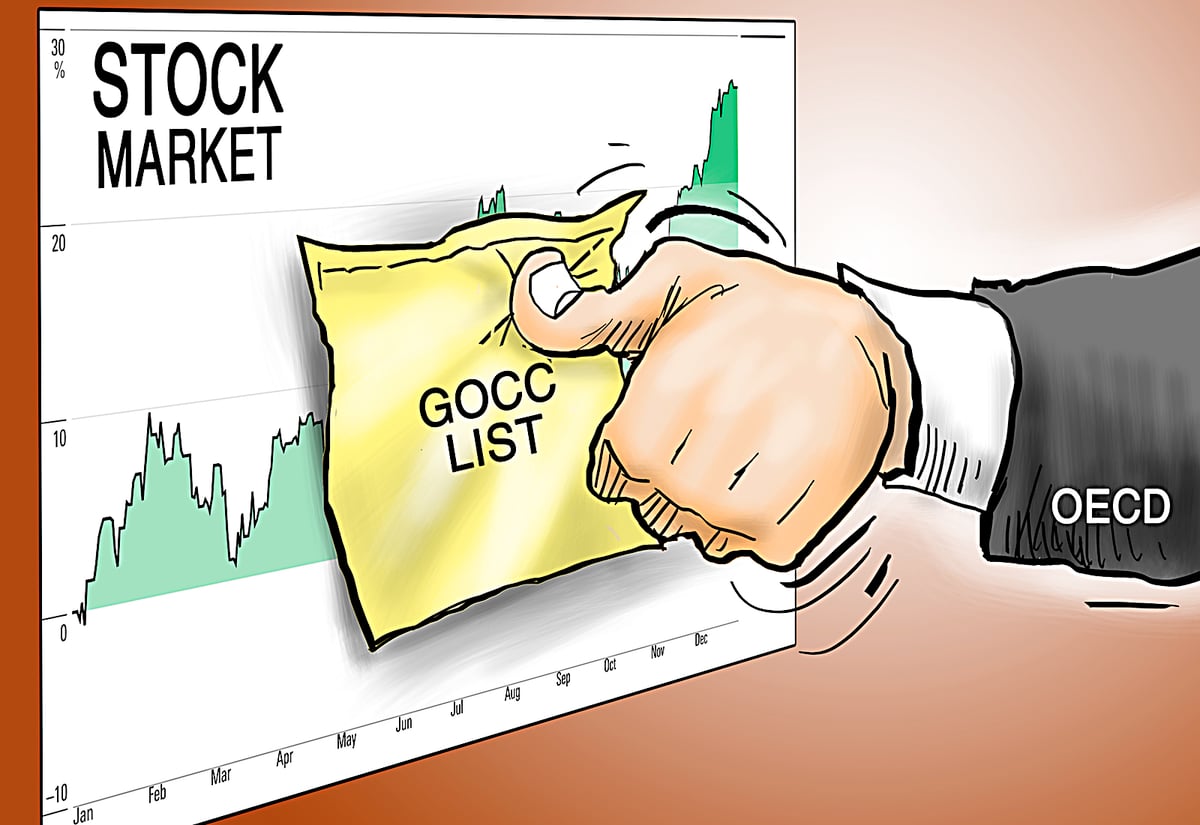
OECD wants GOCCs listed
Public listing has a largely understated importance among domestic companies, as the equity market could be expanded by bringing more companies to the bourse, the powerful Organization for Economic Cooperation and Development (OECD) stated in a report.
OECD reviewed the local capital market to identify the factors that continue to stunt the growth of the stock exchange, which remains among the lowest in the region in terms of participation.
Identified by the OECD as among the untapped potential in equities trading are state firms, even though most have struggled under mismanagement and are racking up losses.
Currently, there are many initial public offering candidates within the universe of large unlisted companies and among state-owned enterprises (SOEs), according to the OECD.
An analysis of conglomerates suggested that in 2021, there were 411 large unlisted non-financial companies, with assets above P5.6 billion or $100 million. The minimum criteria for listing on the Main Board of the PSE is to have shareholders’ equity or an anticipated market capitalization of at least P500 million, a free float of at least 20 percent, a minimum net income of P50 million for the most recent fiscal year, and a minimum of three years of financial reporting.
Using the shareholders’ equity reported on the balance sheet as a proxy for anticipated market capitalization and the minimum net income criteria, 55 percent of the large unlisted companies in the Philippines are eligible for listing, the OECD contended.
Moreover, the average company age in this category is 25 years, meaning that many are mature firms. In 2021, the median asset size of these companies was P11.4 billion, median sales were P9.9 billion, and their median return on equity was 13 percent.
Aside from fulfilling the minimum criteria, many large unlisted companies outperform the currently listed ones both in terms of size and profitability.
Large unlisted companies have slightly lower median assets but higher median sales and higher leverage (Panel A). Median profitability, measured by net profit and ROE, is higher for unlisted companies compared to listed companies.
OECD pointed to many state-owned enterprises, or what are termed as government-owned and -controlled corporations (GOCCs), as having the potential to become listed. The listing of state-owned enterprises has significantly contributed to the growth and dynamism of capital markets worldwide, the report added.
It said that over the last decade, an increasing number of GOCCs in Asia have been listed on regional stock exchanges to enhance their productivity, efficiency and competitiveness.
At the start of 2024, 76 percent of the state-controlled companies across the world were listed on Asian stock exchanges. In ASEAN countries, state-controlled companies account for almost a third of the region’s market capitalization.