




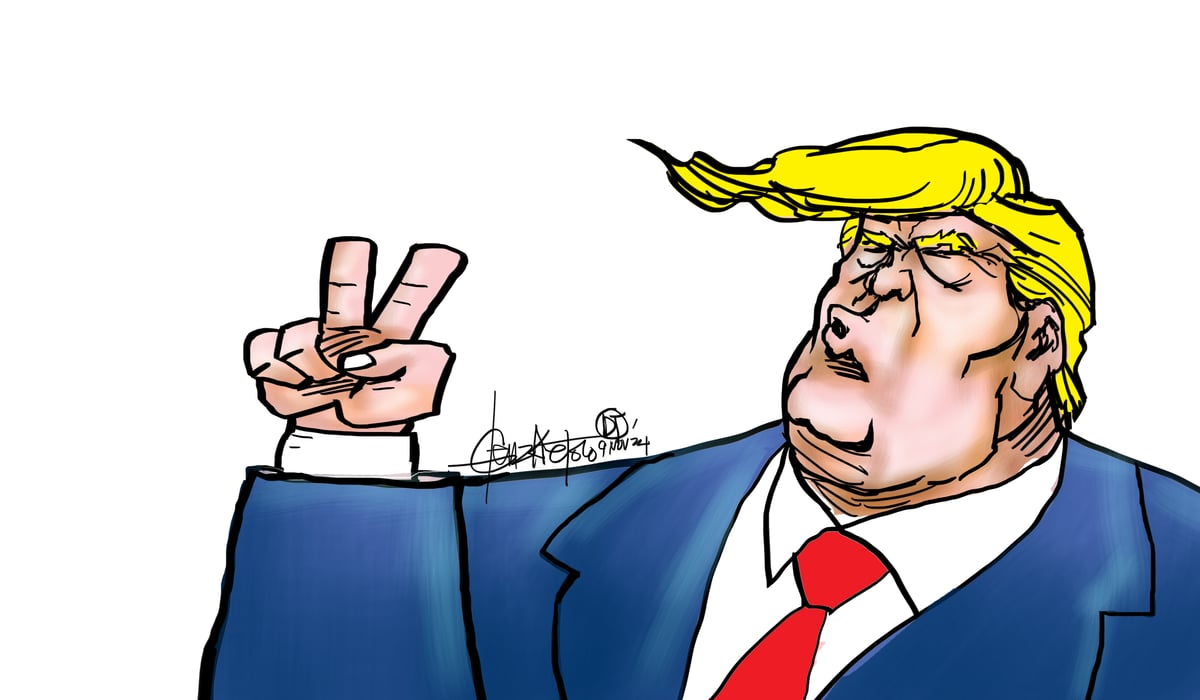
Trump, victorious: What’s next?
A particular worry for Manila is that Trump could sideline the Philippines while focusing on other issues, such as intervention in the Russia- Ukraine conflict and the Israel-Gaza war.

Text size
A particular worry for Manila is that Trump could sideline the Philippines while focusing on other issues, such as intervention in the Russia- Ukraine conflict and the Israel-Gaza war.
Most of the world, including Asia, is bracing for Donald Trump’s potential re-ascension to the White House. Many are concerned that his return could inject uncertainty into the region’s relations with the United States, along with fears that his trade policies might upend global trade, which amounts to trillions of dollars.
During the campaign, Trump frequently stated that he would launch an even more aggressive “America First” policy, which would include a protectionist economic agenda and the imposition of higher tariffs.
Risk analysts suggest that Trump could go beyond the targeted tariffs of his first term, broadening his focus to include a much wider range of products from China and beyond.
Relations with China soured during Trump’s first term in 2016 and have remained strained under the current Biden administration. These tensions are expected to worsen if Trump follows through on his expressed intention to raise tariffs on Chinese imports to at least 60 percent.
Analysts believe that one critical development to monitor is the tension between the US and China, which is sure to cause ripple effects throughout the wider region, particularly for China-linked supply chains in Asia. Leaders across Asia are anxiously awaiting to see how the US president-elect’s economic agenda will take shape. Many Southeast Asian economies are highly trade-dependent and are particularly concerned about the possible implementation of Trump’s proposed tariffs — 10-20 percent on imports, with tariffs on Chinese imports reaching as much as 60 percent. Such a policy would severely impact export-driven economies across Southeast Asia, including those in the ASEAN region.
Risk strategy advisers are urging leaders and policymakers in the region to begin planning for various possible scenarios.
For his part, National Economic and Development Authority (NEDA) Secretary Arsenio Balisacan has taken a “wait-and-see” approach, but has expressed concern that Trump’s campaign promise to impose additional tariffs on non-Chinese products — along with even higher tariffs on Chinese goods exported to the US — could have a significant impact on the global economy.
In addition to the fact that the US is home to over four million Filipinos, whose remittances represent over 40 percent of worldwide remittances (valued at around $1 billion), the US is also the Philippines’ largest export destination.
Credit Rating and Investors Services PH economist Emmanuel Leyco points out that relying on one country — the US — for 40 percent of Philippine exports is risky. He stresses that the Philippines must broaden its export markets.
Balisacan agrees, noting that the Philippines is on the right track with its efforts to diversify both products and trade partners. “The US is among the country’s top export markets, but free trade deals are also being pursued with other nations,” he said.
Because of the policy uncertainties involving the Philippines’ major trading partners, particularly the US, the country is resuming free trade agreement negotiations with other countries, including the United Arab Emirates and the European Union.
Meanwhile, another point of concern, particularly for ASEAN member countries, is the possibility that Trump may not prioritize US-ASEAN relations.
A particular worry for Manila is that Trump could sideline the Philippines while focusing on other issues, such as intervention in the Russia–Ukraine conflict and the Israel-Gaza war (which has now expanded to include Israel and Iran). This could leave a vacuum in the region that China might seek to exploit, further asserting its presence in Philippine territorial waters.
Philippine officials remain optimistic that the US will continue its commitment to the Philippines, but analysts like International Development and Security Cooperation President Chester Cabalza believe that US presence in the region may not be as pronounced under Trump, especially in his first year, compared to the Biden administration.
In a local talk show, Cabalza remarked, “Let’s watch how things unfold, but I see him (Trump) following through on his extreme measures against immigration. As for defense and security, I see him intervening in Russia and Ukraine, as well as in Israel. He wants to show the world that he can solve problems in these areas and demonstrate that the US still has the capability to lead and show might as a world power.”
While this view may seem to conflict with Trump’s “America First” mantra, it’s hard to predict his next move. Energized by his stunning victory, he may be tempted to take on the world stage once again.
Three decades after the Marcopper mining disaster devastated Marinduque’s waterways, the province is again pressing the…
Housing is probably the biggest issue affecting people the world over.
Malacañang on Monday called for a more thorough investigation into the questioned flood control projects in Taguig…
The defense on Monday backed the move by senator-judges to exclude a prosecution witness who testified on the firearms…
