
 Daily Tribune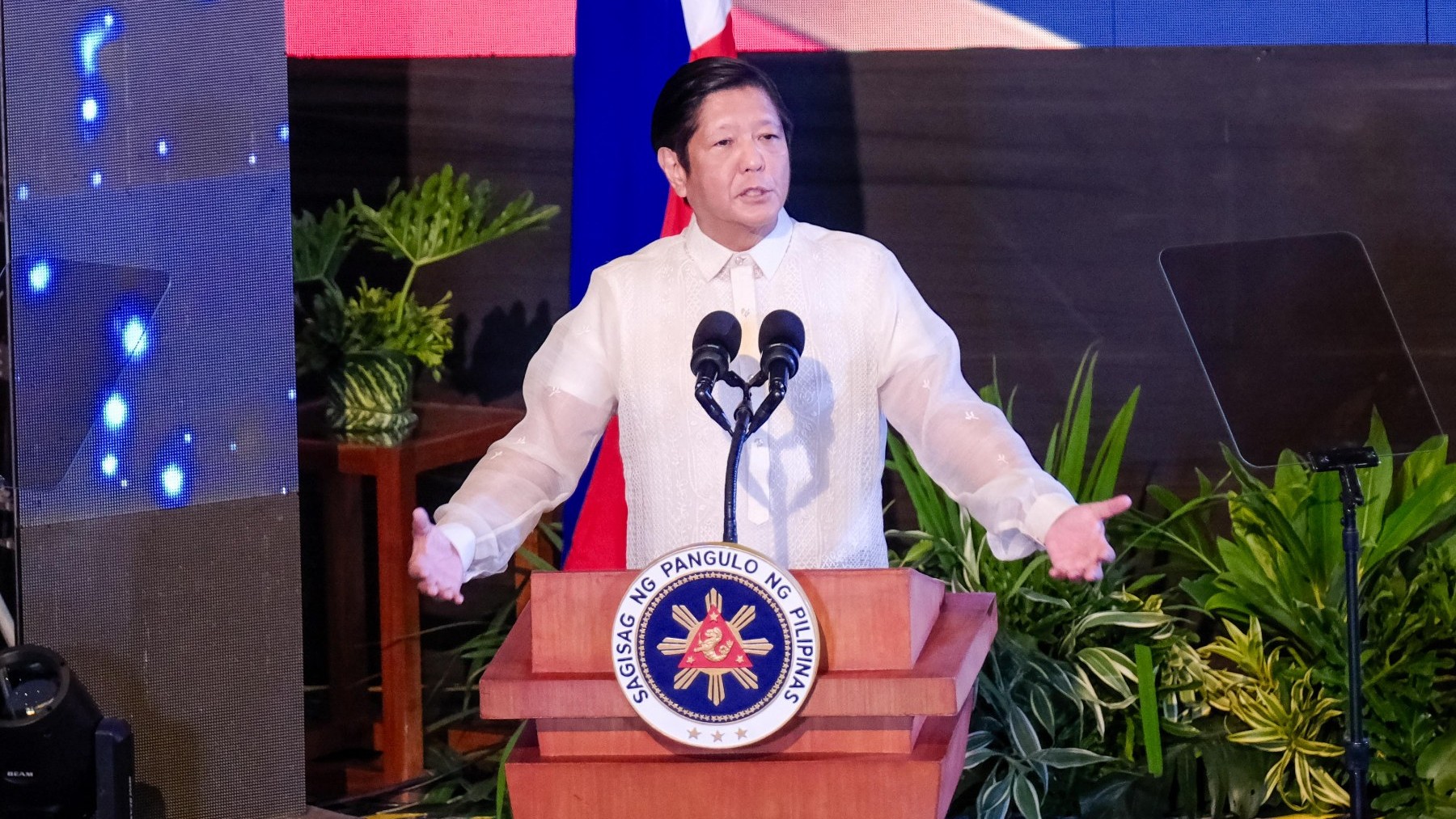
President Ferdinand Romualdez Marcos Jr. attends the National Higher Education Day Summit at the PICC Complex, Pasay City on Wednesday, 15 May 2024. Joining the president onstage are Executive Secretary Lucas Bersamin, J. Prospero De Vera III, Chair of CHED, Senator Chiz Escudero; Senate, Chairman Committee on Education, and Baguio City Representative Mark Go. In his message, President Ferdinand R. Marcos Jr. emphasized the critical importance of higher education. He highlighted the need for collaboration between government and private educational institutions, stressing that education is a top priority for national development and economic prosperity. Marcos noted the progress of Philippine Higher Educational Institutions in global rankings but acknowledged that much work remains to be done to improve their standings. He advocated for a strategic, comprehensive approach to enhance educational standards, ensuring they are responsive to current and future societal needs.
PHOTO BY YUMMIE DINGDING
President Ferdinand Marcos Jr. on Wednesday said it is the government's responsibility to provide Filipinos a good education as no country can prosper without one.
In his speech during the National Higher Education Day Summit in Pasay City on Wednesday, Marcos mentioned the pivotal role education plays at every level of society.
"No challenge demands greater attention than this. This is the highest priority," Marcos said, emphasizing the pivotal role that education plays in both individual and national prosperity.
"As far as my view of government service is concerned, the most important service that government must provide to its people is a good education. No country can prosper without a good educational background," Marcos added.
He also said that the bright future of today's youth relies on how well the current leaders can run higher education systems that provide the youth with the skills they need to survive and thrive in a world that is quickly changing.
Marcos said that providing the youth the right competencies and skills and training is the only way for them to prevail, and to prosper, in this highly competitive world.
"Our greatest obligation to them is to mold them into critical thinkers, into problem solvers, into visionaries, wielding the skills that will allow them to succeed in the future," Marcos said.
“Without an educated workforce that will implement them, any national economic blueprints will remain simply as that --- blueprints. We will not have the means or the capacity or the labor force to be able to make those plans a reality,” Marcos added.
In the same speech, Marcois said much work needs to be done in the higher education sector following the Philippines' performance in the Times Higher Education (THE) 2024 Asia University Rankings.
Marcos acknowledged that more higher education institutions are making it into foreign rankings, but none of the Philippine HEIs made it into the top 100 most prestigious university rankings.
This year's THE Asia University scores put Ateneo de Manila University between 401 and 500 rank. The University of the Philippines and De La Salle University came in at 501 and 600th, respectively.
“We must acknowledge that in the recent Times Higher Education’s 2024 Asia University Rankings, unfortunately, no Philippine university has reached Top 100, with the country’s top schools either dropping or maintaining their rankings,” Marcos said.
“This just goes to show that much work is still to be done. We must pursue a comprehensive and all-encompassing strategy that will turn this trend around. The state of our education today shapes the future of the nation,” Marcos added.
As of 4 January 2024, there were 1,977 higher education institutions (HEIs). Of these, 113 were state universities and colleges; 137 were local universities and colleges; 1,714 were private HEIs; and 13 were other government schools, institutions supervised by CHED, and special schools.


