
Reincarnated ‘Mebuyan’s Colony’ and other works of light: Otherworldly experiences of our own world


In art and literature, there is this technique called “defamiliarization,” which presents common or familiar subjects, ideas and images in a new or unconventional way so as to give viewers and readers a feeling of being out of this world — but in fact the work speaks of something we see every day. In the end, one gains new perspectives on the subject, or the work refreshes your views of it.
Environmentalism or concern for the earth is a subject much talked about in recent years, and, yes, much abused by many people and organizations who want to put on a mantle of relevance by promoting such a cause but are actually wanting on insights, actions and even concern. With the vogue of talking about environmental causes comes the danger of fatigue. But this concern is of great urgency, and the role of art is thus crucial in the constant renewal of the battle cry for the environmental conservation by conjuring a sense of wonder for our world and instilling horror for its damage.
In recent years, the Cultural Center of the Philippines (CCP) has been mounting works of art that provoked, inspired and encouraged the celebration of Earth Day on 22 April.
“The Earth Day installation is a project that the CCP does to call attention, of course, not only for Earth Day, but also to the need for us to take care of our environment,” said CCP vice president and artistic director Dennis N. Marasigan.
For this year, the iconic cultural institution offers three works — an installation, a light-and-sound show and an immersive experience — that approximate magic, mine mythology, harness the imagination and pay tribute to the Earth.
The latest incarnation of Leeroy New’s ‘Mebuyan’s Colony’

The CCP main building with its Earth Day lighting titled 'Anud-Agos.'
The Earth Day works are bannered by the monumental Mebuyan’s Colony by one of the most exciting and provocative young visual artists today, Leeroy New, recipient of many awards including the Ateneo Art Award in 2009 and the prestigious 13 Artists Award in 2019.
“His works can be seen and have been seen from theatrical productions to television productions to film design. And this year, Leeroy’s work, which is called Mebuyan’s Colony, is actually a new work but this is the fourth iteration of this particular work,” Marasigan shared during the inauguration program on 25 April. “Leeroy is actually — well, as can be sensed — a multidisciplinary artist whose practice actually manifests in large-scale environments, collaborative performances that are driven by concepts of world-building, mythmaking and social change. And he is fascinated not only by the use of natural materials, found objects and assorted discards that are transformed into representations of the speculative future but also by their intersection with Filipino contemporary life that also has vestiges of precolonial mythology and, of course, environmentalism, which makes him the ideal artist for the CCP to collaborate with on this particular project.”
“The first iteration as Leeroy was just telling me, originally only had the bamboo stills, which actually showed the connection between above ground and underground, but it also alludes to Mebuyan’s dual role as the goddess of both death and fertility,” he added. “And as it now stands, here at the CCP front lawn, it actually incorporates the 2024 Earth Day theme of ‘Planet Versus Plastics,’ and mixes organic and recycled materials to create a multi-sensory installation of foliage, discarded plastic bottles, bamboo and steel. May I add also that in the installation, you will find growth of seedlings that hopefully will not die under the weather that we are experiencing, and hopefully will last until the end of the installation.”
The work takes inspiration from Mebuyan, a goddess in the mythology of the indigenous Bagobo Manobo people of southern Mindanao, where New hails from, particularly in General Santos City.
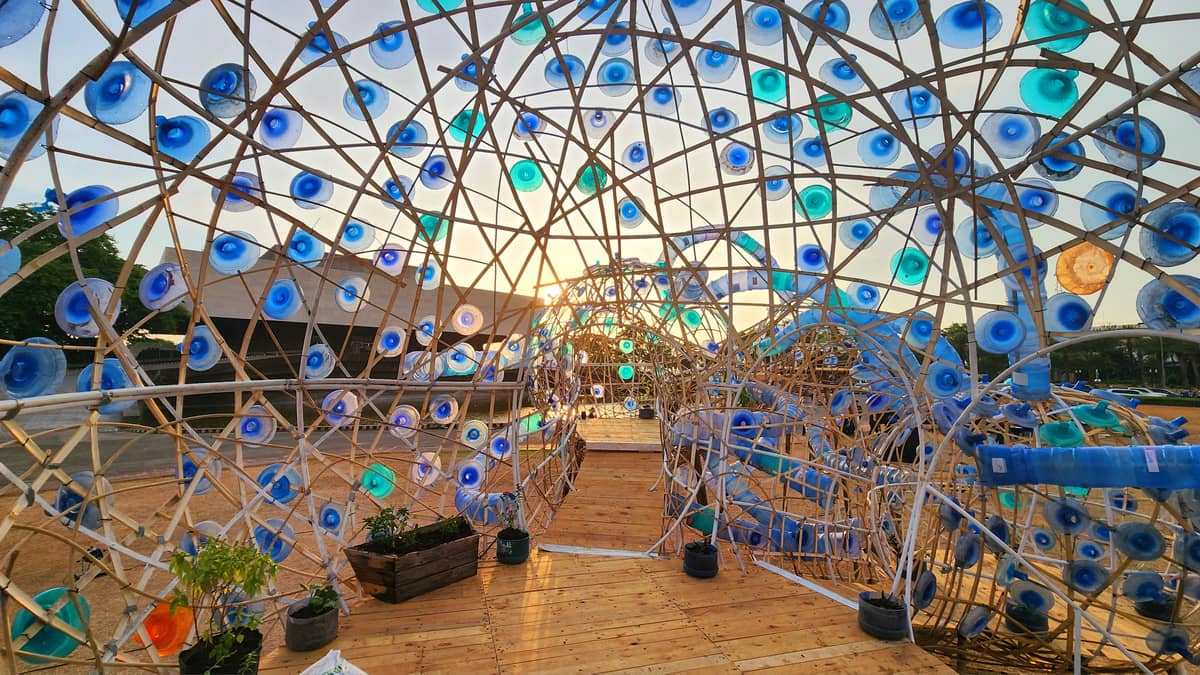
Visitors can explore inside the installation.
Known for works influenced by a range of fields from science fiction to precolonial mythology, New was introduced to the mythic character by one of his mentors at the Philippine High School for the Arts, artist Roberto Feleo who frequently mines myths, folklore and traditions of different indigenous peoples for his works.
“I believe we’ve been starved of narratives about the feminine principles, maternal principles. We’ve been, for most our lives, solely led to a more patriarchal society that has led to the exploitation of nature versus, you know, narratives about Mebuyan [which] I think [is] a very badass mythological figure,” New explained. “Not only is she the goddess of fertility, but also death. She controls who lives and who dies by shaping a kalamansi tree. If the fruit that falls is ripe, the person that will die will be old, and if the fruit that falls is young, the person that will die will be young. So, the reason for having breasts all over her body is that in the afterlife in Bagobo cosmology, they still have to undergo a journey... And so she nurtures the spirits of the dead children, so they may become adult spirits.”
He continued: “So, it’s all about ideas about regeneration, looking towards the Earth. We hear stories about billionaires building spaceships that hope to colonize other planets and kind of leaving behind, forgetting about the planet, forgetting about ideas about regeneration and balance and harmony with the earth that we’re currently living in.”
“So, you know, I hope the piece becomes a model, especially for like reuse and upcycling because the work itself has been moved from Ateneo. It is basically a recycled piece, literally and figuratively. It was moved from Ateneo, which housed it for almost three years because of the pandemic. And I’m happy that it’s been moved to a much more public space… I’m very happy that piece is given a new extended life and has evolved as well. The previous iteration didn’t have the blue bottles. I kind of discovered the use of blue bottles, discovered that in most junk shops. We are obviously reliant on water containers, having no potable drinking water. We are left with thousands and thousands of these unused blue bottles which are either sold as planters, or floaters. But I think I’ve found a new, almost infinite material source. So, I’m constantly exploring the different ways I can use these,” the artist further said.
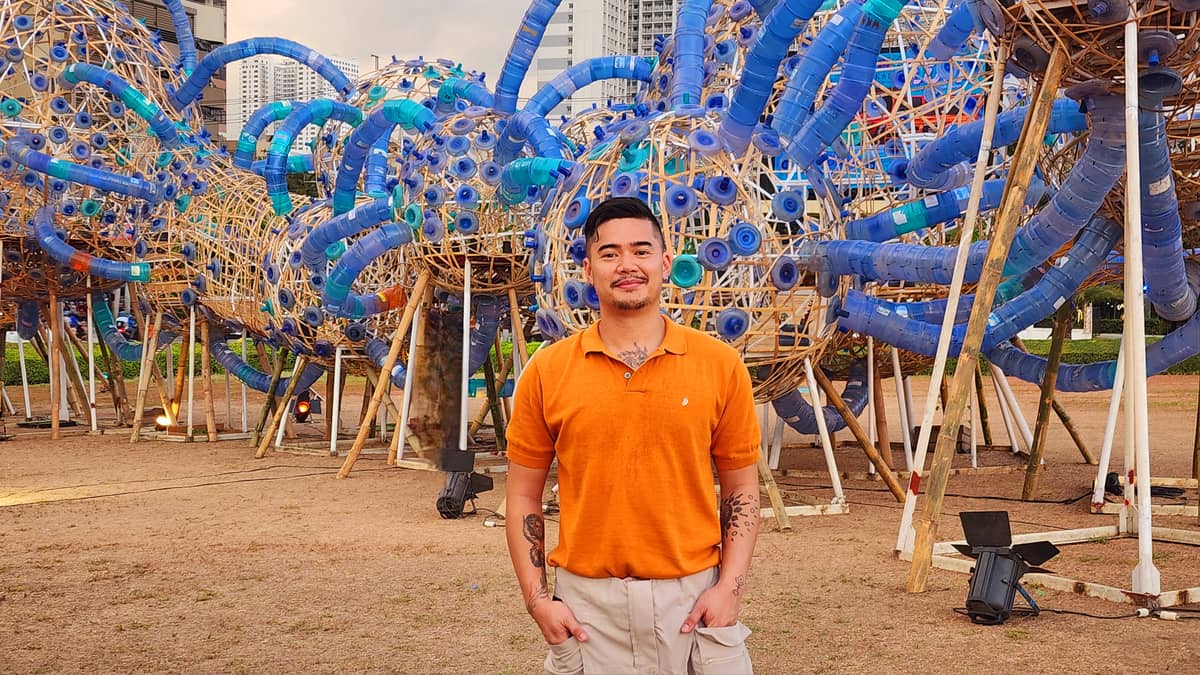
Artist Leeroy New.
Mebuyan’s Colony started with Mebuyan’s Vessel, mounted after years of research and idea development together with teams from the Ateneo Art Gallery and Emerging Islands. It received a grant from the Burning Man Project in 2021, with a cluster of it installed at Black Rock City in Nevada, United States, and a “polyp” at Art in the Park in Makati City. The following year, Mebuyan’s Vessel was installed on a beach in San Juan, La Union.
With support from the Ignacio B. Gimenez Outdoor Installation Grant Program, Mebuyan’s Colony was launched in 2022 at the Wong Chu King Foundation Cove, Ateneo College Batch 1980 Cove and the Eli and Elizabeth Hubahib Cove at the Areté Amphitheater of the Ateneo de Manila University in Quezon City, when the country and the world were still grappling with the coronavirus pandemic, which entered the country in early 2020, and slowly coming out of strict restrictions, which in the Philippines, were occasionally inconsiderate and abusive, given the political climate at that time.
The structure was a network of globes or pods of different sizes, propped up by stilts, which visitors could enter through connecting tunnels or walkways. The pods were made of a network of bamboo poles and metal, reminding me of balls of yarns or nests of weaver birds. Plant boxes were placed inside the installation with seedlings or young plants that were let to grow, making it an artwork as well as a garden.
Mebuyan’s Colony gained attention, being one of the biggest installations in the country, and became historical when the whole structure was lit in pink lights for several months, beginning in February 2022, to express support for the presidential campaign of then Vice President Leni Robredo. During that feverish period, several sectors including the LGBTQ+ community, labor groups and artists and cultural workers came together for a big volunteerism effort for Robredo’s campaign, an unprecedented phenomenon.
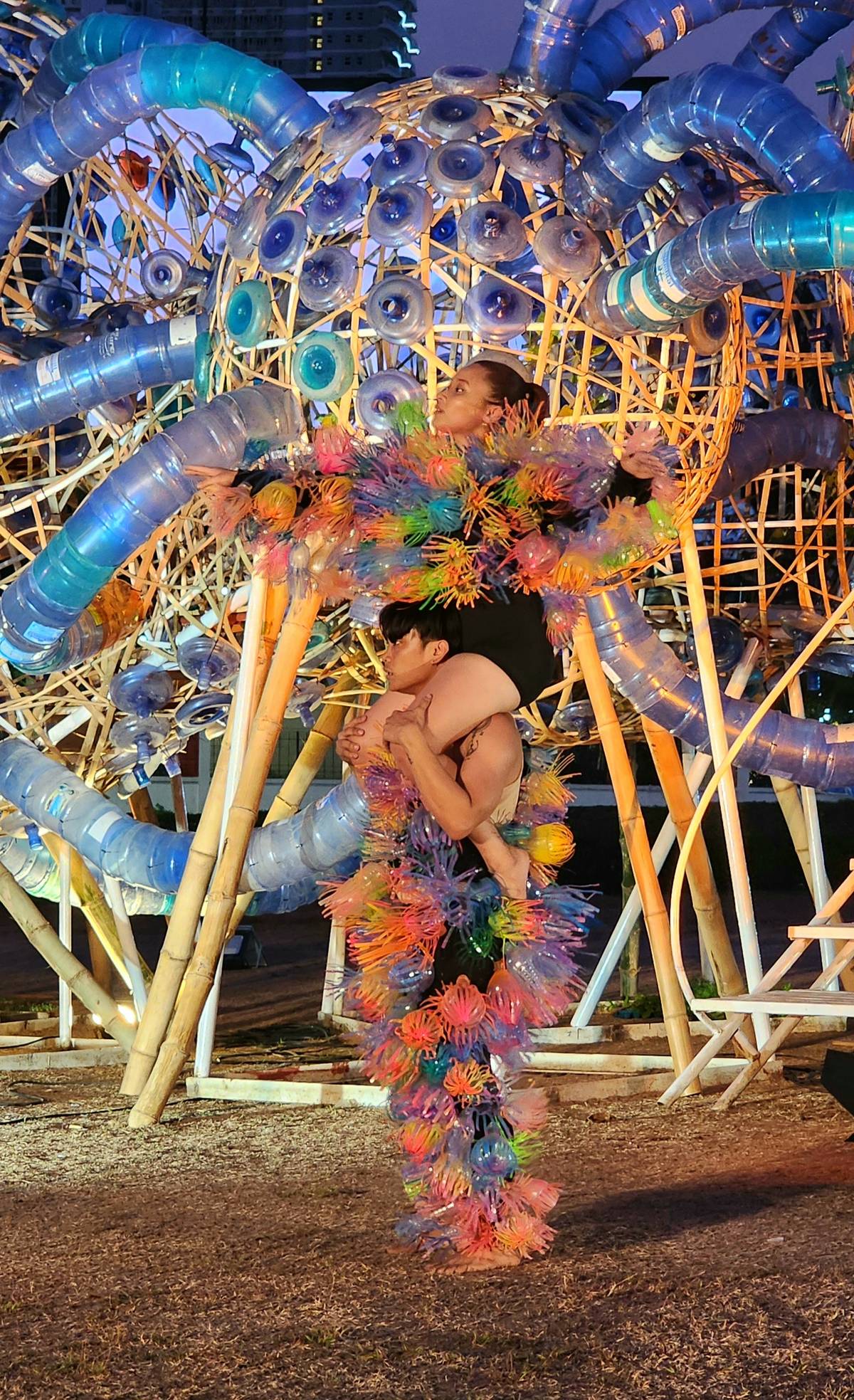
Performance of dancers from Daloy Dance Company wearing costumes designed by New during the inauguration.
Now, recreated at the CCP, Mebuyan’s Colony continues to advocate for the cause of the environment and the propagation of art, with new seedlings planted within the structure, donated by the Department of Environment and Natural Resources.
“Hopefully, the plants will overgrow and overtake the structure, hopefully, in a few months, if CCP allows to keep it for that long. Now, when you come back, it will be green and there will be vegetables hanging from inside that can be harvested,” New mused. “We could host harvest events, and it can even be a stage for an opera or a dance piece. So that’s really the main intention — for it to be in multi-purpose space for the public to just enjoy, use as shade or as a playground. I welcome everybody to enter Mebuyan and experience it for yourself. And it, hopefully, will be a living structure. So, every time you visit, hopefully, there’s new growth, new color, new plants and new different people congregating within the space.”
Mebuyan’s Colony is at the CCP front lawn until 25 May, but according to Marasigan, there is a plan “to transfer it to the Liwasang Kalikasan so that it will become part of the environment that you will see. Hopefully, it will last until the end of the year, perhaps. Hopefully even further again.”
‘Anud-Agos’: Flow of light on the CCP façade
Alongside Mebuyan’s Colony, the iconic CCP main building, which is still undergoing repairs and rehabilitation, is lit at night for the light-and-sound show called “Anud-Agos” or “Ebb and Tide.”
Wave-like pattens of aquamarine light are projected on the façade, while the fountain bursts, bathed in similar blue light. The light show is meant as a tribute to life-giving water and to convey the ideas of tranquility, bounty and power, amidst the harried traffic in the area. It also aims to call attention to the degradation of bodies of water and the challenges in water resources.
Conceptualized and designed by Jericho Pagana with supervision from Camille Balistoy and the Lighting Gobo Team, headed by Shantie de Roca, the lighting project is a collaborative effort of the CCP Production and Exhibition Department, headed by Ariel Yonzon, and the Production Design and Technical Services Division, headed by Ricardo Eric Cruz.
The facade lighting is on nightly from 22 to 30 April, with shows from 6:30 to 10 p.m., except Monday and during inclement weather.
Entering the house of ‘Dagitab/Digital: Banaag’
Beside the CCP main building, the previously underused Liwasang Kalikhasan is now a venue of several cultural endeavors including Earth Day celebrations. One can still find the previous year’s installations, Toym Imao’s Tanod-Lupa, at the leafy park.
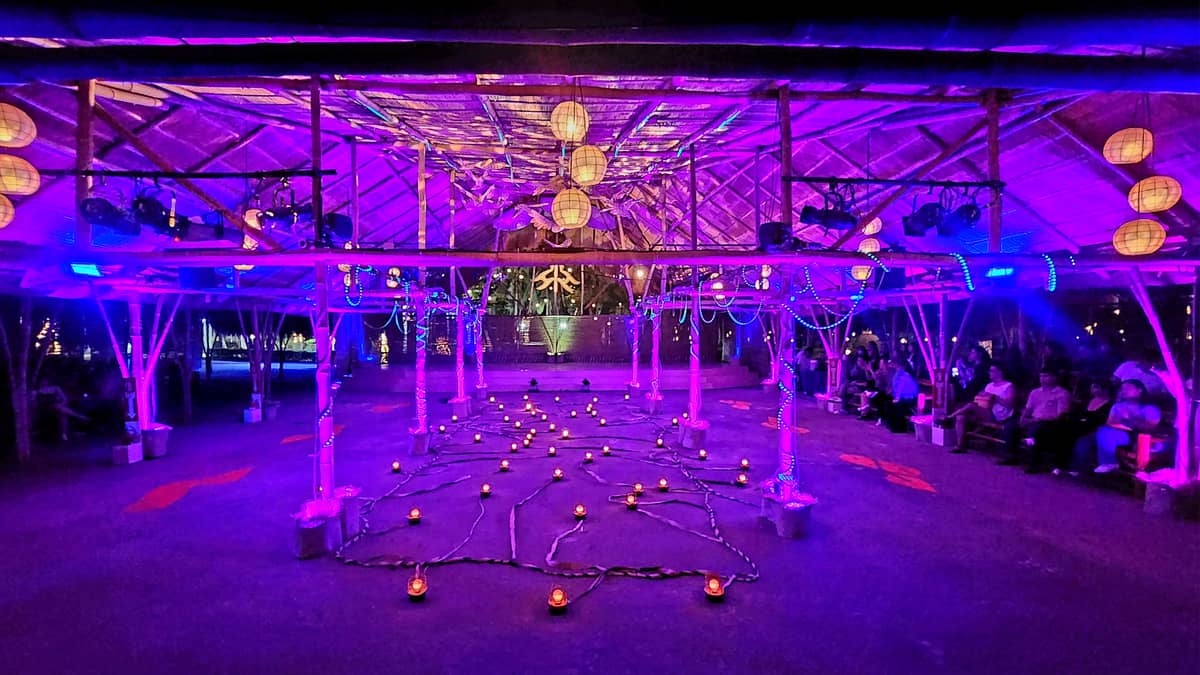
‘Dagitab/Digital: Banaag,’ a light, soundscape and music presentation at the Bamboo and Cogon Pavilion at CCP's Liwasang Kalikhasan.
CCP has recently constructed the Bamboo and Cogon Pavilion, inspired by the native hut or bahay kubo, as additional venue while the CCP building is still undergoing renovations. Here, an immersive presentation using light, sound and space is mounted — “Banaag,” part of its “Dagitab/Digital” series, which spotlights the importance of light design in events, theater, architecture and other art projects, using both analog and digital technologies, and is spearheaded by CCP’s Production Design and Technical Services Division, under the Production and Exhibition Department.
“Most performances, which use lighting design, are produced in conventional settings such as theaters and other performing venues. Through ‘Dagitab/Digital,’ we challenge conventions. The featured light designers work on the unconventional space
— with all its idiosyncrasies and elements — to create a one-of-a-kind show,” Marasigan said.
The first “Dagitab/Digital” show was held in December 2023, featuring the vision of award-winning lighting designer John Batalla. This was followed by “Dagitab/Digital: Masters of Philippine Choral Music” featuring the recordings of the esteemed Philippine Madrigal Singers in early April 2024.
“Dagitab/Digital: Banaag,” the third installment of the light project, features the vision of D Cortezano, resident technical director of Areté Ateneo at Ateneo de Manila University; faculty member of the Ateneo Fine Arts, Guang Ming College, and the Pamantasan ng Lungsod ng Valenzuela Theater Arts program; moderator and director of technical and design at Tanghalang Ateneo, and a collaborating member of the Asia-Pacific Bond of Theater Schools, the ASEAN University Network on Culture and the Arts, and the ASEAN Youth Cultural Forum.
For the Earth Day show, Cortezano plays with the architectural elements of the pavilion and uses colors in bold and luminescent shades that overwhelm the whole space, almost transforming it. This is accompanied by classic and contemporary music and different sounds including those from farm animals to help evoke the rice fields of Central Luzon. The show highlights the strength of traditional structures, as well as calls attention to the importance of farming as source of sustenance.
“Compared to previous light shows, we are exploring an interactive type of installation, where passing through the space instead of being a sit-down experience can help keep the audience interested. The experience needs to be curated. The audience experience needs to be clear from the moment they enter to the time they exit the structure,” said Cortezano, who works with a project team composed of assistant lighting designer Rafa Sumilong, production manager Jericho A. Pagana, assistant production manager Benette Emmanuel Estrada, technical assistants Camille Balistoy and Danilo Villanueva, led by project manager Ricardo Eric Cruz.
These installations and light designs at the CCP invite visitors to enter another world only to realize that it is own world, reminding us of its wonder and magic as well as of their impending loss if not cared for. For that is one compelling function of works using fantasy — not of escape but of a more enthralling encounter with reality. The experience can also be likened to entering a womb, being nourished and coming out hopefully with consciousness reborn or visions renewed.