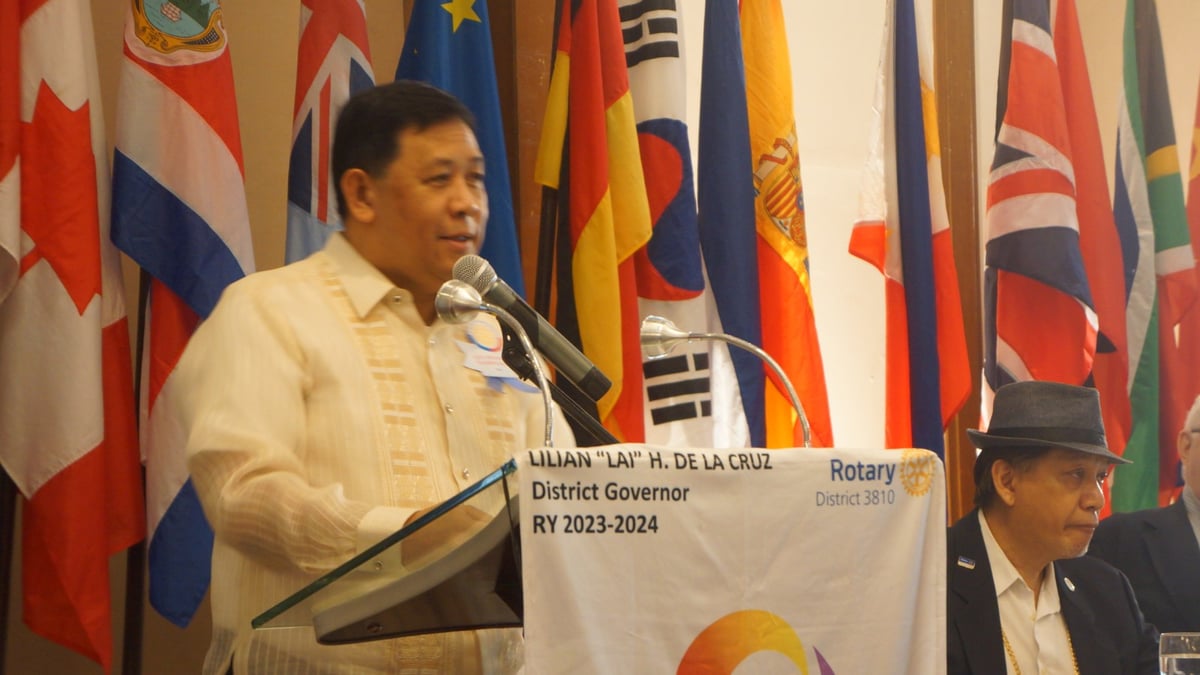
Former Armed Forces of the Philippines (AFP) Chief of Staff, retired Gen. Benjamin R. Madrigal Jr. said the security challenges confronted by the country in its exclusive economic zone, particularly in the West Philippine Sea (WPS), are evolving, thus the need to adopt advanced approaches to the threats.
In a speech delivered before members of the Rotary Club of Manila last 4 April 2024, Madrigal underscored the need to “harmonize the country’s actions” in addressing current security challenges, especially China’s overlapping claims of the WPS.
The former AFP chief of staff was RC Manila’s guest of honor and speaker during its 2 April 2024 meeting held at the Manila Polo Club in Makati.
“What we can do as the government is to harmonize our actions and integrate our solutions to the problem,” Madrigal said even as he likewise noted that “much of this issue also involves local government.”
Madrigal, who served as AFP Chief of Staff from 11 December 2018 to 24 September 2019, said the Philippines and China are now engaged with each other in a “battle of messaging” over their territory claims in the South China Sea (SCS).
China’s vast claim of the entire SCS overlaps with the Philippines’ exclusive rights in the WPS. Beijing’s 9-dash line (now expanded to 10) claims encompasses practically the entire WPS.
Arbitral tribunal ruling
However, an arbitral tribunal ruling on 16 July 2016, under the United Nations Convention on the Law of the Sea (UNCLOS), has declared with finality that the Philippines has full rights in its exclusive economic zone in the WPS and that it should have sovereignty over the maritime territory.
The Philippines and China are both parties to UNCLOS.
The United States is the only country in which the Philippines has a Mutual Defense Treaty. United States forces are conducting various military exercises with their Filipino counterparts, which triggers China to react by saying the Philippines has been pushing provocative actions with the US.
Madrigal was asked to what extent would the Chinese-caused tension in the WPS trigger the 1951 Mutual Defense Treaty between the US and the Philippines.
“Actually what’s going on here is a battle of messaging you probably have those messages from the United States and there are also messages coming from China.”
The former AFP chief recalled a previous dialogue where defense officials from different countries, including the Philippines, France, the US and China, as well as other involved countries, spoke about the issues in the SCS.
“We were in Singapore, the Shangri-La Dialogue, where defense officials from various countries speak. I remember there, the French defense minister said, we came to the South China Sea, brought our armada to make sure that nobody stopped us. Then, of course, the United States defense minister also spoke. The Chinese minister spoke,” he said.
Intimidation process
Madrigal said China has been very determined to push through on its vast claims of the entire SCS.
Quoting the Chinese minister, he said, “Of course, the Taiwan issue is a red light for them, and another issue he mentioned — he said, if you do that, you will attack, and we will attack resolutely. And after the messages, I remember one media personality approached me: He said, sir, what is your comment on the message from China? I said, well, I have no comment.”
When asked about China’s SCS stance, Madrigal stressed that the Filipinos will work on addressing the issue because China’s narrative over their claims on the maritime territory was consistent despite the arbitral ruling in favor of the Philippines.
“There’s nothing strange, that has been the narrative all along. What I’m saying is that there is a battle of messages. If you have seen, especially on the part of China, you get to read history, and you get to read the Chinese mindset,” Madrigal said.
He mentioned three major things that he said people will notice about China’s actions over the WPS.
“One is the use of deception. Second is the use of intimidation. They want to win wars before even the first violation is shot. And, of course, secrecy. And for those who probably have watched Marco Polo, they negotiate before they attack,” he further explained.
He said the end part of the intimidation process is allowing your counterpart to essentially surrender even before the actual conflict happens.
“So at this time, what we see is, of course, a battle of messages,” he noted.
Madrigal said part of pushing a credible defense posture is acquiring modernized defense assets, such as submarines.
“But the other side has about 20 credible defense postures. So what we do is to build on with our like-minded countries and allies, to sort of tame the other side, to make sure that we maintain the peaceful status quo,” he added.
Gentleman’s agreement, show of force
The former AFP chief lamented China’s terms on the WPS, citing the so-called gentlemen’s agreement entered by former President Rodrigo Duterte with the Chinese government.
“I don’t know if you have seen or read some of the messages where they say, you go back to the right path, going back to the right path — on the part of the Chinese government is sticking to that particular line — where they want the Philippine government to ask permission before undertaking an operation to allow their Coast Guard to board our ships and inspect,” he said.
Madrigal noted that China is “basically on a show that they actually are in control” of the entire SCS.
He debunked the notion that an agreement have been made between the Philippines, under Duterte, and China.
In recent reports, former presidential spokesperson Harry Roque, Duterte insisted that no promise has been made to the Chinese government on any matter other than bringing construction materials to the BRP Sierra Madre grounded on Ayungin Shoal.
Possible economic sanctions
There is a notion that the increasing tension in the WPS would cause China to impose economic sanctions against the Philippines.
A geopolitical analyst had said that China could lose more if it decides to impose economic sanctions on the Philippines amid the heightened tension in the South China Sea.
This is because Japan, say, can easily fill the gap caused by a Chinese sanction, according to the analyst, which Madrigal concurred.
“Now we’re doing a lot of engagements with Japan and we have also, of course, security concerns, considering our proximity in this area,” Madrigal said.
“But what we’re saying is how can anyone think that this bully could be transformed by a political decision,” he stressed.
Madrigal noted that ASEAN centrality essentially cannot be achieved because the various ASEAN member countries have different concerns with regards this particular (China) issue.”
There are also conflicting boundaries among ASEAN countries, he added.
“But what we are doing now is to engage bilaterally also with the other (ASEAN) countries, hopefully, to be able to resolve issues between our countries and come up with some peaceful solutions. And eventually, we are able to come up with a common understanding as to how to resolve this issue and engage China all together,” Madrigal said.