
Bombs kill 103 at Iran memorial for slain general: state media
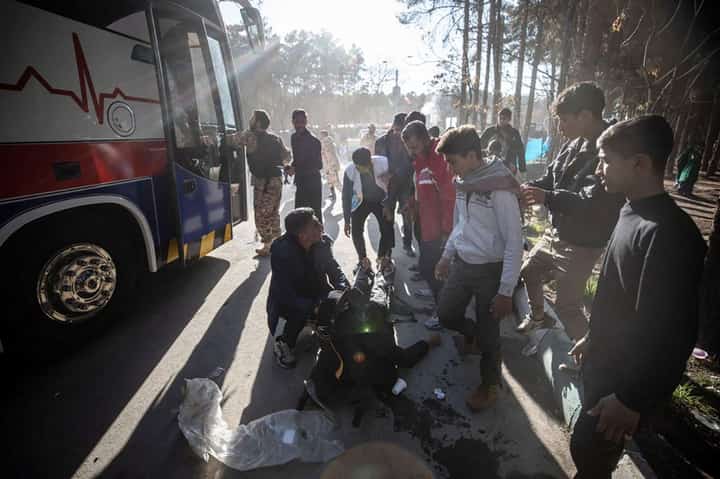
An injured man receives assistance after two explosions in quick succession struck a crowd marking the anniversary of the 2020 killing of Guards general Qasem Soleimani, near the Saheb al-Zaman Mosque in the southern Iranian city of Kerman on January 3, 2024. Photo by MEHR NEWS / AFP
At least 103 people were killed in Iran Wednesday as two bombs in quick succession struck a crowd commemorating slain general Qasem Soleimani on the anniversary of his killing, state media reported.
The blasts, which state television called a "terrorist attack", came with tensions running high in the Middle East a day after Hamas number two Saleh al-Aruri — an Iran ally — was killed in drone attack on a Beirut southern suburb which Lebanese officials blamed on Israel.
The blasts stuck near the Saheb al-Zaman Mosque in Kerman, Soleimani's southern hometown where he is buried, as supporters gathered to mark the fourth anniversary of his killing in a US drone strike just outside Baghdad airport.
Kerman's deputy governor, Rahman Jalali, said the explosions were a "terrorist attack".
There was no immediate claim of responsibility for the attack.
"The number of people killed rose to 103 following the death of people injured during the terrorist explosions," said official IRNA news agency, which earlier reported 73 deaths.
Another 141 people were wounded in the bombings, IRNA said, adding that some were in "critical condition".
Iran's Tasnim news agency, quoting informed sources, said "two bags carrying bombs went off" at the site.
"The perpetrators… of this incident apparently detonated the bombs by remote control," Tasnim added.
The ISNA news agency quoted Kerman mayor Saeed Tabrizi as saying the bombs exploded 10 minutes apart.
"We were walking towards the cemetery when a car suddenly stopped behind us and a waste bin containing a bomb exploded," an eyewitness was quoted by ISNA as saying.
"We only heard the sound of the explosion and saw people falling. There was a bomb in the trash can," the witness added.
Online footage showed crowds scrambling to flee as security personnel cordoned off the area.
Deadly adversary
Images on state television showed several ambulances and rescue personnel in the area.
Among the 73 killed were three paramedics who were dispatched to the area following the first explosion, according to Iran's Red Crescent.
Soleimani headed the Quds Force, the foreign operations arm of Iran's Islamic Revolutionary Guards Corps, overseeing military operations across the Middle East.
Declared a "living martyr" by Iran's supreme leader Ayatollah Ali Khamenei while still alive, Soleimani was widely regarded as a hero for his role in defeating the Islamic State jihadist group in both Iraq and Syria.
In the eyes of many Iranians, his military and strategic prowess were instrumental in warding off the multi-ethnic disintegration of neighbouring countries such as Afghanistan as well as Syria and Iraq.
Long seen as a deadly adversary by the US and its allies, Soleimani was one of the most important powerbrokers across the region, setting Iran's political and military agenda in Syria, Iraq and Yemen.
On days after his death in 2020 and leading up to his funeral in Kerman, millions turned out to mourn in a show of national unity.
A survey published in 2018 by IranPoll and the University of Maryland found Soleimani had a popularity rating in Iran of 83 percent, ahead of then-president Hassan Rouhani and then-foreign minister Mohammad Javad Zarif.