NASA to unveil first images of historic asteroid sample
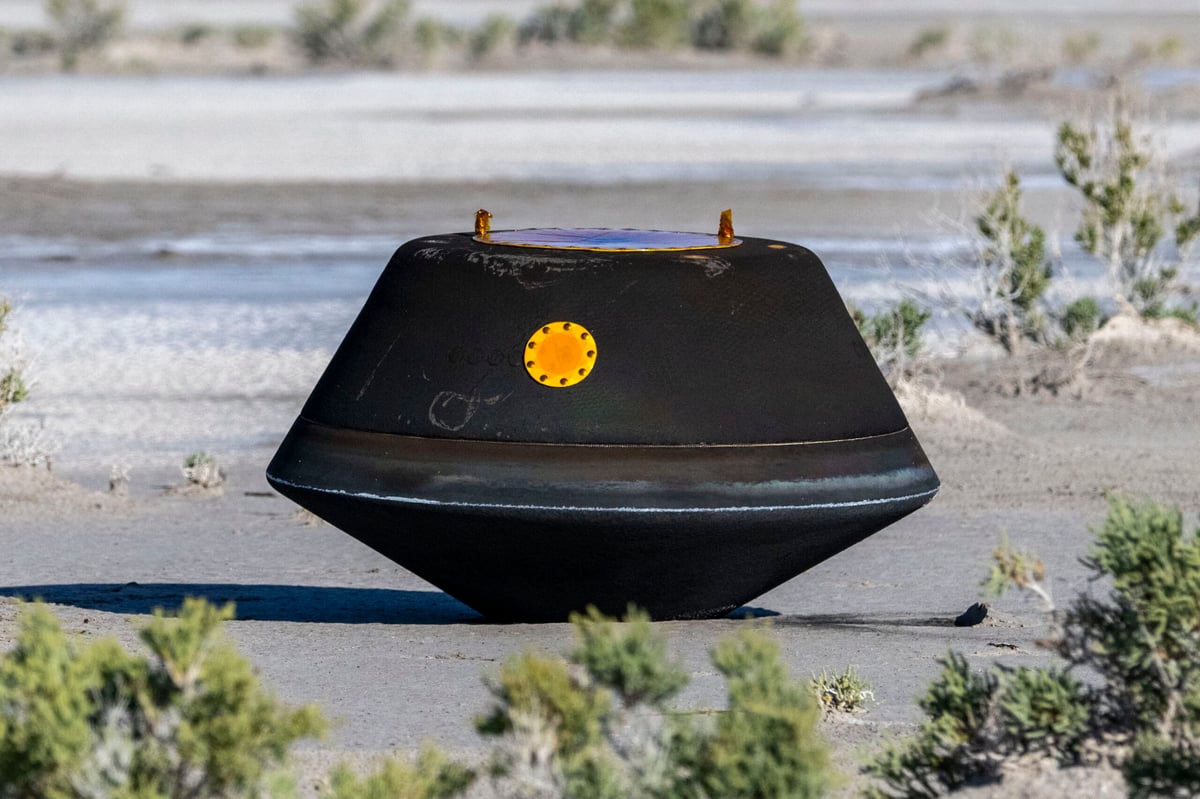
DUGWAY, UTAH - 24 SEPTEMBER: In this handout provided by NASA, the sample return capsule from NASA's OSIRIS-REx mission is seen shortly after touching down in the desert, on 24 September 2023 at the Department of Defense's Utah Test and Training Range in Dugway, Utah. The sample was collected from the asteroid Bennu in October 2020 by NASA's OSIRIS-REx spacecraft. (Photo by NASA / GETTY IMAGES NORTH AMERICA / Getty Images via AFP)
NASA is set to reveal on Wednesday the first images of the largest asteroid sample ever collected in space, something scientists hope will yield clues about the earliest days of our solar system and perhaps the origins of life itself.
The OSIRIS-REx mission collected rock and dust from the asteroid Bennu in 2020, and a capsule containing the precious cargo successfully returned to Earth a little over two weeks ago, landing in the Utah desert.
It is now being painstakingly analyzed in a specialized clean room at NASA's Johnson Space Center in Houston.
The space agency will hold a live-streamed news conference at 11:00 a.m. Eastern Time (1500 GMT) to share photographs and preliminary scientific analysis.
OSIRIS-REx wasn't the first mission to rendezvous with an asteroid and bring back samples for study — Japan succeeded in the feat twice, returning bits of space pebbles in 2010 and 2020.
But the substantial amount of material — 250 grams (half a pound) — as opposed to the 5.4 grams returned by Japan's Hayabusa2 — is a key difference.
NASA chose to sample Bennu because it is believed to be rich in organic compounds.
Scientists think similar asteroids could have delivered organic building blocks to Earth along with water through collisions billions of years ago.
Bennu's orbit, which intersects that of our planet, also made the roundtrip journey easier than going to the Asteroid Belt, which lies between Mars and Jupiter.
NASA researchers have so far been heartened by the discovery of "bonus particles," described as black dust and debris coating the sample collector.
Back in October 2020, when the OSIRIS-REx probe shot nitrogen gas at Bennu to collect its sample, a flap meant to seal it got wedged open with a piece of rock, allowing some of the finer material to flow out of the collector without escaping altogether.
"The very best 'problem' to have is that there is so much material, it's taking longer than we expected to collect it," said deputy OSIRIS-REx curation lead Christopher Snead, in a statement.