
Mankayan IPs say mining fight is about survival, ancestral land
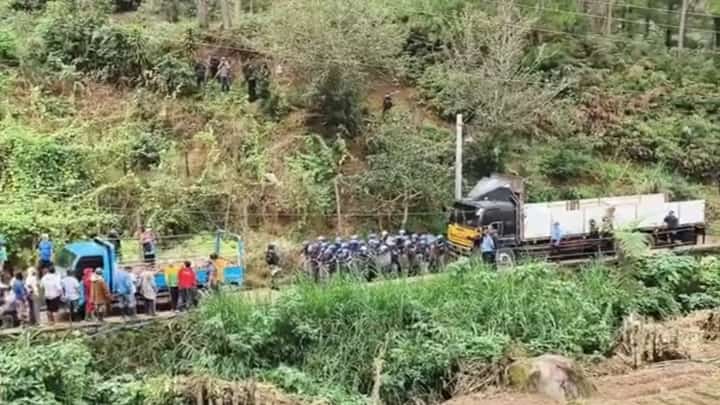
MANKAYAN, Benguet — For indigenous farmers in the high-altitude communities of Barangays Bulalacao and Guinaoang, their opposition to mining exploration is not simply a protest but a fight to protect their ancestral land, water sources and agricultural livelihood.
Kankanaey residents have maintained physical barricades along local access roads to prevent heavy equipment of Crescent Mining and Development Corp. (CMDC) from entering areas where exploratory activities are planned.
Community leaders said the barricades are necessary to protect the land and water resources that sustain their farming communities and ensure these remain available to future generations.
The dispute involves the renewal of a 25-year Mineral Production Sharing Agreement (MPSA) originally granted in 1996. The agreement expired in 2021, but government agencies later authorized an extension covering more than 500 hectares across Bulalacao and Guinaoang.
Residents have questioned the validity of the extension, alleging that regulatory requirements and the rights of host communities were not properly observed.
A major issue raised by the communities is the conduct of the Free, Prior and Informed Consent (FPIC) process required under the Indigenous Peoples Rights Act (IPRA).
Community members have filed administrative and criminal complaints with the Office of the Ombudsman against officials of the National Commission on Indigenous Peoples (NCIP) and the Mines and Geosciences Bureau (MGB), alleging that permits and other authorizations related to the mining project were issued before the required community consent process was completed.
The residents also alleged that important technical information was not sufficiently disclosed during consultations, including projected water extraction, waste disposal and potential environmental effects on agricultural areas.
Another point of contention is the voting process used to determine community support for the project.
Residents said Bulalacao and Guinaoang, the communities directly affected by the proposed mining activities, initially voted against the project. They argued that subsequent voting involving other barangays diluted the opposition of the host communities.
The mining dispute has also reached the courts, with the company securing court orders and injunctions related to access roads and the movement of its drilling equipment, according to community representatives.
Lawyers representing the indigenous groups have challenged the actions, arguing that the legal proceedings have placed additional pressure on residents opposing the project.
For community members, however, the dispute goes beyond the mining permits and court cases.
Residents have expressed concern that reports portraying them as opponents of development or lawbreakers fail to reflect their dependence on farming and their concerns about the potential effects of mining on their land and water resources.
Community representatives have also criticized government regulatory agencies, accusing them of failing to adequately protect the rights of indigenous communities while allowing mining-related activities to proceed despite continuing opposition and pending legal challenges.
Despite the legal disputes, residents of Bulalacao and Guinaoang continue to take turns monitoring the barricades around the clock.
They said they would maintain their opposition until the permits they consider invalid are revoked and their ancestral land rights are respected.
“Papano na ang aming kabuhayan at ang kinabukasan ng aming mga anak, apo kung sisirain ng minahan ang lugar namin?” Bulalacao elder Gary Dulag said during a recent gathering at the barricades.
Dulag said residents would continue standing guard with their neighbors for as long as necessary.
The communities rely heavily on vegetable farming, with their produce supplying markets in various parts of Luzon. For the farmers, protecting their ancestral territory is therefore also a matter of protecting the livelihood of present and future generations.