
Co-ops must open up for private capital
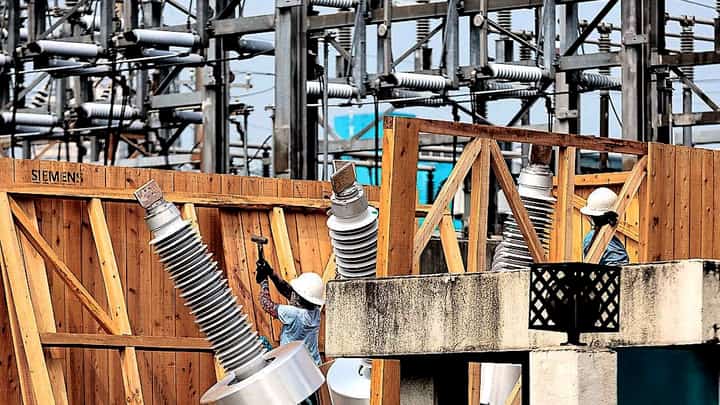
WORKERS uncrate a newly arrived high-voltage circuit breaker at a Meralco substation in Paco, Manila. The distribution utility is urging electric cooperatives to consider converting into stock corporations to open the door to private capital for upgrading and modernizing their systems. Meralco has said such investments could help address aging infrastructure and improve power distribution services.
PHOTOGRAPH by Toto Lozano for DAILY TRIBUNE
Inefficient electricity services and high power costs are the biggest disincentives to investment, worsened by highly politicized supply distributors outside Metro Manila.
Dominant power distributor Manila Electric Co. (Meralco) is pressing electric cooperatives across the country to convert to stock corporations, arguing that the decades-old non-stock, non-profit structure has left many of them unable to raise the capital needed to keep pace with the surging power demand in urbanizing and industrializing areas.
Meralco’s head of strategic distribution utility (DU) partnerships, Arnel Casanova, said on Daily Tribune’s online program Straight Talk that the shift is allowed under Section 57 of the Electric Power Industry Reform Act (EPIRA) of 2001, which permits electric cooperatives to convert from non-stock, non-profit entities into stock corporations.
“Under Section 57, the electric cooperatives, from a non-stock, non-profit entity, could actually convert into a stock corporation,” Casanova said.
“This is beneficial to the member consumers because once an electric cooperative is converted to a stock corporation, they become stockholders,” he explained.
Electric cooperatives were established in the 1970s and 1980s under a “missionary” mandate to bring electricity to rural households, largely funded and subsidized by the government.
Casanova said that model has since been overtaken by decades of urbanization, industrialization, and the rise of digital technology, which have driven electricity demand well beyond what many cooperatives were built to serve.
Historic hindrance
“The problem now is that being non-stock and non-profit, the rural cooperatives cannot anymore increase their capital expenditures ahead of the demand of the times,” he said, noting that a single substation can cost hundreds of millions of pesos — an outlay most cooperatives cannot afford on their own.
Casanova said the disparity is evident in Laguna, where all 20 economic zones sit within Meralco’s franchise area.
“The portion Meralco is not servicing, that’s where probably the poorest part of Laguna is,” he said. “But the most industrialized and the more economically progressive is within the Meralco franchise because of reliability.”
Meralco currently serves only about three percent of the country’s land area — largely Metro Manila, Cavite, Rizal, Bulacan, and parts of Pampanga and Batangas — yet it accounts for 55 percent of national power consumption, Casanova said.
The remaining 120 electric cooperatives cover the rest of the country.
Under the corporatization model, Casanova said Meralco does not seek to take over cooperatives but to become a co-owner alongside the member-consumers who would retain their shares and receive dividends once the entity turns a profit.
“We take the majority of the equity because that’s the way we could actually create more impact,” he said, adding that Meralco would infuse “billions of pesos” in fresh capital while the cooperative keeps its franchise, assets, and employees.
“That’s actually not a takeover,” Casanova said, addressing concerns that private investment could dilute member control. “It’s actually vesting in the consumers direct ownership of the distribution utility.”
Beyond capital, Casanova said Meralco would bring 123 years of operating experience, modern smart-grid and SCADA technology, and workforce training through the company’s Meralco Power Academy, which he said has already sent 15 scholars abroad for graduate studies in nuclear engineering as the company explores future investment in nuclear power.
Casanova said Meralco’s approach is nationwide, targeting cooperatives adjoining its existing franchise for ease of interconnection, as well as underserved areas in Mindanao and the Visayas. He cited Mindanao’s agricultural base as a priority, saying reliable power is needed to build cold storage and agro-industrial facilities that would reduce post-harvest losses for farmers.
One live test case, Casanova said, is South Cotabato Electric Cooperative 2 (Socoteco II), which serves General Santos City, Sarangani province, and the towns of Polomolok and Tupi.
Meralco submitted a partnership proposal to the cooperative, he said, but the Socoteco II board instead approved a rival proposal from Ignite Power, a venture linked to businessman Enrique Razon and former senator Manny Pacquiao — without putting the matter up for competitive bidding as Casanova said is required under National Electrification Administration (NEA) Resolution No. 88.
“We’re actually questioning the direct award to Ignite Power,” Casanova said, noting that Meralco was told its proposal was disqualified partly because it involved conversion to a stock corporation — even though the Ignite Power proposal is also structured as a stock corporation.
“There’s really a very clear bias and partiality in favor of the others,” he said.
Casanova said a group of member-consumer owners has since filed a complaint with the Office of the Ombudsman, alleging that NEA-appointed officials sitting on the Socoteco II board approved the deal despite the lack of a transparent selection process.
“That’s not a consent,” he said of members being asked to approve a proposal whose terms were never disclosed to them.
Casanova said Meralco would accept the outcome of any genuinely competitive process.
“Let transparency and integrity prevail in this process,” he said. “At the end of the day, it’s going to be the member-consumers who will benefit.”
Suppressed economy
He argued that the stakes extend beyond any single cooperative. Citing the Philippines’ installed generating capacity of roughly 30 to 31 gigawatts against Taiwan’s 61 gigawatts, Casanova described the country as “a suppressed economy” held back by inadequate power infrastructure.
“If you have a scarcity of power supply, then it will become expensive,” he said. “But if you have more power plants, the generation charge which is 65 percent of your power bill could actually be lower.”
Loss removal still tabled
Meanwhile, Senate President Sherwin Gatchalian is pushing measures to lower electricity costs as the economy slows, including a proposal to bar distribution utilities from passing on system loss charges to consumers.
The call comes after the gross domestic product expanded by 2.3 percent in the second quarter, the weakest quarterly growth since the pandemic. Growth slowed from 2.8 percent in the first quarter and 5.4 percent a year earlier, according to the Philippine Statistics Authority.
“If we want to revitalize our economy and give real financial relief to Filipino families and small businesses, we need to bring down the cost of electricity,” Gatchalian said Saturday.
Gatchalian earlier filed Senate Bill 2350, which seeks to prohibit distribution utilities from charging consumers for system losses and remove the value-added tax on electricity sales.
System loss charges pertain to the electricity lost during transmission and distribution.
Gatchalian’s office said they account for five to six percent of a typical Meralco bill, with a household consuming 200 kilowatt-hours paying nearly P149 a month in such charges from August 2025 to July 2026, excluding VAT.
The Energy Regulatory Commission has moved to remove the 12-percent VAT on system loss charges, saying this could save consumers about P6 billion annually. The regulator stressed that pass-through charges are not profits for distribution utilities but payments collected for generators, the transmission provider, and the government.
Gatchalian also filed Senate Resolution 581 seeking an inquiry into the lack of regular fuel cost audits amid the rising generation charges.
He cited Meralco figures showing that a household using 200 kWh a month paid about P2,350, or P11.74 per kWh, in January 2025, compared to about P2,970, or P14.83 per kWh, in July 2026.
Fuel costs accounted for 86.16 percent of Meralco’s generation charges in July, according to figures cited by Gatchalian.
He said the country’s reliance on imported fuel leaves consumers exposed to global energy price swings.