
After weekend deluge, Parañaque eyes river floodgate

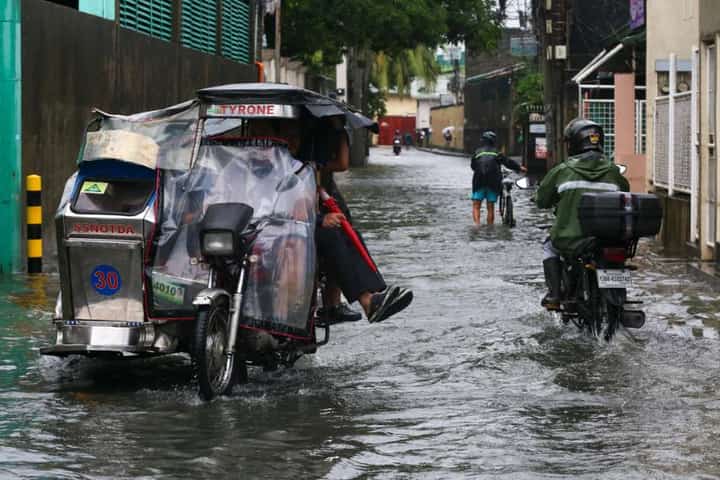
Residents and motorists wade through a flooded street in Parañaque City on Sunday, 9 August, as the southwest monsoon (Habagat) continues to bring rain across Metro Manila and other parts of the country.
Toto Lozano
The national government and the Parañaque City government are studying a proposal to construct a floodgate along the Parañaque River to address persistent flooding in several barangays, Mayor Edwin Olivarez said.
Olivarez said the proposed floodgate would help control water flowing from Manila Bay into the Parañaque River system, which traverses several communities in the city.
He said the river system contributed to severe flooding in parts of Parañaque over the weekend and on Monday, 10 August, as the enhanced southwest monsoon, or habagat, brought heavy rains.
“When there is high tide at the Manila Bay, the water from the Paranaque River returns to the city. The Paranaque River is where the water from the Metro South passes. When there is high tide and heavy rains, the water can not pass through to Manila Bay,” Olivarez said in a radio interview.
Among the areas that experienced significant flooding were portions of Barangays San Dionisio, San Isidro and San Antonio, as well as sections of Dr. A. Santos Avenue.
The flooding prompted complaints on social media from residents who described the problem as having persisted for years, with some directly criticizing the city government and Olivarez.
In response, the city government said rescue and relief operations were continuing in areas hardest hit by the floods.
Evacuation centers were also opened for residents in vulnerable communities.
“We recognize the serious impact of flooding on our residents and assure everyone that our teams remain on the ground and ready to respond. The flooding is not isolated to Paranaque, as many parts of Metro Manila and other areas are also experiencing similar conditions,” the city government said.
Some residents criticized the statement, accusing the local government of being reactive rather than preventive in addressing the city’s flooding problem.
“Be proactive, not reactive. Evacuation should be the last resort,” one commenter wrote.
“Making up excuses, when it’s practically Paranaque that’s all over the news,” another said.
Olivarez said the city government is coordinating with national agencies, particularly the Metropolitan Manila Development Authority, on additional measures to address flooding.