
Prof. Atienza reads VP on rhetoric, Romanovs
Just because you received more than 50 percent of the votes in 2022 or have high trust ratings does not give you a license to threaten people or utter words that insinuate violations of the law.
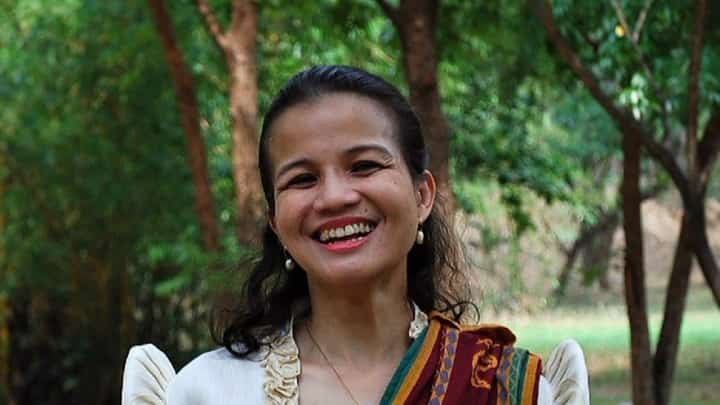
Weight of stewardship Leadership is all about being more responsible and careful because people have high expectations, University of the Philippines Diliman’s Department of Political Science professor Maria Ela L. Atienza said.
Photograph courtesy of Maria Ela L. Atienza/FB
During an interview in DAILY TRIBUNE's Impeachment Rundown: The Trial of Vice President Sara Duterte, professor Maria Ela L. Atienza laughed off her being referenced as a lawyer, which she never was.
Atienza is a political scientist, the former chair of the University of the Philippines Diliman’s Department of Political Science and the current chairperson of Division VIII (Social Sciences) at the National Research Council of the Philippines.
But when she sat down for an extended interview during the third week of the Senate impeachment trial of Vice President Sara Duterte, it was easy to see why the confusion persists.
She argues like someone trained to anticipate the counterargument before it arrives.
Atienza, who hails from Batangas, has an instinct for precision that ran through nearly every answer she gave on the trial’s most contested episodes.
Asked about National Bureau of Investigation director Melvin Matibag, she pointed out that the head of the investigation agency was not testifying purely as an individual with personal grievances; he was presenting an NBI investigation built by many hands, only some of which carried any conflict at all.
The videos he introduced into evidence, showing members of the Duterte family invoking the assassinated Romanov dynasty and Mussolini in conversations about the President, could not simply be argued away. “These things actually happened,” Atienza said. It was this refusal to be moved by theater that shaped her reading of the trial’s larger arguments.
“Popularity should make you more responsible and more careful because people have high expectations,” she said, directing her comment to the VP who remains a top choice as Marcos’ successor.
“Just because you received more than 50 percent of the votes in 2022 or have high trust ratings does not give you a license to threaten people or utter words that insinuate violations of the law.”
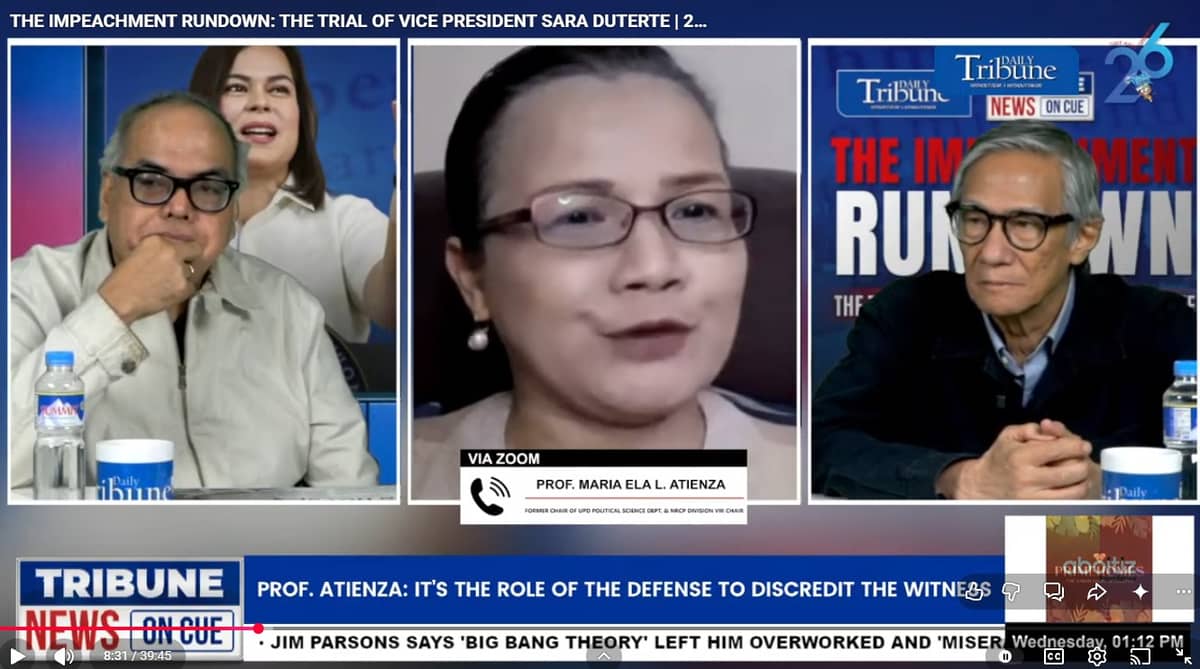
Sheer arrogance is bad optics If it’s not bad optics, the Vice President’s decision to travel abroad while the impeachment trial proceeds was a signal of disrespect toward a coequal branch of government exercising its constitutional mandate, professor Maria Ela Atienza (middle) shared with Daily Tribune’s ‘Impeachment Rundown: The Trial of Vice President Sara Duterte’ hosts Chito Lozada (left) and Teddy Montelibano.
Screen grab from Impeachment Rundown: The Trial of Vice President Sara Duterte
Setback for House lawyers
The defense’s exclusion of the Vice President’s foreign currency deposits from subpoena, she said, was a real setback for the prosecution, a door closed on one avenue for tracing unexplained wealth, but not a fatal one, given that the Statement of Assets, Liabilities and Net Worth (SALN), tax records, and anti-money laundering data remained open to scrutiny.
On the disputed, unnotarized affidavit of former Davao Death Squad leader Arturo Lascañas, she drew a distinction many commentators skipped past: it was never offered as definitive evidence, only as an investigative lead, and it does not even appear among the Articles of Impeachment.
Where Atienza turned pointed was on the question of double standards. She traced the Vice President’s now-notorious remarks, and her brother Baste Duterte’s musings about the President’s head, his invocations of the Romanovs and Mussolini, to what she called “the Duterte brand”: a style of rhetoric normalized since 2016, when ordinary Filipinos who joked about bombs at airports faced swift law enforcement action while the politically powerful spoke of violence against the nation’s own president with near impunity.
“Popularity should make you more responsible,” she said, “not less.” It is a line that could serve as her governing thesis on power in the Philippines: office is not license, and high trust ratings are not immunity.
She was equally direct about the Vice President’s decision to travel abroad while the impeachment trial she is meant to answer proceeds without her.
Atienza called it bad optics at best, and at worst a signal of disrespect toward a coequal branch of government exercising its constitutional function.
She noted the contradiction embedded in the VP’s camp’s own statements: insisting the trip was private while also describing official-sounding aims, all while state-funded security presumably still travels with her.
It is, Atienza said, the clearest evidence yet of a double standard, someone facing the country’s highest tribunal enjoying a freedom of movement no ordinary defendant would ever be granted.
Asked for a “fearless forecast,” she demurred entirely. The 16 votes needed for conviction remain, by her count, a difficult number — perhaps 13 senators inclined toward conviction, three short of the threshold, with senator-judges weighing not only evidence but their own political futures and the public sentiment now shaping around 2028.
She was careful to note that Sara Duterte’s early declaration of her presidential ambitions may itself be strategic, a bid to color how senators calculate their votes.
What emerges from the conversation is less a partisan brief than a civic argument, delivered in the register of a lecture hall rather than a rally.
Whether or not the Senate ultimately convicts, Atienza suggested, the trial itself has already produced something the public should not discard: a record, however the vote falls, of the character and judgment of a woman who wants to be president in 2028.
That, she implied, is a verdict voters can render even if senators do not.