
‘Marcos demand will kill co-ops’
Consumers might enjoy lower electricity bills, but they will ultimately shoulder the cost as taxpayers.
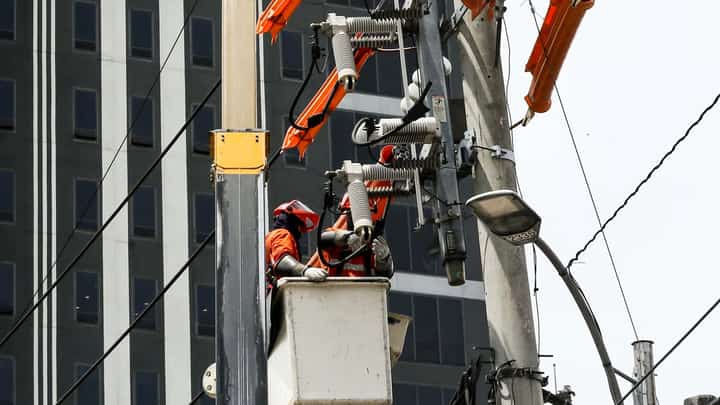
Power lines Calls to scrap system loss charges that add to consumers’ electricity bills continue to face resistance despite President Ferdinand Marcos Jr.’s push to eliminate the fees before the end of the year.
Photograph by Analy Labor for DAILY TRIBUNE
Electric cooperatives’ inefficiencies have resulted in substantial system loss charges collected annually from electricity consumers, a practice that two economists warned could leave many cooperatives financially vulnerable if the charges are removed without alternative government support.
Economist Alexander Escucha, a former president of the Philippine Economic Society, said President Ferdinand Marcos Jr.’s proposal to remove the system loss charge from electricity bills could force many small electric cooperatives into financial distress or even bankruptcy unless the government provides larger subsidies.
President Marcos issued the order to remove the item from monthly power bills during his fifth State of the Nation Address (SoNA) on 27 July, arguing that if the goal is to reduce the cost of electricity, the charge passed on to consumers must be scrapped.
Branding it as unfair for consumers to bear costs that aren’t their fault, Marcos drew a standing ovation from the lawmakers and others in attendance.
“Therefore, we the people request, no, we demand, the immediate amendment of the EPIRA law to prohibit the charging of the system loss to consumers, including the value-added tax thereon,” Marcos declared.
Meralco chairperson Manuel V. Pangilinan, however, vehemently opposed the blanket removal of the charge, saying it would simply shift, not eliminate, a multibillion-peso burden that the power industry cannot afford to absorb.
The system loss cannot be eliminated because part of it results naturally from the physics of transmitting and distributing electricity, according to experts.
Most cooperatives, however, exceed an allowable system-loss level of about 8.25 percent, consisting of roughly 3.75 percent technical losses and 4.5 percent non-technical losses that include illegal connections, electricity theft, and inefficiencies in utility management.
Escucha argued that the bigger concern is not necessarily efficient private utilities such as Meralco, but the country’s 121 electric cooperatives, some of which reportedly experience system losses of 12 to 16 percent.
Electric cooperatives receive government support through the National Electrification Administration (NEA) amounting to some P2.8 billion annually.
If cooperatives are prohibited from passing on allowable system losses and related taxes to consumers without addressing their inefficiencies, Escucha warned their losses would eventually be recovered through additional government subsidies.
Consumers might enjoy lower electricity bills, but they will ultimately shoulder the cost as taxpayers, he said.
Economist Bienvenido Oplas Jr., who is also president of think tank Minimal Government Thinkers, shared the view that many electric cooperatives would face bankruptcy if the system loss charge is removed.
In an interview on Daily Tribune’s Straight Talk online program, he said large utilities like Meralco might be able to survive because of their financial strength, but even it would likely have to reduce investments to improve its infrastructure, such as the strengthening of power lines and utility poles to better withstand typhoons.
Most of the electric cooperatives are heavily subsidized. The NEA has an annual budget of around P14 billion each year, with roughly P2 billion going to support power distributors outside Metro Manila.
“The problem is that many of those cooperatives don’t even repay their loans. In effect, they are being bailed out and protected by the government,” Oplas said.
He said electric cooperatives should eventually be converted into corporations regulated by the Securities and Exchange Commission (SEC) instead of remaining under the NEA.
Let them go under
“If they are financially mismanaged, they should be allowed to fail and be replaced by more efficient private operators that can continue serving their franchise areas,” Oplas said.
He said electric cooperatives often boast that their rates are lower than Meralco’s.
“For example, Meralco may charge around P14 per kilowatt-hour, while a cooperative claims to charge P13.50, but they rarely mention that their areas experience frequent blackouts,” Oplas said
The frequent outages eventually turn off potential investors in the provinces.
“That’s why I often say that the most expensive electricity is no electricity at all,” he said.
Oplas said the abuses of electric cooperatives lead to their huge system losses, well above the allowable ceiling, sometimes nearly double.
“One area that should really be eliminated is the practice of passing on the electricity consumption of cooperative officials to consumers,” he stressed.
Instead of removing the charges, a more practical measure that can be implemented within a week or a month is to reduce the taxes on energy products.
“A temporary suspension of the excise tax on petroleum products would significantly reduce energy costs, not only for electricity generation but also across the broader economy,” Oplas said.
Law before holidays
The proposed laws seeking to implement the marching orders of the President will likely be passed by the Senate in September and may be enacted into law before Christmas, Senator Erwin Tulfo said.
Tulfo, chairperson of the Senate energy committee, acknowledged the resistance from energy stakeholders but asserted that Congress is steadfast in expediting the passage of the bills to turn President Marcos’s order to lower monthly power rates by removing the system loss charge into reality before the end of the year.
“I’ll make sure that it’s not only a press statement [of the President],” Tulfo said in Filipino in a radio interview, adding that the panel will finish its deliberations in two months.
Speed up process
The Presidential Legislative Liaison Office, which is responsible for facilitating the President’s legislative agenda, has reportedly expressed strong interest in collaborating with the committee and suggested streamlining the proceedings by holding a single hearing.
Thereafter, the bills will be consolidated by a technical working group, proceed to the bicameral conference committee to harmonize the Senate version with that of the House of Representatives’, and subsequently be sent to Malacañang for the President’s signature.
“If it’s really that fast, then perhaps the system loss charge will be removed by the end of September,” Tulfo said.
He pointed out, however, that this would be challenging for Congress due to the strong pushback from power distributors, who cautioned against the government’s swift action to implement the proposal without a prior determination of how and who will absorb the costs.
During a hearing on Thursday, Energy Regulatory Commission Chairperson Francis Saturnino Juan told senators that scrapping the non-technical system loss could lower the monthly electricity bills.
He noted, however, that it would only be a minor reduction in the bills since non-technical losses account for about 1.5 percent of the power utilities’ total system loss charge.
Remove VAT only
The Philippine Rural Electric Cooperatives Association (Philreca), which groups power distributors in the provinces, indicated support for removing the value-added tax (VAT) on the system loss charge while maintaining the charge as part of the monthly bills.
For the removal of VAT on system loss to be truly meaningful and fair, it must not result in unrecoverable input VAT or disguised costs for electric cooperatives, generation companies, and the National Grid Corporation of the Philippines. If not, end-consumers will ultimately have to shoulder the cost.
Escucha expressed reservations about removing the VAT on electricity. While this could immediately lower consumers’ bills, he said it would deprive the government of revenue that would eventually have to be recovered elsewhere.
As economists often say, there is “no such thing as a free lunch.” Somebody ultimately bears the cost, he said.