
PCG earns praise in RIMPAC 2026 debut
"They really brought valuable capability to the exercise, especially in maritime law enforcement, search and rescue, and humanitarian assistance," Jablon said Wednesday during a virtual press briefing.
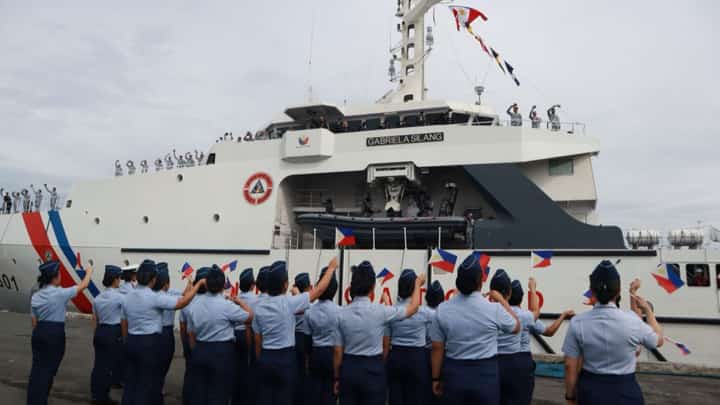
The Philippine Coast Guard (PCG) received high marks from senior military officials following its first participation in the Rim of the Pacific (RIMPAC) exercise, with the United States citing its contributions to maritime law enforcement, search and rescue, and humanitarian assistance.
RIMPAC 2026, the 30th edition of the world's largest multinational maritime exercise, brought together forces from 30 nations under the theme "Partners: Integrated and Prepared."
Vice Adm. Jeffrey T. Jablon of the U.S. Navy said the PCG quickly integrated with participating forces during the exercise.
"They really brought valuable capability to the exercise, especially in maritime law enforcement, search and rescue, and humanitarian assistance," Jablon said Wednesday during a virtual press briefing.
The Philippines deployed the BRP Gabriela Silang and BRP Miguel Malvar to this year's exercise.
Jablon commended the BRP Gabriela Silang for integrating "seamlessly" with partner nations, saying the PCG's participation reflects the growing role of coast guards in regional security and reinforces the shared commitment to a free and open Indo-Pacific.
He added that the PCG's participation underscored the strength of the U.S.-Philippines alliance and the importance of capable maritime partners in safeguarding regional waters.
Integration
Jablon said one of the biggest takeaways from RIMPAC 2026 was how quickly the multinational force operated as a single team.
"Our theme, 'Partners: Integrated and Prepared,' isn't just a theme. It's exactly what we saw on land, in the air and at sea," he said.
He said the participation of 30 nations in more than 500 maritime events demonstrated improved interoperability in detecting, tracking and responding to maritime threats.
Multinational leadership
This year's exercise also featured expanded leadership roles for partner nations.
The United States led the combined task force, while Japan served as vice commander and the Republic of Korea headed the maritime component. Chile served as deputy commander, Canada led the air component, and Japan also directed humanitarian assistance and disaster relief operations.
Rear Adm. Takuo Kobayashi of Japan said multinational leadership reflects the reality that no single country can address today's security challenges alone.
"Nations can collaborate effectively towards a shared objective," Kobayashi said.
Jablon said the leadership roles were operational rather than symbolic, allowing participating countries to contribute their respective capabilities while strengthening coordination.
Free and open Indo-Pacific
Jablon said RIMPAC's expansion from five participating nations in 1971 to 30 this year reflects the growing commitment to maintaining a free and open Indo-Pacific.
He described the PCG's debut as a significant milestone and expressed hope that coast guard participation in future exercises would continue to expand, particularly in maritime law enforcement and humanitarian missions.
RIMPAC, hosted biennially by the U.S. Pacific Fleet in Hawaii and Southern California, opened on 24 June and concludes on 31 July.