
Serbia backs Philippines as investment hub
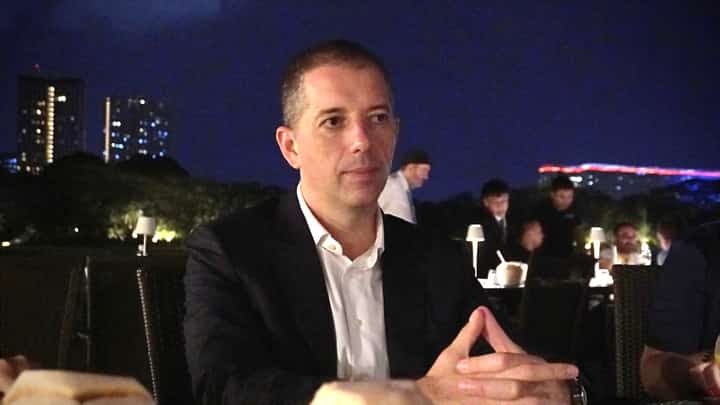
SERBIA Minister of Foreign Affairs Marko Đurić speaks to DAILY TRIBUNE at the Manila Polo Club in Makati last Thursday, 23 July.
Photo by Yuko Shimomura for DAILY TRIBUNE
MAKATI, Philippines — The Republic of Serbia has expressed support for the Philippines as an attractive investment destination while reaffirming the two countries' longstanding diplomatic ties and expanding economic partnership.
In an exclusive interview with DAILY TRIBUNE last Thursday, Serbian Minister of Foreign Affairs Marko Đurić said both countries stand to benefit from closer bilateral cooperation.
"I believe that Serbia can be one of the entry points for the Philippines into Europe, for your economy, for your businesses. But also, vice versa, I believe that the Philippines can be one of the entry points for Serbia into Southeast Asia," he said.
"And I really am impressed with what I'm seeing here in terms of both the economic development and infrastructural development, but also when it comes to the human potential that exists here — unparalleled talent, a big number of hard-working people who are also pursuing to create a modern, innovative economy," he added.
Đurić, who visited the Philippines last week for the 59th ASEAN Foreign Ministers' Meeting, highlighted Serbia's rapidly growing economy, which he said has tripled in size over the past 15 years, driven by its strategic geographic position and open trade policy.
"We tried to turn around our regional situation by opening up for cooperation with countries in the region. At the same time, we leveraged our unique position of being geographically at the center of Europe while not being subject to all European regulatory frameworks. As a result, we were able to attract 65 percent of all foreign direct investments into Southeast Europe," he said.
"We are the only country in Europe that has an active free trade agreement with China. We also have FTAs with the UAE, Turkey and Egypt, which has positioned us as an attractive destination for doing business," Đurić added.
According to the World Bank, foreign direct investment (FDI) inflows into Serbia reached 6.2 percent of gross domestic product (GDP) in 2024, among the highest rates in Europe. The sustained inflows have supported export-oriented manufacturing, technology, mining and infrastructure investments over the past decade.
"A huge part of this growth has been driven by advances in our IT and software industries," Đurić said.
"Also, by the re-industrialization of the country and by leveraging the comparative advantage of maintaining relations with countries beyond our immediate region."
By comparison, FDI inflows into the Philippines fell to pandemic-era levels in 2025 following the outbreak of the flood control scandal. The government has since sought to restore investor confidence by pursuing 10 double taxation agreements while also beginning work to adopt the Organisation for Economic Co-operation and Development's global minimum tax framework to attract more foreign investment.
Đurić also reaffirmed the strong relationship between Serbia and the Philippines, saying geographical distance should no longer be viewed as a barrier to deeper engagement.
"Serbia and the Philippines share a long, friendly, positive history of diplomatic relations. We've always been by each other's side at difficult historical intersections and moments," he said.
"I believe that in an interconnected era, in which the challenge is no border or geographic distance, we need to search for like-minded partners. And I hope to find one in the Philippines."