
Duterte defense, prosecutors spar over 'ultimate facts' in unexplained wealth charge

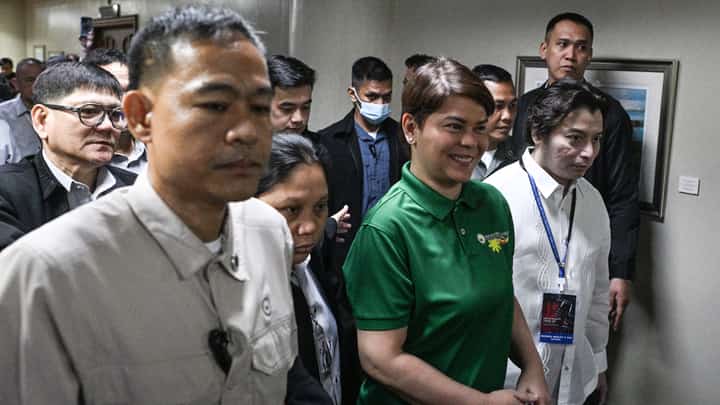
VICE President Sara Duterte, accompanied by lawyer Michael Poa, makes a surprise appearance at the Senate on Tuesday for a closed-door strategy meeting with her defense team as her historic impeachment trial unfolds. Inset: Senate President Sherwin Gatchalian confers with Senator Francis ‘Chiz’ Escudero, the presiding officer of the impeachment court, during the proceedings.
PHOTOGRAPH BY ARAM LASCANO FOR DAILY TRIBUNE/AGENCE FRANCE-PRESSE
A legal debate over what constitutes "ultimate facts" took center stage in Vice President Sara Duterte's impeachment trial on Monday, as her defense argued that one of the articles of impeachment fails to state the essential facts required by law, while House prosecutors insisted the complaint satisfies legal pleading standards.
Defense counsel Michael Poa urged the Senate impeachment court to reject evidence supporting Article II of the impeachment complaint, arguing that the accusation of unexplained wealth was built on broad conclusions rather than specific acts allegedly committed by Duterte.
"The complaint merely says that the Vice President's SALN increased from 2007 to 2025," Poa told senator-judges. "It does not identify what act she committed, when she committed it, or how she supposedly amassed unexplained wealth."
Poa argued that the complaint failed to allege what lawyers call "ultimate facts" — the essential factual allegations that constitute a cause of action — and instead relied on conclusions that were only later supplemented by evidence gathered through subpoenas.
Philippine jurisprudence defines ultimate facts as the material facts that establish a legal claim, distinct from evidentiary facts, which merely prove those allegations.
According to Poa, the prosecution only began looking for supporting evidence after Duterte had already submitted her answer before the House Committee on Justice, suggesting prosecutors were attempting to build a case retroactively.
"We filed her answer while objecting that these pieces of evidence were produced only after we had already answered," he said.
He likened the prosecution's efforts to "casting a huge net into the sea" in the hope of catching evidence to support allegations that had not been sufficiently pleaded.
The argument goes to the heart of one of the defense's central legal strategies: that the impeachment complaint itself is defective because it allegedly lacks enough factual allegations to justify the subpoenas for Duterte's tax records and other financial documents.
House prosecutor Chel Diokno countered that the defense was conflating ultimate facts with evidentiary facts.
Diokno told the court that the complaint already alleges the essential elements of unexplained wealth — that Duterte amassed wealth "manifestly disproportionate to her lawful income and earnings during her incumbency as a public official" and failed to fully disclose assets in her Statements of Assets, Liabilities and Net Worth (SALNs).
"Those are the ultimate facts. The evidentiary facts follow in the succeeding pages of the Articles,” Diokno said.
He argued that the complaint subsequently details the transactions and circumstances prosecutors intend to use to prove those allegations during trial.
Under Philippine procedural rules, pleadings are generally required to state ultimate facts rather than every piece of supporting evidence, allowing the evidence itself to be presented during proceedings.
The Supreme Court has consistently distinguished ultimate facts from evidentiary facts, holding that the former establish a cause of action while the latter merely prove it.
Responding to the defense's claim that prosecutors were engaged in a "fishing expedition," Diokno said investigators already had a factual basis before seeking additional records.
He cited testimony before the House Committee on Justice from the executive director of the Anti-Money Laundering Council, who disclosed reports showing about P6.7 billion had passed through Duterte's bank accounts from 2007 onward, including more than P3 billion during her years as Davao City mayor and vice mayor.
Those transactions, Diokno said, were reflected in covered and suspicious transaction reports submitted to the AMLC, making the subpoenas a targeted effort rather than an open-ended search for evidence.
"If we had no basis at all, that could be called a fishing expedition. But that is not the situation here," he said.