




REP's 'Man of La Mancha' Review: Worth the quest
Buencamino's Don Quixote and a uniformly strong ensemble provide the production's surest footing.

Text size
Buencamino's Don Quixote and a uniformly strong ensemble provide the production's surest footing.

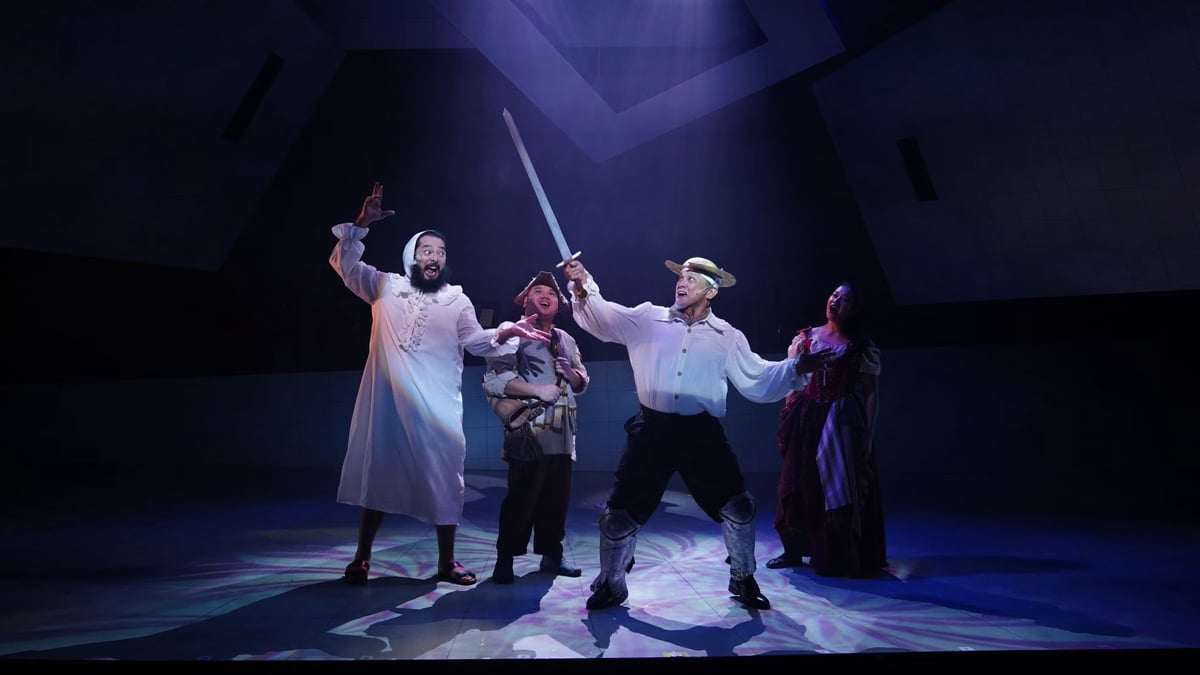
Give the Nonie Buencamino the year-end award already!
REP/Krizhal Daryl Ordas of Indio Creatives

The ensemble is uniformly strong.
REP/Krizhal Daryl Ordas of Indio Creatives
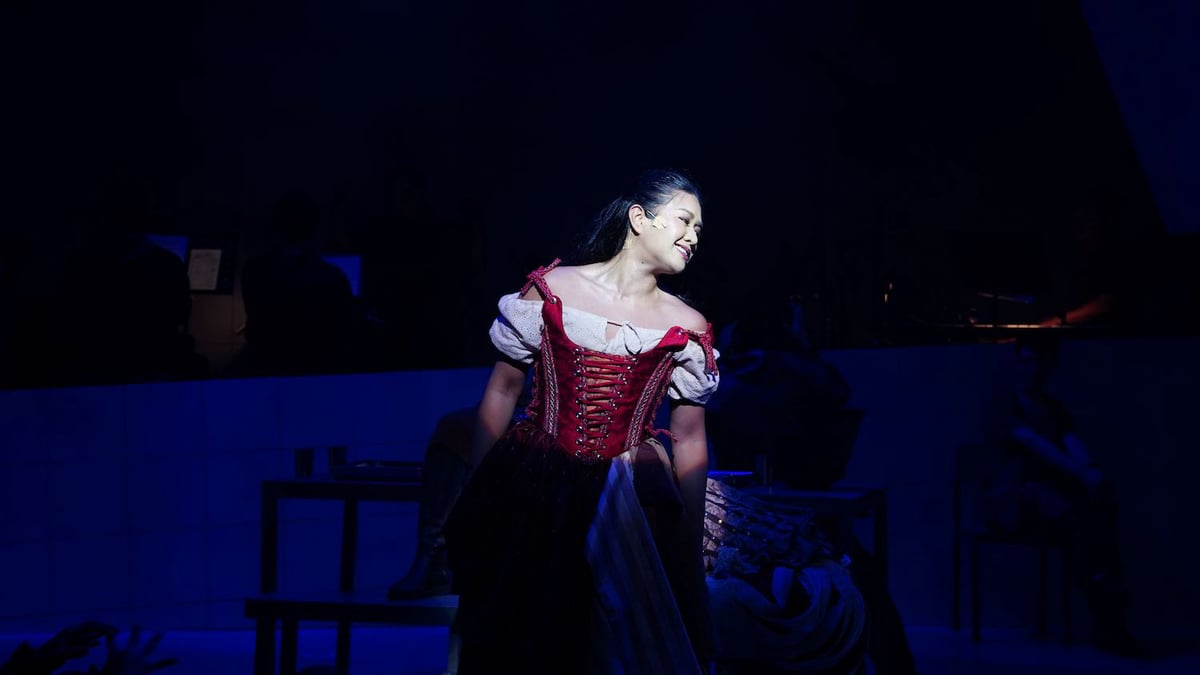
Katrine Sunga’s vocal fire and dramatic intensity make you forget technique; you believe everything she says and feels.
REP/Krizhal Daryl Ordas of Indio Creatives
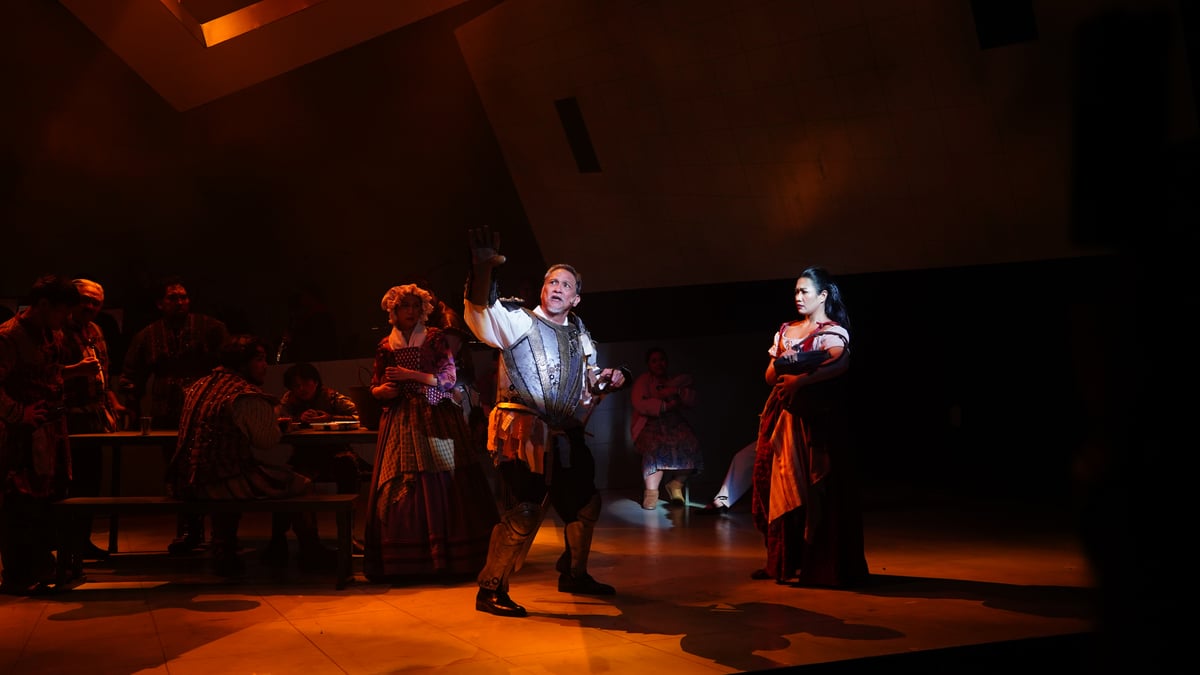
REP/Krizhal Daryl Ordas of Indio Creatives
If Superman has a heroic entrance anthem, Don Quixote has one too. His signature number, "I, Don Quixote," practically announces: Behold! I am here!
The song is grand. Noble. Earnest. Ridiculous. And irresistibly catchy.
Packed with Spanish musical colors and infused with the sweeping theatricality of classic Broadway, it recalls the heroic declarations of nineteenth-century operetta. It is impossible to miss, and even harder to forget.
And when Nonie Buencamino belts it out, the effect is electrifying. Give the man the year-end award already!
The versatile actor, our man in Man of La Mancha, does not merely sing. He sings his adventure, his worldview, his delusions. Buencamino’s vocal range is formidable, but more impressive is how completely he inhabits the role. He sings the life of an idealist, a romantic madman who marches purposefully into La Mancha, challenges windmills as though they were giants, and transforms an abused prostitute named Aldonza into a noble lady named Dulcinea through the force of his imagination.
It is a character that has endured for generations, and one that returns in Repertory Philippines' latest staging of Man of La Mancha, now playing at Eastwood Theater until 28 June. The production marks the company's third outing with the beloved musical.
Three decades after the Marcopper mining disaster devastated Marinduque’s waterways, the province is again pressing the…
Housing is probably the biggest issue affecting people the world over.
Malacañang on Monday called for a more thorough investigation into the questioned flood control projects in Taguig…
The defense on Monday backed the move by senator-judges to exclude a prosecution witness who testified on the firearms…
To the unfamiliar, the 1965 Tony Award-winning work, with a book by Dale Wasserman, music by Mitch Leigh, and lyrics by Joe Darion, is not a direct adaptation of Miguel de Cervantes' novel Don Quixote. Rather, it evolved from Wasserman's own teleplay, I, Don Quixote, itself inspired by Cervantes' beloved classic.
Set in seventeenth-century Spain and populated by friars, governors, innkeepers, muleteers, and dreamers, the musical unfolds as a play within a play. At its center is Miguel de Cervantes himself: a failed actor, struggling poet, and tax collector imprisoned alongside his servant, Sancho Panza, after foreclosing on a monastery.
Inside prison walls, fellow inmates stage a mock trial. To defend himself, Cervantes proposes a performance about an aging dreamer named Alonso Quijana, who renames himself Don Quixote and embarks on a quest to revive the ideals of chivalry and justice.
Director Nelsito Gomez and set designer Julio Garcia reimagine the musical's traditional dungeon setting as a contemporary detention facility: a cold, stark institutional environment dominated by a floor-to-ceiling chain-link fence and towering walls. Instead of the robes and ecclesiastical authority of the Spanish Inquisition, this reimagining features ICE agents in tactical vests, visored helmets, and riot shields. And instead of the atmosphere of sixteenth-century Spain, it presents a world of present-day confinement, surveillance, and state power.
The monochromatic shades of gray and angled walls recall modern prison architecture, while the tiled surfaces reinforce a sense of rigidity and confinement. Suspended above the stage is a glowing rectangular frame that functions simultaneously as a practical lighting element and a symbolic cage hanging over the characters.
This austere detention-center aesthetic strips away the warmth and romanticism traditionally associated with Don Quixote's world. And even as the fantasy unfolds, the audience remains conscious of the prison surrounding it.
But there is genuine excitement when the prison's side panels open, like walls disappearing, as Cervantes' in-jail theater begins, opening the imagination to inns, roads, castles, and battlefields. The same excitement returns whenever Alonso Quijana opens his trunk and begins pulling out costumes and props. Characters emerge. Stories emerge. Entire worlds emerge. The audience witnesses theater being created before its eyes.
And what the production occasionally loses in visual warmth, it regains through its performers. The ensemble is uniformly strong.
At the center of the evening is Buencamino in a performance of remarkable depth, stamina, and precision. Playing Miguel de Cervantes, Alonso Quijana, and Don Quixote, he carries the production with seemingly effortless authority. At 59, his stamina is astonishing, but even more impressive is the clarity with which he differentiates the three identities.
His gait, posture, and bearing instantly communicate the knight's peculiar blend of nobility, idealism, and delusion. One completely believes that this man sees castles where others see inns and giants where others see windmills.
Most importantly, Buencamino never reduces Don Quixote to parody. He plays him with dignity. Vocally, he remains magnificent. His rendition of "The Impossible Dream" is emotionally resonant, technically assured, and delivered with complete sincerity.
Equally impressive is Katrine Sunga as Aldonza. And give her a year-end award already, too! Sunga’s vocal fire and dramatic intensity make you forget technique; you believe everything she says and feels. Her voice possesses strength, texture, and emotional honesty, which make Aldonza/Dulcinea a fully realized character.
Meanwhile, the ever-competent Marvin Ong's Sancho Panza serves as the show's emotional heart. With Ong’s impeccable comic timing and naturally warm stage presence, he delivers one of the evening's most enjoyable performances. His rendition of "I Like Him" becomes a comic standout because he invests the song with genuine affection. Also, the bright-eyed admiration he directs toward Don Quixote makes Sancho's loyalty entirely believable. His chemistry with Buencamino is equally convincing.
Additional standouts include Stephen Hotchkiss as Padre, whose authority and vocal strength sweep you away, and Tariq El-Tayek as the Innkeeper-Governor, who delivers a commanding and memorable performance.
And, of course, the music. For audiences who love the score, this production is richly rewarding.
Songs such as "Man of La Mancha," "Dulcinea," "Little Bird, Little Bird," "I'm Only Thinking of Him," and "The Impossible Dream" continue to soar decades after they were written. The melodies remain memorable, the orchestrations lush, and the emotional impact undeniable.
A few technical concerns, though. Because the orchestra is partially visible, audience members seated higher in the theater may occasionally find themselves watching the musicians rather than the actors. It is a minor distraction, but a distraction nonetheless.
More significant were issues with lighting and sound. From my seat in Row J Center at the 5 June gala, there was one point at which I was blinded by the lights. The audio volume also reached such intense levels that I had to literally cover my ears, while my Apple Watch repeatedly triggered loud-noise warnings.
Whether these issues were specific to certain seating locations or some broader calibration errors is difficult to determine.
But despite these technical concerns, REP has delivered a production of exceptional quality.
For longtime admirers of Man of La Mancha, this staging offers a thoughtful and skillfully executed interpretation of a beloved classic. For newcomers, it serves as an excellent introduction.
Sure, taste is subjective, and not every audience member will leave believing in Don Quixote's impossible dream. But many will leave believing in the enduring power of live theater.
