
Philippines urged to lead ASEAN on high seas treaty implementation
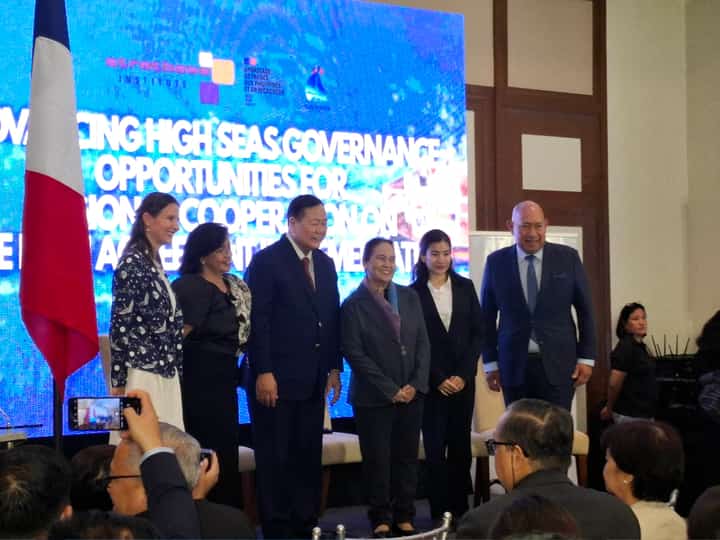
Forum for the regional implementation of the Biodiversity Beyond National Jurisdiction (BBNA) on Tuesday, 9 June, at the Manila Polo Club.
Jose Gole Cruz
The Philippines is in a strategic position to lead Southeast Asia in implementing the landmark Biodiversity Beyond National Jurisdiction (BBNJ) treaty, with experts and diplomats calling for stronger regional cooperation to protect the world's high seas and marine biodiversity.
During a forum organized by the French Embassy in Manila and the Stratbase Institute on 9 June in Taguig City, government officials, scientists and legal experts highlighted the country's role as the apex of the Coral Triangle and current chair of the Association of Southeast Asian Nations (ASEAN).
The discussions also coincided with the approaching tenth anniversary of the 2016 arbitral ruling on the West Philippine Sea, underscoring the importance of preserving marine ecosystems within and beyond national jurisdictions.
The Philippines became the 65th state to ratify the BBNJ treaty on 23 September 2025, placing it in a key position to help build a common ASEAN approach ahead of the United Nations Climate Change Conference (COP31), where implementation of the agreement is expected to take center stage.
The BBNJ, also known as the High Seas Treaty, establishes mechanisms for creating marine protected areas, conducting environmental impact assessments, ensuring equitable sharing of marine genetic resources and strengthening capacity-building efforts for developing nations.
Stratbase Institute President Victor Andres "Dindo" Manhit said the Philippines' marine environment is inseparable from the health of the high seas.
"Our waters are deeply connected to the rest of the world. The health of our national waters is linked to the health of the high seas, in the same way that what happens within Philippine waters reverberates across the globe, and what happens in the high seas shapes the future of our fisheries, coastal communities and marine ecosystem," Manhit said.
French Ambassador Marie Fontanel said the rapid pace of ratifications reflects the growing urgency of ocean protection, noting that less than one percent of the high seas currently enjoy any form of protection despite a global target of conserving 30 percent of the world's oceans.
She also reaffirmed France's partnership with the Philippines, including support for a scientific expedition involving the University of the Philippines Marine Science Institute and the Tara Foundation.
At present, 89 of the 193 United Nations member states have ratified the treaty, which entered into force in January 2026.
The Department of Environment and Natural Resources said the government has already begun strengthening ocean governance through the creation of an Ocean Environment Task Force in 2025 and the drafting of a National Ocean Environments Policy that will guide marine management, stakeholder engagement and capacity development.
Officials are also studying amendments to existing environmental laws, including the Wildlife Resources Conservation and Protection Act, to align domestic legislation with the treaty's provisions on marine genetic resources and biodiversity conservation.
Scientists emphasized that implementation must extend beyond visible marine life.
André Abreu de Almeida, head of international policy for the Tara Foundation, said marine genetic resources largely involve plankton, microscopic organisms that account for 80 percent to 90 percent of life in the high seas and play a critical role in sustaining ocean ecosystems and advancing biotechnology research.
He called for greater investment in genomics, satellite observation, microscopy and bioinformatics, as well as stronger scientific representation in the treaty's technical bodies.
University of the Philippines Marine Science Institute scientist and National Academy of Science and Technology academician Dr. Rhodora Azanza urged the government to future-proof marine management through marine spatial planning and expand maritime education across all levels of society.
Former Supreme Court Associate Justice Antonio Carpio also warned that the Philippines must continue asserting its rights in the West Philippine Sea.
Carpio noted that although China ratified the BBNJ treaty in December 2025, it maintains that there are no high seas in the South China Sea. He cautioned that under the international law doctrine of acquiescence, a state's failure to protest a claim within a reasonable period could be interpreted as consent.
"If the High Seas Treaty is left unapplied in the South China Sea, it may imply that it would not be applied elsewhere," Carpio said.