
Drilon says remote voting push tied to Sara impeachment trial
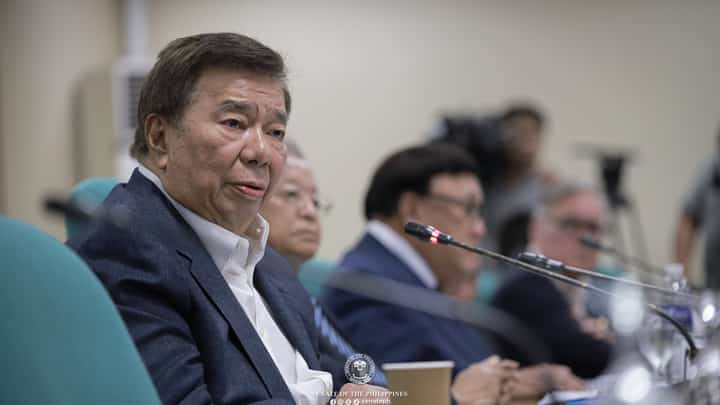
The aggressive push by the Senate majority bloc to amend the rules to allow remote participation and online voting, amid a threat of an arrest warrant against their colleagues, boils down to the impending impeachment trial of Vice President Sara Duterte, former Senate president Franklin Drilon asserted Wednesday.
Drilon speculated that the ulterior motive behind the effort is not merely to enable senators to take part in the law-making process regardless of whether they are physically present in sessions, but also to defeat the minority—who are obviously outnumbered—in crucial voting when the trial begins.
This could happen when there is a motion to subpoena Duterte’s bank records during the trial. Drilon explained that in the event that Senate President Alan Cayetano rejected such a motion as a presiding judge, the same could be appealed by the minority on the floor.
However, if the current Senate rules remain unchanged, Cayetano and allies are likely to lose the vote to the 11-member minority bloc, allowing the Senate impeachment court to compel Duterte’s financial records to be disclosed and undergo scrutiny amid allegations of graft and corruption.
“So, it is very crucial now that electronic voting be allowed because personal presence would not be possible and muster the necessary votes to sustain [the] denial of the subpoena on the bank records. So they all connected to the impeachment trial,” Drilon told ANC’s Headstart. “Maybe the minority would still have no 13 votes to reorganize, but in terms of the issues being voted upon, then the present majority would not have the numbers to carry out the measure, or any motion on the floor.”
The minority bloc, led by ousted Senate president Tito Sotto, staged a walkout during a session late Tuesday in protest against amending Rule 14, Section 41 of the Senate Rules introduced by Senator Rodante Marcoleta. The move aims to allow senators—for justifiable reasons—to attend and participate in sessions via videoconference or other forms of electronic means.
Under the current Senate's rules, virtual participation is allowed only during force majeure or unexpected and uncontrollable circumstances, or during emergencies such as the Covid-19 pandemic.
The so-called “Solid Bloc 11” assailed Marcoleta’s proposal, which was strongly backed by Cayetano, who firmly insisted on dividing the house despite the debate still being ongoing. Opposition senators accused Cayetano and allies of “railroading the process,” citing Senate rules that any amendments to the same must be presented to the floor one day before its consideration.
They derided the move as a veiled effort to allow allies like Senators Bato de la Rosa, Jinggoy Estrada, and Joel Villanueva to participate in congressional proceedings amid threats of a warrant.
De la Rosa has an outstanding warrant from the International Criminal Court, while Estrada and Villanueva could face the same following the Ombudsman’s pronouncement that plunder and corruption-related charges are set to be filed against them at the Sandiganbayan over their alleged involvement in the flood control anomalies.
The walkout resulted in a lack of quorum, forcing an adjournment that effectively halted the majority’s plan to amend the rules.
The move has drawn mixed reactions from critics and political observers, although Drilon argued that it was “necessary because that was the only way to prevent the tyranny of the majority.”
‘Abuse of discretion’
Drilon, a former Justice secretary, lamented the acts of Cayetano and allies in the majority in rushing the amendments as a blatant show of “abuse of discretion,” warranting Supreme Court intervention.
Furthermore, he averred that it would set a bad precedent, adding that it would be unfair to previous senators like the late Juan Ponce Enrile, Leila de Lima, and Senator Sonny Trillanes, who were strictly not allowed to attend sessions, much less vote, while they were detained.
Citing Senate rules, the erstwhile Senate leader also emphasized that Marcoleta’s proposal should have been referred to the committee on rules, which would subsequently issue a report to be tackled in the plenary.
“The report was forced to be released even though the committee on rules was not constituted. This is a clear abuse of discretion; the Supreme Court should intervene,” he argued.
According to Sotto, if the committee on rules was truly constituted, he would have known, as he is an ex officio member. In concurring, the minority senators pointed out that the recent leadership revamp left all committees vacant, making it improbable to hold hearings and release the report.
On the contrary, Cayetano argued that the Senate rules also allow that the plenary may decide by majority vote whether to take up a motion to amend the rules, even without committee endorsement.
“If you look at Section 136 of our Rules, you do not need the endorsement, nor the forwarding of the committee of rules for the amendment of the rules… right now that’s irrelevant because we have given back to the plenary the proposal,” the Senate chief said on Tuesday during the intense debate.
Marcoleta first introduced the motion to amend the Senate rules on 11 May. However, Senator Kiko Pangilinan argued that the motion had already lapsed, and the one raised on Tuesday must take precedence.
Thus, the minority contended that they would take it up on Monday. Congress only holds sessions from Monday to Wednesday, but since 27 May is a holiday, in observance of Eid al-Adha, the session will resume on Monday, 1 June.
Cayetano’s insistence on dividing the house for voting prompted the minority to walk out of the session hall, leaving only Sotto, who later moved for the adjournment for a lack of quorum.