
ICC confirms Duterte suffered fall on 'rare occasions' but not a basis for interim release
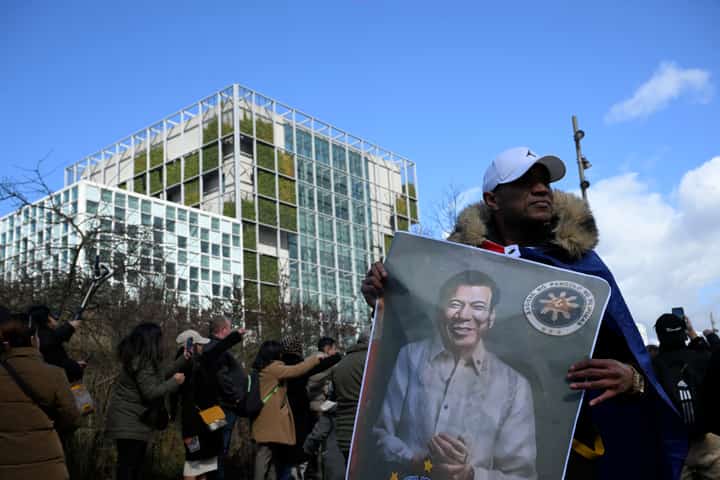
[FILE PHOTO] A man holds a portrait of former Philippines president Rodrigo Duterte in front of the International Criminal Court (ICC) where he will be appearing, in The Hague on March 14, 2025. Philippine ex-president Rodrigo Duterte was expected to make his first appearance at the International Criminal Court on 14 March to face crimes against humanity charges over his deadly narcotics crackdown. The 79-year-old was set to appear before judges for a short hearing where he is to be informed of the crimes he is alleged to have committed, as well as his rights as a defendant.
Nicolas TUCAT / AFP
The International Criminal Court has confirmed that former president Rodrigo Duterte had suffered a fall on “rare occasions” inside his detention cell in The Hague, though not as severe as alleged by his lawyer to warrant an interim release.
The Trial Chamber III ordered the court’s Registry to submit its observations on Duterte following a petition by his former lead counsel, Nicholas Kaufman, for a fresh review on whether his continued detention remains necessary.
Before he resigned from the defense team earlier this month, Kaufman requested that the Trial Chamber launch another medical review of Duterte’s health.
Kaufman alleged that Duterte has “experienced frequent episodes of falls occasioned by a loss of balance,” making him incapable of fleeing and obstructing the proceedings. These two grounds were previously cited by the Pre-Trial Chamber I and Appeals Chamber as justification for his continued detention.
In a filing dated 20 May, the Registry said Duterte did have a fall “on rare occasions,” although their medical team was always able to respond immediately.
“Following these rare events, adjustments have been made to his cell to better accommodate his comfort and movement and are adjusted as needed,” the submission reads.
The Registry added that Duterte has also been placed under strict surveillance, and that, “There has not been any fall recorded in the last 30 days.”
As for the loss of balance, the Registry said this is only “consistent with his age and mobility.”
Nonetheless, it assured that Duterte’s medical condition remains under “constant attention.”
“The use of cell monitoring…helps to optimize his care, which is why it continues to be reviewed and may be ordered every 14 days until the MO (medical officer) no longer deems it necessary,” the filing further reads.
Kaufman had long argued that the risk factors under Article 58(1)(b) of the Rome Statute—which outlines the grounds for a suspect’s continued detention—can no longer be actualized by Duterte due to his advanced age and “frail” condition.
As a result, this warrants his temporary release from ICC detention pending his trial.
However, their bid was twice denied by the ICC, maintaining that the 81-year-old Duterte remains a flight risk and poses a threat to potential witnesses in his case once released.
In confirming the crimes against humanity of murder against Duterte in April, the Pre-Trial Chamber I ruled that there are “substantial grounds” to believe that the former president is “criminally responsible” for the alleged extrajudicial killings linked to the drug war.
This includes the killings of 78 individuals, including six children, allegedly suspected of drug dealings from 2013 to 2018, spanning his tenure as Davao mayor and as president.
It also covered the killings by the so-called Davao Death Squad, which was founded and headed by Duterte, as alleged by ICC prosecutors.