
Trump-Xi Summit: Were we even on the agenda?
While the Trump-Xi summit agenda spoke volumes, the South China Sea barely registered, signaling that Filipino interests were subordinated to the larger transactional calculus between the two superpowers.

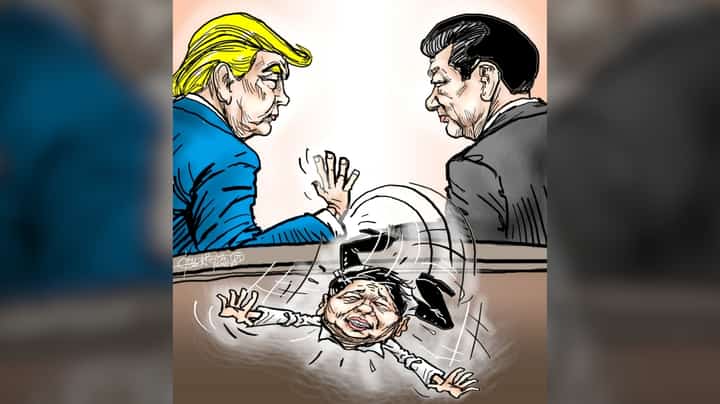
As Donald Trump and Xi Jinping sat across from each other in the Great Hall of the People, the grandeur of the moment masked a quieter, sharper anxiety felt thousands of miles away — on a tiny outpost administered by the Philippines since the 1970s called Pag-asa (Thitu), the second largest of the Spratly Islands in the hotly contested West Philippine Sea.
For smaller US allies across the Indo-Pacific, what transpired at the summit may matter as much for what was left unsaid as for any formal agreements that were reached.
The summit’s stated framework was one of “constructive strategic stability” — a phrase in Beijing’s readout that signaled both powers’ preference for managed, predictable rivalry over open confrontation.
On its face, that sounded reassuring. In practice, for a country like the Philippines, sitting astride the fault lines of the South China Sea, stability between Washington and Beijing could easily come at Manila’s expense.
The backdrop was already unfavorable for US allies in Asia. Experts noted that the ongoing war on Iran had led Washington to divert military resources away from the Indo-Pacific to the Middle East — a shift that gave China greater leverage over Trump, particularly in any scenario involving the South China Sea.
Meanwhile, a brief by the Washington-based think tank, Center for Strategic International Studies (CSIS), warned that the US military would face serious challenges in a protracted conflict with China, citing shortfalls in long-range munitions and air defense systems and vulnerable bases across the region.
This is the strategic vacuum that China may step into. Beijing’s coercive behavior in the South China Sea has been steadily escalating, with serious incidents involving the Philippines, including a Chinese helicopter recently flying within three meters of a Philippine patrol aircraft near Scarborough Shoal, and paramilitary vessels forcing Philippine scientific teams to abandon their surveys near Thitu Island.
China claims most of the South China Sea, including Philippine-occupied Spratly Islands, despite a 2016 international tribunal ruling that found Beijing had no legal basis for its sweeping claims.
Trump has been characteristically ambivalent about his commitment to Manila.
While the Pentagon announced a “Task Force Philippines” to strengthen maritime security cooperation, serious questions remain about just how high defending the Philippines under the Mutual Defense Treaty ranks on Trump’s priorities.
His pursuit of improved relations with Xi signals a deliberate effort to avoid disruptions — including in disputes that Washington’s own National Security Strategy appears to implicitly frame as China’s sphere of influence.
The summit’s agenda spoke volumes. The dominant topics were trade, Iran, the Strait of Hormuz, and Taiwan, which Xi called “the most important issue” in US-China relations. The South China Sea barely registered, signaling that Filipino interests were subordinated to the larger transactional calculus between the two superpowers.
The most likely scenario emerging from Beijing is not a dramatic betrayal of the Philippines, but something more insidious: a managed silence.
Trump and Xi will agree to a strategic stability, trade tensions will ease, and China — reassured that the United States is distracted and transactionally minded — will quietly continue its aggressive gray-zone behavior in the West Philippine Sea, incrementally, just below the threshold of an open conflict.
For Spratly Island’s residents hoping for a positive outcome from the Trump-Xi meeting, the real danger is that the world’s two most powerful nations will find their stability precisely by leaving smaller countries like the Philippines to navigate an increasingly hostile sea — alone.