
Fortinet: AI-powered threats reshape cyber battlefield

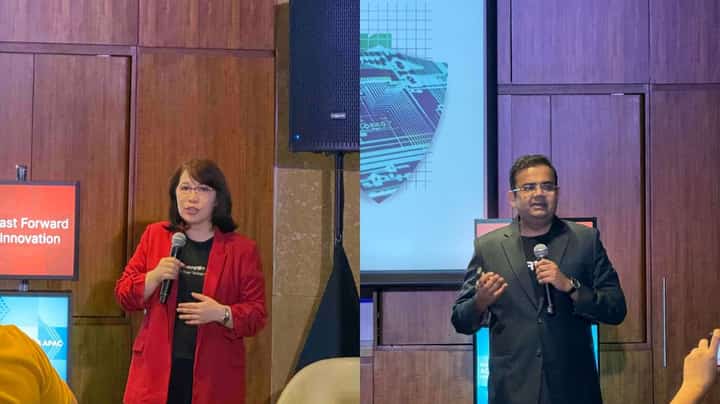
AI vs. AI. Fortinet Philippines country manager Bambi Escalante (left) and Asia and ANZ vice president for marketing and communications Rashish Pandey warn that artificial intelligence is reshaping the cyber battlefield, with organizations racing to defend against faster and more sophisticated AI-driven attacks. |
Photograph by Carl Magadia for DAILY TRIBUNE
Artificial intelligence is rapidly reshaping the cybersecurity landscape in the Philippines, with organizations struggling to keep pace as AI-driven attacks become faster, more scalable, and more difficult to detect, according to a new study presented by cybersecurity firm Fortinet.
Speaking during Fortinet Accelerate APAC Philippines Edition 2026, Fortinet executives said cybercrime has evolved from isolated attacks into a highly organized, profit-driven industry increasingly powered by AI.
“Gone are the days that the bad actors are hobbyists,” said Bambi Escalante, country manager of Fortinet Philippines.
“The groups have banded together, they operate like an enterprise. Their main goal is to monetize.”
Fortinet cited findings from a Forrester Consulting study covering 585 cybersecurity leaders across Asia-Pacific, including respondents from the Philippines.
The study found that 57 percent of organizations now consider AI-driven threats as their top cybersecurity risk, while 54 percent cited fragmented tools and systems as a major factor increasing vulnerability.
Rashish Pandey, Fortinet vice president for marketing and communications for Asia and ANZ, said AI is accelerating both the scale and sophistication of cyber attacks.
“AI doesn’t just help the good guys, it also helps the bad guys,” Pandey said.
He noted that attacks that previously took weeks or months to prepare can now be executed within hours using generative AI tools.
The study also found that 50 percent of organizations are struggling with “alert overload,” where security teams are overwhelmed by massive volumes of security notifications, making it harder to identify legitimate threats.
At the same time, cybersecurity maturity across the region remains limited, with 68 percent of organizations classified at only an intermediate stage of readiness.
Fortinet warned that many companies continue to rely on fragmented cybersecurity systems, often juggling 20 to 40 separate security tools.
According to Pandey, this complexity is now becoming a cybersecurity risk itself.
“What you cannot see, you cannot control,” he said.
The company said businesses are now shifting toward platform-based security architectures that integrate networking, visibility, automation, and AI into a single system.
While only 20 percent of organizations currently operate unified security platforms, the figure is projected to rise to nearly 60 percent within the next two years.
Fortinet, which reported $8 billion in revenue over the past 12 months and serves more than 900,000 customers globally, positioned itself as a major player in the shift toward integrated cybersecurity systems.
“It is very important that the cybersecurity vendor is financially stable because we are securing mission-critical operations,” Escalante said.
The company also highlighted growing concerns over cybersecurity talent shortages, particularly as organizations now seek professionals with AI-related security skills.
Fortinet executives said AI will increasingly become central to cybersecurity operations, but warned that fragmented systems and disconnected data environments could limit its effectiveness.
“AI can only deliver meaningful outcomes when it is built on an integrated foundation,” Pandey said.