
EV program awaits PBBM’s approval — DTI
This is to incentivize manufacturers, including Toyota and Mitsubishi, and other companies to set up a manufacturing and assembly plant here in the Philippines for electric vehicles. Both the incentives will be whether hybrid plus electric, or pure electric.’
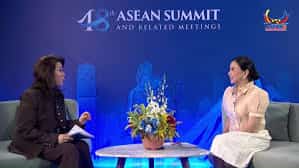
DTI Secretary Christina Roque (right) sits for an interview with broadcast journalist Cathy Yang at the International Media Center, Mactan World Museum, Lapu-Lapu City, Cebu.
Photograph courtesy of Radio-TV Malacañang
MACTAN, CEBU — Trade Secretary Christina Roque said the Electric Vehicle Incentive Strategy (EVIS), a flagship program aimed at boosting local EV manufacturing, which targets production of four million locally produced e-vehicles (two-wheelers, e-trikes, e-PUVs) in 10 years, is awaiting approval of President Ferdinand Marcos Jr.
“Once we get approval for that, then it is ready to go. This is to incentivize manufacturers, including Toyota and Mitsubishi, and other companies to set up a manufacturing and assembly plant here in the Philippines for electric vehicles. Both the incentives will be whether hybrid plus electric, or pure electric,” said Secretary Roque during a fireside chat at the ASEAN Summit 2026 at the International Media Center here.
The DTI earlier said that EVIS includes fiscal support and replaces the previous Revitalizing the Automotive Industry for Competitiveness Enhancement (RACE) program, focusing on e-PUVs and green metals.
Transport groups inclined to shifting to EVs
Meanwhile, Roque said the DTI team just had a public utility vehicle (PUV) drivers in Bacolod City. “They are really looking forward to shifting from combustion vehicles to electric vehicles, especially with this loan that the Small Business Corporation is rolling out. They have already started to talk to tricycles, jeepneys, and bus suppliers. It is very important for us now to provide financial assistance to enable them to shift, as the savings can go from 33 percent to 80 percent,” she said.
“Especially since there is a fuel crisis now, it is very timely to shift,” Roque stressed.
The DTI-SBCorp is offering a P2-billion E-Transport Loan program to help transport operators and drivers transition to electric vehicles (EVs). It provides up to P1.5 million per unit (maximum of P3 million per borrower) with a 5-year repayment term, 0 percent interest for the first year, and a one-year grace period.
As charging stations for e-vehicles remain scarce, Roque said DTI has already talked to EV manufacturers to establish more charging stations, particularly where the PUV transport groups who will acquire the e-jeepneys will be operating.
“We provide the loans to the transport groups, but we cannot tell them where to buy the e-vehicle, so it’s up for them to choose. The companies have also assured that they will cooperate by putting up more charging stations. In return, I also assured them that we will take a whole-of-government approach so that it will be easier for them to put up charging stations in the different provinces, in partnership with LGUs. This is ASAP,” Roque said.