
Manila ramps up energy security push with Japan
Kishida is Supreme Adviser to the Asia Zero Emission Community, the Japanese-led initiative launched in 2023 to promote decarbonization across Asia, and is the Special Envoy for the Japanese government on energy security and regional cooperation.

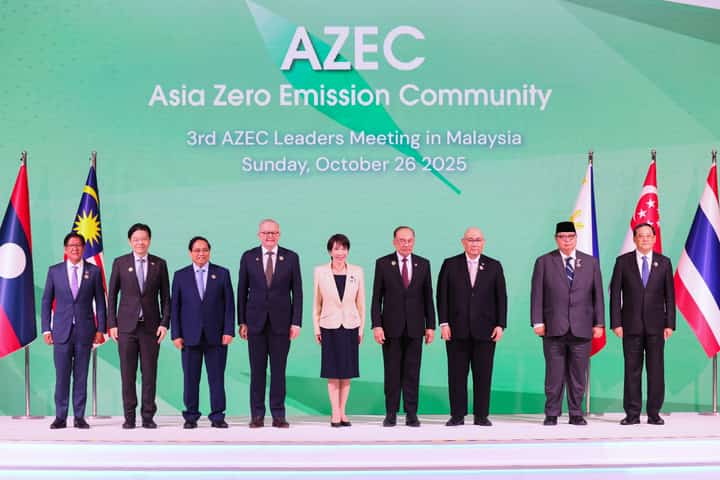
Facing rising energy risks, the Philippines is turning to Japan to strengthen supply security and accelerate its transition under the Asia Zero Emission Community (AZEC) as it seeks to secure a stable power supply amid global uncertainty.
The Asia Zero Emission Community (AZEC) is a Japanese-led initiative launched in 2023 to promote decarbonization across Asia while balancing energy security and economic growth. It serves as a framework for 11 partner countries to cooperate on energy transitions using varied, country-specific pathways.
On Saturday, the Stratbase Institute said that the recent visit of former Japanese Prime Minister Fumio Kishida, who currently acts as Supreme Adviser to the Asia Zero Emission Community (AZEC) who met with President Ferdinand Marcos Jr. and Energy Secretary Sharon Garin, underscored the growing urgency of energy security in the country’s policy agenda.
No longer just an economic concern
“Energy security is no longer merely an economic concern. It is now a strategic imperative tied directly to national resilience, long-term competitiveness, and sovereign decision-making,” the think tank said.
According to Stratbase, AZEC provides a framework for the Philippines to strengthen supply security while attracting investments and advancing its transition to cleaner energy.
The Philippines is also set to co-host the 4th AZEC Leaders’ Meeting in November as it expands its role in regional energy cooperation.
Energy deals could pose geopolitical risks
However, the institute cautioned against energy deals that could pose geopolitical risks.
“Any energy arrangement that comes with implicit or explicit concessions in the West Philippine Sea… directly undermines the country’s sovereign and national interests,” it said.
Accelerate AZEC initiatives
Stratbase thus urged the government to accelerate AZEC initiatives and pursue concrete energy projects with Japan and other like-minded partners to boost long-term resilience.
Under the Philippine Energy Plan, the country targets a 35 percent share of renewable energy by 2030 and 50 percent by 2050, but remains heavily reliant on fossil fuels to meet near-term demand.