
Higher rice prices prompt farmers to boost planting, DA says

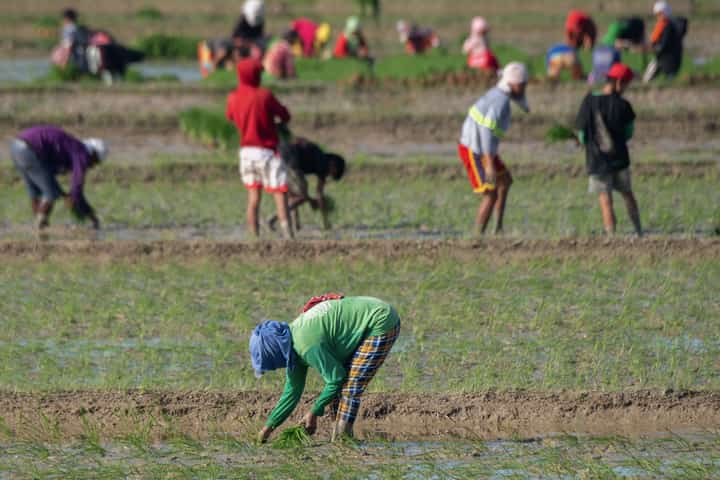
Farmers plant rice at a field in Nara town, Palawan province. The Department of Agriculture, through the National Food Authority, has resumed palay procurement to support local farmers amid low traders’ prices.
Photo by Ted ALJIBE/Agence France-Presse
Rising farmgate prices are beginning to draw farmers back into rice production, with the Department of Agriculture (DA) expecting stronger harvests and increased planting in the coming seasons after a period of losses that dampened output.
Agriculture Secretary Francisco P. Tiu Laurel Jr. said the sharp recovery in palay prices is restoring confidence in the sector, reversing earlier decisions by farmers to scale back planting due to weak returns.
“Many farmers decided not to plant last season because they were still recovering from losses when palay prices were between P10 and P12 per kilo,” he said. “This harvest season, we are seeing prices improve to P22 to P27 per kilo, and we hope this continues so farmers are encouraged to plant more for the next season.”
He added that the improving price environment is expected to support a stronger dry-season harvest while influencing planting intentions for the next crop cycle, signaling a turnaround for the industry.
The rebound follows a difficult period when farmgate prices dropped below production costs, falling to as low as P8 per kilo in some areas. The slump forced many farmers to delay or abandon planting, contributing to lower output.
Government measures helped stabilize the market, including a temporary restriction on rice imports between September and December ordered by President Ferdinand Marcos Jr., which tightened supply and lifted local prices.
Despite the improving outlook, recent data still reflects the impact of last year’s disruptions. Palay production in the first quarter declined to 4.4 million metric tons from 4.69 million metric tons a year earlier, as crops were planted during a period marked by low prices and adverse weather.
Typhoons in late 2025 also damaged key rice-producing areas such as Cagayan Valley and Western Visayas, while irrigation constraints further limited output. Around 37,000 hectares served by the Upper Pampanga River Integrated Irrigation System were affected, reducing water supply to farms.
To sustain the recovery, the Department of Agriculture said it is continuing support programs, including subsidies for fertilizer and fuel, faster distribution of farm inputs, and expanded financial assistance. A voucher system is also being studied to improve access to inputs and lower production costs.