
Villaroman: Aboitiz powers renewable energy future
‘We are not just building power plants. We are building the backbone of a resilient, self-sufficient and low-carbon Philippines.’

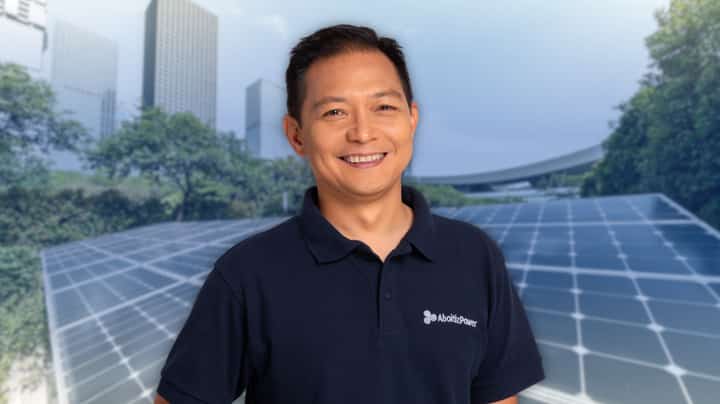
Quiet confidence, bold vision Aboitiz Renewables Inc. president James ‘Jimmy’ Villaroman speaks with calm conviction about the accelerating shift to a decarbonized future. The company he helms is defining the nation’s clean-energy transition.
Photographs courtesy of Aboitiz Renewables
James “Jimmy” Villaroman, president of Aboitiz Renewables Inc., spoke with quiet confidence about the accelerating shift toward a decarbonized energy landscape.
As the renewable energy (RE) arm of AboitizPower, the company he leads is defining the energy transition. “We are not chasing targets,” Villaroman told DAILY TRIBUNE.
“We are building the infrastructure that will make those targets inevitable.”
AboitizPower, with its partners, already stands as the country’s largest owner and operator of renewable energy based on installed capacity.
The RE journey tells a story of deliberate, rapid scaling. From less than one gigawatt of attributable net sellable renewable energy capacity in 2020, the portfolio has more than doubled to 2.3 gigawatts as of February 2026.
Solar has driven much of the recent growth, but the landmark acquisition of the 789-megawatt Caliraya-Botocan-Kalayaan (CBK) Hydroelectric Power Plant Complex in Laguna has reshaped the company’s capabilities overnight.
The CBK turnover in February 2026 was a strategic inflection point as the complex, particularly its Kalayaan pumped-storage units, functions as a massive battery for the Luzon grid.
It stores excess energy during periods of high renewable output and dispatches power instantly when demand spikes or the sun dips.
For Villaroman, the “CBK is more than an asset,” he explained. “It is now a cornerstone of our renewable energy portfolio and part of a larger ecosystem of clean energy that powers homes, businesses, schools, and hospitals.”
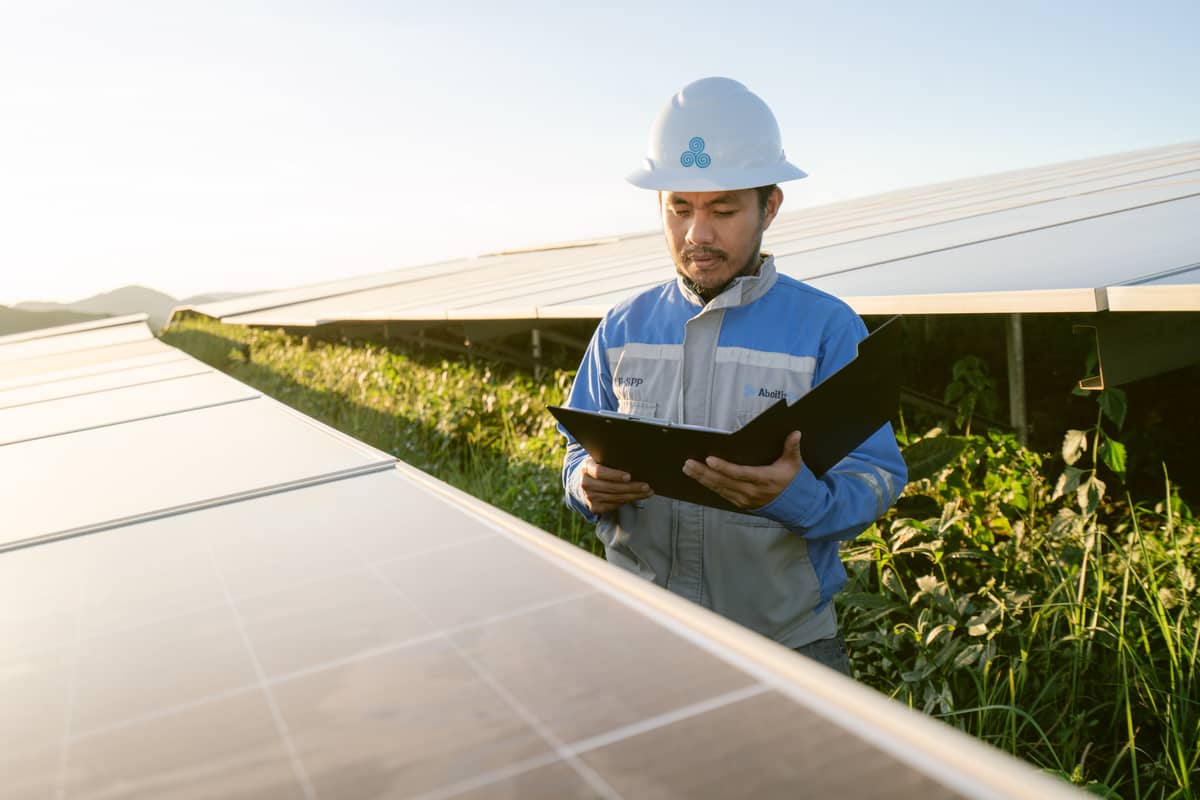
Sunlight meets stewardship An Aboitiz Renewables engineer runs a careful review across a gleaming panel at the 95-MWp Cayanga-Bugallon Solar Farm in Pangasinan, where repurposed sloping land now harvests tomorrow’s power.
Together with the existing Makban geothermal facility in Laguna, Aboitiz Renewables now operates over 1,200 megawatts (MW) of renewable capacity in the province alone.
The addition of CBK has pushed the company’s total installed dependable capacity above three gigawatts, with hydropower accounting for 57 percent of the portfolio.
The balanced mix, solar for daytime generation, hydro and pumped storage for dispatchable power, and geothermal for baseload, gives Aboitiz Renewables a unique edge in delivering firm, continuous clean energy.
The solar build-out that preceded CBK was equally massive. In October 2025, the 93-megawatt-peak (MWp) San Manuel solar power plant in Pangasinan came online, its third facility in the province and the company’s sixth overall.
Earlier that year, the 173-MWp Calatrava solar project in Negros Occidental secured its Final Certificate of Approval to Connect, becoming the largest operating solar PV farm in the Visayas.
The project earned Aboitiz Renewables the “Independent Power Producer of the Year” award at the 2025 Asian Power Awards in Kuala Lumpur.
“We appreciate NGCP (state grid operator National Grid Corporation of the Philippines (NGCP) for working closely with us,” Villaroman said.
The facility helps distribution utilities meet their Renewable Portfolio Standards obligations while advancing national energy-transition goals. These projects were not built on prime farmland.
The 95-MWp Cayanga-Bugallon and 159-MWp Laoag solar plants in Pangasinan sit on repurposed, non-arable, sloping ground.
The 47-MWp Armenia solar facility in Tarlac, energized in November 2024, was the company’s first in Central Luzon. Even the pioneering 59-MWp San Carlos Sun Power Inc. (SacaSun) plant in Negros Occidental, now eight years without a lost-time incident, continues to set safety benchmarks recognized by the Department of Energy and the Safety and Health Association of the Philippines Energy Sector.
Formidable projects on the horizon
In the pipeline are more than 1,800 MW of renewable energy projects in various stages of development across solar, wind, hydro, geothermal, and energy storage.
In Laguna, AP Renewables Inc. is preparing the Bay battery energy storage system (BESS), the country’s first BESS-geothermal hybrid. Under the SN Aboitiz Power joint venture with Scatec ASA, additional BESS capacities — 40 MW at Binga in Benguet and 16 MW at Magat in Isabela — are scheduled for commercial operations this year, co-located with existing hydro plants.
These storage solutions will multiply the value of variable renewables by smoothing output and providing ancillary services.
Villaroman’s vision is anchored in the government’s own ambitions of a 35 percent renewable energy in the power mix by 2030 and 50 percent by 2040.
“Every megawatt we add accelerates energy self-sufficiency,” he explained. “Indigenous resources like solar, hydro, and geothermal reduce our reliance on imported fuel and shield consumers from global price volatility.”
As AboitizPower holds a commanding 23.86 percent national market share in power generation capacity (as of July 2025), the company’s expansion directly supports grid reliability amid rising demand from data centers, electrification and economic growth.
The man behind these megawatts brings more than three decades of leadership across the energy and power sectors.
A Management Engineering graduate from Ateneo de Manila University (with a minor in Management Information Systems) and an MBA holder from the University of Western Ontario, Villaroman is also a certified Six Sigma Black Belt.
That continuous-improvement discipline, he said, permeates every project, from site selection to commissioning to operations.
“We treat safety, efficiency, and sustainability as non-negotiable,” he noted, pointing to SacaSun’s safety record as proof that operational excellence and bold growth can coexist.
Villaroman also reflected on the deeper purpose driving Aboitiz Renewables. The company’s mission to transform energy for a more sustainable world has never felt more urgent.
With CBK now online, solar farms multiplying across Luzon and the Visayas, and hybrid storage projects moving from blueprint to reality, the next decade will test the team’s ability to scale at unprecedented speed while maintaining the reliability Filipinos expect.
For Villaroman, the horizon is clear. “We are not just building power plants,” he said. “We are building the backbone of a resilient, self-sufficient, and low-carbon Philippines. The energy system of 2040 is being decided today — and Aboitiz Renewables intends to be its architect.”