
PCMC expands access to autism support

(April 25 2026) Children with the autism spectrum enjoy performing and playing the mascot with their parents as they join the Philippine Children’s Medical Center 3rd Autism Camp, a series of lectures and workshops for parents, a community effort that brings together families, health professionals, and advocates in one setting. And also to support, Inspire, Nurture: Autism Empowering Guardians. during the launching held at PCMC hospital in Quezon City on Saturday April 25 2026. With the volunteers Neurodevelopmental Pediatrics teachers. Photo/Analy Labor
ANALY LABOR
Gathering over 168 combined numbers of attendees and experts in Metro Manila, the Philippine Children’s Medical Center (PCMC) hosted its third Autism Day Camp on Saturday, equipping parents with practical tools and knowledge to overcome the severe financial hurdles of neurodevelopmental care.
Held 25 April, the half-day event serves as the flagship initiative of the SINAG (Support, Inspire, Nurture: Autism Empowering Guardians) program.
Led by neurodevelopmental pediatrics head Dr. Christine Leonor Ma. C. Conducto, the camp broadened its scope this year to guide children up to 18 years old through the critical transition from childhood to adulthood.
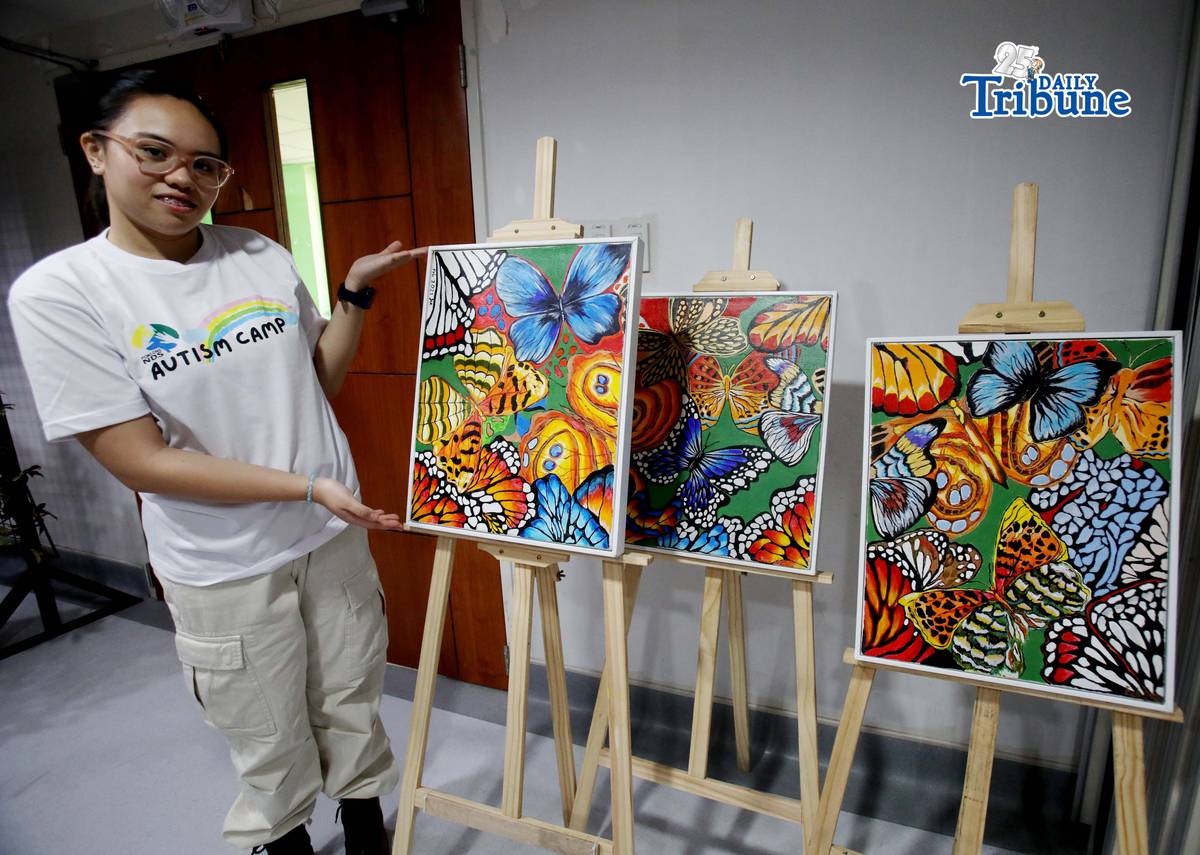
(April 25 2026) Juliana Elijah Erlano 18 years old show her art work with Philippine Children’s Medical Center (PCMC) Neurodevelopmental Pediatrics head Dr. Ermenilda Avendaño, during the Philippine Children’s Medical Center 3rd Autism Camp launching, a series of lectures and workshops for parents, a community effort that brings together families, health professionals, and advocates in one setting. And also to support, Inspire, Nurture: Autism Empowering Guardians, held at PCMC hospital in Quezon City on Saturday April 25 2026. Photo/Analy Labo
ANALY LABOR
Led by neurodevelopmental pediatrics head Dr. Christine Leonor Ma. C. Conducto, the camp broadened its scope this year to guide children up to 18 years old through the critical transition from childhood to adulthood.
The event also celebrated the profound capabilities of neurodivergent youth, highlighted by a vibrant art exhibition featuring works by 18-year-old autistic artist Juliana Elijah Erlano.
Addressing expensive care and scarce practitioners through parent empowerment
At the heart of the camp’s mission is a stark and often overwhelming reality: the high cost of continuous neurodevelopmental care. In Metro Manila, private therapy sessions typically range from ₱1,500 to more than ₱3,500 each—an expense that quickly becomes unsustainable for many families.
For participants like parent Catherine Clavo, the financial burden proved insurmountable. In the wake of post-pandemic economic strain, she had no choice but to stop therapy for her 15-year-old son, Yohan.
“If I only put him in therapy for the short term, I am just wasting money. It has to be long-term, because otherwise, it's a waste of time,” Clavo said.
The interruption came with serious consequences. Clavo pointed out that public schools are often ill-equipped to support physically mature adolescents on the autism spectrum, leaving families with limited options.
“They were scared because they feared he would harm others, and the teachers wouldn't be able to handle him,” she said. “Yes, he learns to socialize in school, but education for children like him is not polished yet. They settle for ‘ok na muna yan’ [that will do for now].”
In response to both the shortage of affordable specialists and the realities of institutional gaps, the Philippine Children’s Medical Center (PCMC) has advanced a “Home Empowerment” model—an approach that shifts the focus from clinic-based care to capability-building within the household. Dr. Conducto underscored the program’s goal of equipping parents with practical skills in behavioral management and structured teaching, effectively transforming the home into a consistent therapeutic space.
“We want them to feel confident. That even if I don't have the funds, even if I don't go to therapy every day, as a parent, I can do something for my child,” Conducto said. “That's what we call empowerment.”
What began as a series of introductory online webinars has since evolved into more intensive training under the SINAG program. Parents are provided with tools such as a “Family Guide” and are trained in evidence-based strategies—from structured teaching and dietary management to behavioral redirection—delivered by specialized therapists.
Through this initiative, families are not only supported but also equipped. The program fosters a network of informed and capable caregivers who can sustain their children’s developmental progress, even when formal therapy remains financially out of reach.
The next step forward
As the SINAG program continues on its positive trajectory, organizers said they will first strengthen their foundations before expanding to assist families in far-flung provinces. When asked about concrete plans to partner with non-governmental organizations to scale the camps in remote locations, Conducto emphasized the need for a deliberate and well-calibrated approach.
"We're trying to, you know, start small first, in our institution," Conducto said.
"It is defining what else needs to be done or improved. So that when we go remote, [our methods] have become more or less polished already."
By refining their localized support and digital resources first, PCMC ensures that a life-changing clinical standard is firmly established before expanding the initiative nationwide.