
OCAC workshop boosts Mandarin teaching skills of Philippines educators

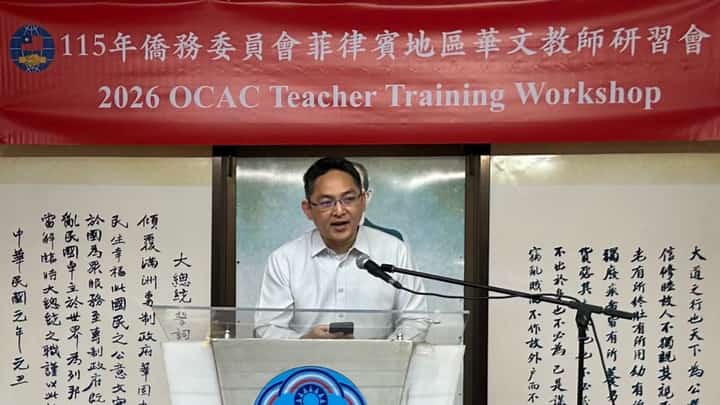
Director Eric Po-chih Chuang delivers the opening remarks during the 2026 Mandarin Teaching Workshop – Philippines Group.
The Overseas Community Affairs Council (OCAC), in partnership with the Culture Center of the Taipei Economic and Cultural Office (TECO), conducted a two-day Mandarin teaching workshop aimed at enhancing the skills of educators in the Philippines.
Held on 11 to 12 April at the Filipino Chinese Cultural and Economic Association, the 2026 Mandarin Teaching Workshop drew nearly 100 Mandarin teachers from Chinese schools across the country.
The opening ceremony was led by Director Eric Po-chih Chuang, with guest Jasper Huang in attendance. Chuang highlighted OCAC’s continuing efforts to advance Mandarin education overseas through training programs, professional workshops and cultural initiatives.
OCAC provides teaching resources such as the “Let’s Learn Mandarin” textbook series and the HuayuWorld digital platform, which offers a range of learning materials for classroom use.
Huang underscored the role of Mandarin education in preserving cultural heritage within overseas communities and encouraged teachers to continue refining their methods and adapting to evolving educational trends.
The workshop featured sessions on teaching methodologies, pronunciation and tone instruction, beginner-level listening and speaking techniques, and vocabulary development. It also addressed common challenges faced by overseas learners, offering practical strategies for classroom application.
OCAC tapped instructors from the Chinese Language Center of National Sun Yat-sen University—Wei-Hsin Tung and Hsin-Yu Chang—whose teaching demonstrations were well received by participants.
Interactive activities, including group discussions and peer exchanges, were also conducted to encourage collaboration and the sharing of teaching practices.
The program concluded with a closing forum and certificate presentation, with participants expressing appreciation for the practical insights gained.
OCAC said it remains committed to promoting Mandarin education globally and strengthening the capabilities of educators through continued engagement with overseas communities.