
New tech at St. Luke’s QC aims to improve safety in spine operations

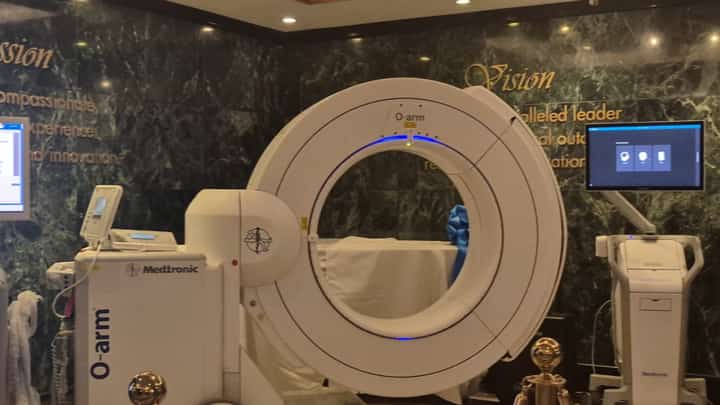
St. Luke’s Medical Center Quezon City (SLMQC) has introduced a new imaging system for orthopedic surgeries that aims to make procedures faster and more precise, particularly for spine operations.
The O-arm Surgical Imaging System allows surgeons to see real-time, 3D images during surgery, giving them a clearer view of the area they are working on. While similar machines already exist, this version is an upgraded one designed to improve speed and accuracy in the operating room.
“So in a way, this machine is more or less the gold standard of trying to put in accuracy and precision at the forefront for spine surgery,” said Dr. Mikhail Lew P. Ver, an orthopedic spine surgeon at St. Luke’s in Quezon City and Bonifacio Global City.
Unlike traditional imaging systems, the machine can be used during the operation itself, helping surgeons check positioning and make adjustments immediately.
This is especially important in procedures involving implants, where precision is critical. A small mistake can lead to serious complications, including paralysis or further injury.
“It produces a more accurate placement, a safer placement of implants because we know exactly where the direction is,” said Dr. Joselito L. Lazaga, head of the Institute of Orthopedic Surgery and Sports Medicine at SLMQC.
Dr. Ver added that the technology can help give patients more confidence, knowing that implant placement is guided by detailed imaging.
Doctors also noted that having this type of equipment locally means patients may no longer need to travel abroad for certain specialized spine procedures.
Beyond orthopedics, the system can also be used in neurosurgery, ENT, and other procedures involving bone structures.
Despite the advanced technology, doctors emphasized that it does not replace the role of the surgeon.
“Just imagine if you combine those two worlds—the human side of it plus the technological side,” Dr. Lazaga said.