
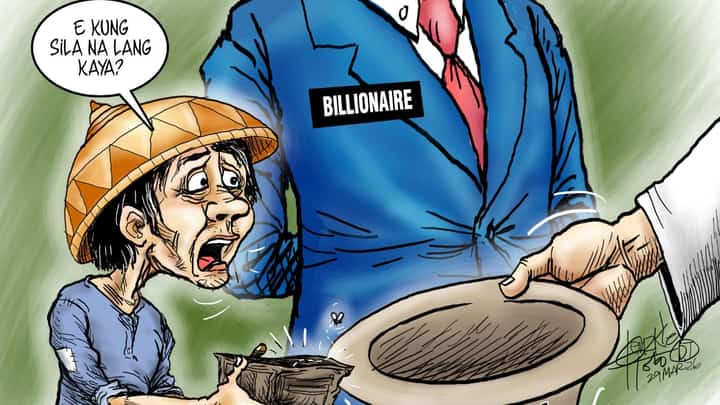
Billionaires must give back
A wealth tax of one to three percent, based on Ibon’s estimate, can generate P500 to P600 billion a year, if it covers 3,000 Filipino billionaires with total assets of P8.2 trillion.

Given the dire economic situation, measures beyond the still-uncertain reduction of the fuel excise tax must be implemented.
Even as President Ferdinand Marcos Jr. signed Republic Act 12316, granting him the authority to suspend or reduce the excise tax on petroleum products temporarily, there has been no indication of when the reduction will take effect, as it is set to be implemented only 15 days after the law’s publication.
Half a month is a matter of life and death for Filipinos crippled by high prices.
Economists even consider the move on the fuel tax as a knee-jerk reaction.
Former National Economic and Development Authority chief Winnie Monsod said touching the fuel tax is a wrong move since, instead of helping Filipinos, it would make life even harder, especially for those living in poverty.
The University of the Philippines School of Economics professor emeritus said funds for essential programs would be reduced.
The measure is not targeted and would benefit both the rich and the poor, while denying the government revenue that could be used to subsidize the needy.
Monsod said what should be worked on is a tax on the ultra-rich or a wealth tax.
Under the scheme, a tax will be imposed on assets rather than earnings, targeting the wealthiest Filipinos.
Monsod’s suggestion is a 3 percent tax on wealth above P3 billion. “If it’s over P3 billion, we will tax it 3 percent. And you know, I looked at the Forbes list. The combined wealth of the 50 richest Filipinos is $86 billion, or about P4.6 trillion.”
“We’re taxing them to help the 60 million or 55 million Filipinos who are at the bottom half of the population.”
Think tank Ibon Foundation backed the proposal, saying taxing the rich while suspending some local projects will allow the government to raise revenues during the price shock.
“The poor should not be made to bear the burden of the crisis, and a wealth tax is eminently justifiable,” Ibon Foundation executive director Sonny Africa said.
Africa said the government will show that it is preparing for the worst by expanding its policy options and considering a wealth tax.
A wealth tax of one to three percent, based on Ibon’s estimate, can generate P500 to P600 billion a year, if it covers 3,000 Filipino billionaires with total assets of P8.2 trillion.
“On the 15 richest Filipinos, a wealth tax could generate P155 billion. That’s actually more wealth than the poorest 15 million Filipino families have,” Africa said.
Ibon came up with a cost-benefit analysis, noting that the Bureau of Customs said it could lose at least P330 billion, or around 30 to 40 percent of its annual revenue, should the government suspend the fuel tax.
Africa said a wealth tax has huge policy levers if the government can exercise political will.
People with low incomes and the middle class — the majority of the population — consistently bear the burden of sustaining the nation during crises through taxes embedded in almost all commodities.
It is time for those with the greatest financial capacity to step up and help alleviate the effects of the worsening crisis.