
ONE AI RULE: White House tells Congress to take charge
‘Congress should preempt state AI laws that impose undue burdens to ensure a minimally burdensome national standard… not 50 discordant ones.’
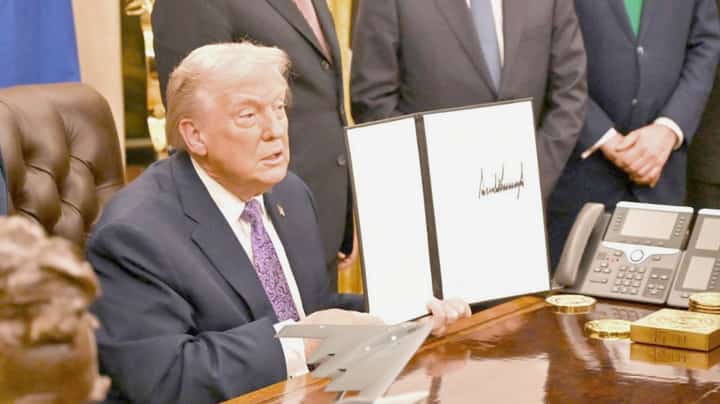
DONALD Trump pushes for a single national rulebook on artificial intelligence, warning against a patchwork of state laws as Washington races to catch up with fast-moving tech.
PHOTOGRAPH courtesy of Alex WROBLEWSKI/agence france-presse
The White House urged Congress to move forward with a national framework for regulating artificial intelligence (AI), calling for a unified federal standard to replace a growing patchwork of state laws.
The Trump administration outlined its proposal in a four-page blueprint described as a “commonsense national policy framework,” covering key issues such as child protection, energy use, intellectual property and free speech.
Central to the proposal is federal preemption of state-level AI regulations, as several states have begun passing their own laws amid delays in Congress.
“Congress should preempt state AI laws that impose undue burdens to ensure a minimally burdensome national standard… not 50 discordant ones,” the framework said.
The push comes as major technology companies increasingly support state-level initiatives in the absence of federal legislation.
OpenAI said states should align with emerging regulatory models in California and New York, while Google’s president for global affairs, Kent Walker, said coordination among states is a welcome step.
The White House proposal includes measures requiring age verification for AI platforms accessible to minors, parental controls for privacy and screen time, and safeguards against risks such as exploitation and self-harm.
On intellectual property, the administration said training AI models on copyrighted material does not violate existing laws, but noted that courts should ultimately decide the issue.
Despite the push, the proposal faces uncertainty in Congress, where previous efforts to establish federal oversight and preempt state rules have failed.
The administration also warned it could restrict broadband and internet funding to states whose AI regulations are deemed overly restrictive.