
Ultra-hot planet completes orbit in just 16 hours

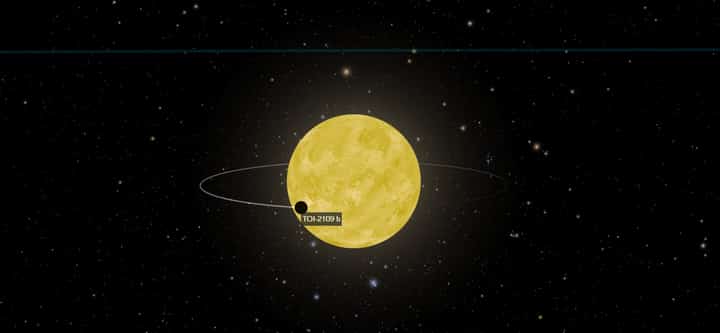
Astronomers have discovered an extraordinary alien world that makes Mercury look sluggish. TOI-2109 b, an ultra-hot gas giant, completes a full orbit around its star in just 16 hours—making its “year” the shortest ever recorded for a planet of its size.
“This planet is extreme in every sense,” said Ian Wong, lead researcher from the Massachusetts Institute of Technology (MIT), whose team first reported TOI-2109 b in 2021. “It’s blisteringly hot, incredibly close to its star, and on the verge of a dramatic transformation.”
TOI-2109 b is classified as an ultra-hot Jupiter. It has about 5.02 times the mass of Jupiter and roughly 1.35 times its radius, orbiting at only 0.025 astronomical units (AU) from its host star—closer than any planet in the solar system is to the Sun.
Its extreme proximity exposes it to searing temperatures exceeding 3,500°C, hot enough to vaporize metals.
NASA’s Transiting Exoplanet Survey Satellite (TESS) played a key role in its discovery, observing periodic dips in the star’s brightness as TOI-2109 b passed in front of it.
“TESS allows us to detect these ultra-fast orbits and monitor changes over time,” Wong said.
Recent findings, including updates reported in August 2025, suggest that TOI-2109 b may be in a gradual orbital decay, slowly moving toward its host star.
Scientists theorize that over millions of years, the gas giant could lose its outer layers, potentially leaving behind a rocky core—offering insights into how some rocky planets may form.
Researchers continue to monitor TOI-2109 b as a natural laboratory for studying planetary evolution under extreme conditions, with its rapid orbit and intense heat making it unlike anything in the solar system.