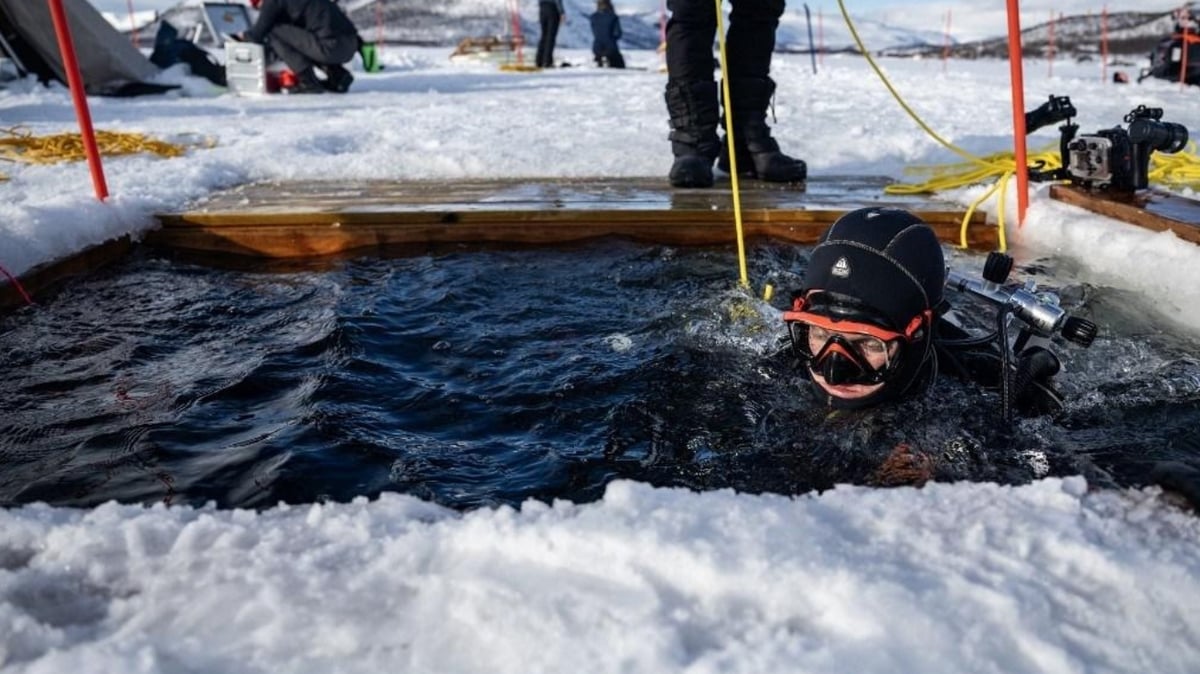
On the frozen Lake Kilpisjarvi, just below the tree line at the intersection of the Finnish, Swedish and Norwegian borders, 12 divers were taking a course to learn how to dive in polar regions so they could carry out scientific research.
“Just wow, every small thing you see in the water... Just wow,” said Lukasik, a 41-year-old oceanology PhD student who works as a diving inspector on fish farms in Norway, mesmerized by the experience.
For 10 days, the international group from different professions and backgrounds learnt vital skills below the 80 centimeters of ice covering the lake.
According to Erik Wurz, coordinator of the program run by the Finnish Scientific Diving Academy which is part of the University of Helsinki, there is a critical need for skilled people who can conduct research in demanding polar environments.
Climate change is warming and transforming the Arctic and Antarctic at a faster rate than the rest of the planet.
“There’s still a lot of questions to be covered in the polar regions and access is very limited,” said Wurz, stood next to two large holes cut into the ice and a pitched wind shelter.
“The number of scientific divers that can go under the ice is even more limited,” he added, estimating there to be only around 100 to 200 people globally.
Wearing dry suits to fend off the 2 degrees Celsius cold in the water, the divers arrived on snowmobiles at the site, located close to the University of Helsinki’s biological station at the foot of the Saana mountains.