
Beyond the barricades
Governments have always had a talent for translating anxiety into shields. Barricades rise, checkpoints multiply and security perimeters expand.

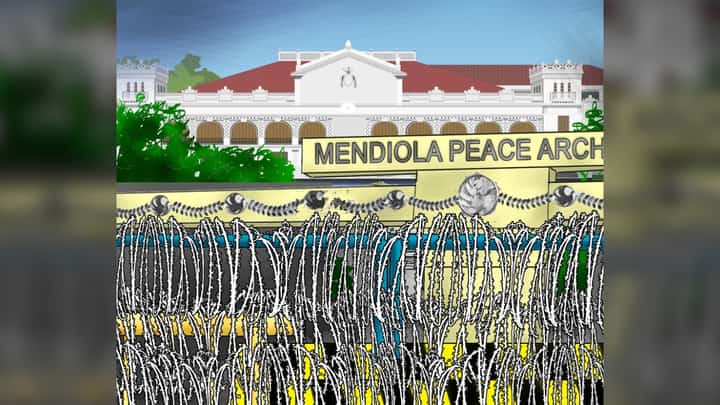
Razor wire has appeared again on streets around Malacañang Palace. The official explanation is security. It usually is, except timing has a way of giving barricades their own meaning.
A Pulse Asia survey released this week shows 44 percent of Filipinos distrust President Ferdinand Marcos Jr., against 35 percent who trust him. Twenty-one percent of the respondents remain undecided, a number that in a country this divided functions less as neutrality than as a still percolating judgment.
The regional picture is damning. Marcos retains majority approval in the rest of Luzon, at 54 percent. But the Visayas disapprove at 61 percent, and Mindanao at 73. The farther from Manila, the clearer is the verdict against him.
That pattern is difficult to ignore. Outside the capital’s political orbit, confidence in the administration has eroded sharply. What looks manageable from inside the Palace gates appears far less stable from the country’s outer provinces.
Class tells the same story. Sixty percent of Class E respondents, the country’s poorest, disapprove of this President’s performance. Among Class D, the electoral majority, the figure is 47 percent. Metro Manila, the seat of his power and the engine of his image, is deadlocked: 42 to 42.
These numbers matter because they describe more than approval ratings. They map the distance between a government and the people it governs.
Vice President Sara Duterte, on the other hand, inhabits a different political universe. Her trust rating stands at 54 percent, her distrust at 26.
In Mindanao, she commands 95 percent approval. Among Class E voters, the same group giving Marcos his worst numbers, she draws 81 percent. Duterte is strongest precisely where Marcos is weakest.
Over three years ago, Marcos and Duterte ran together as the “UniTeam” and won in a landslide that seemed to promise political stability for an entire presidential term. That alliance now reads like a map of a country that no longer exists.
The coalition that once united two powerful regional bases — Davao and the Ilocos — has fractured into competing centers of loyalty. The numbers suggest that voters have begun choosing sides.
As we see it, the survey’s top concerns offer another clue to the shifting mood of the electorate. Inflation leads at 59 percent, followed by corruption at 47 percent, and wages at 36 percent.
No doubt inflation is a daily irritation. Wages are a daily struggle. Corruption, however, carries a deeper sting because it suggests that hardship is not merely economic but engineered at the highest echelons.
On corruption, the damage to this government is undeniable: expelled lawmaker Zaldy Co and former Marine officer Orly Guteza have accused Marcos and his cousin, Martin Romualdez, of taking kickbacks from flood control projects worth billions of pesos, some of which critics claim exist only on paper.
Those flood control projects are not abstract line items in a budget. They are supposed to keep cities from drowning during typhoons and monsoon rains. When such projects proved to be ghost works, the accusation strikes at something more visceral than financial mismanagement.
And how did Mr. Marcos respond? He created an Independent Commission for Infrastructure that forwarded nine referrals involving 65 individuals to the Ombudsman. The move projected action but satisfied almost no one. No senior official was named in the referrals, and the accusations directed at the highest levels of government remained untouched.
Former senator now Rep. Leila de Lima called it plainly: the government was “taking the public for a ride,” with the big fish left untouched.
Now, whether the allegations are ultimately proven or not may take years to determine. In politics, however, perception often moves faster than investigation. Public trust, once eroded, rarely waits for legal proceedings.
So the wire goes up.
Governments have always had a talent for translating anxiety into shields. Barricades rise, checkpoints multiply, and security perimeters expand. These measures by state forces are presented as routine precautions, but they also reveal something about the dark mood inside those walls.
Razor wire has a language of its own. It speaks of distance, of caution, of paranoia, of the uneasy relationship between authority and the public beyond the barricades.