
Nahidlaw Guid Ako sa Imo: On Alice Sun-Cua’s ‘Iloilo City on My Mind’
Reading these pages, one feels that writing itself becomes an act of homecoming. With clarity and attention, Sun-Cua restores a world that might otherwise fade from memory.

I am writing this review on the cusp of spring from Virginia, where I arrived over a month ago just as three consecutive snowstorms swept across the landscape. Alice Sun-Cua’s Iloilo City on My Mind: Personal Essays (Sirena Books; San Jose de Buenavista, Antique; 2025) was with me the whole way, tucked tightly into my backpack as I traveled across time zones and thresholds. I must admit it took some time before I opened the book again; the cold often overcame any desire to move. But when I finally returned to its pages, a certain familiarity took hold almost immediately. Alice begins with the image of the “waft of the sea that permeates everything,” conjuring the old-world atmosphere of Iloilo, and, in doing so, awakens the reader’s unexpected nostalgia for one’s own hometown. Such is the power of writing about place when it is done with devotion and care.
What follows is a mosaic of remembered life: the family photography studio in “The Studio at 57 Guanco Street,” where a father’s passion for photography and the careful rituals of developing images shaped the household; the disciplined rhythms of childhood in “Growing Up ‘Chinese’ in Iloilo City,” from Sun Yat Sen High School to later pre-med studies at the University of San Agustin; and the quiet intimacies of neighborhood life — from the Arroyo Fountain to the modista who stitched everyday garments with patient skill. Interspersed throughout are scenes that linger with particular warmth: the homecomings of English class and the discovery of language, the faded tenderness of old photographs, the comforting aroma of Ilonggo adobo, and the poignant portraits of a beloved mother whose presence animates many of the essays. These pages recover not merely the geography of a city but the emotional architecture of belonging. In such quotidian details, recalled through an intimate aperture, the ordinary takes on an extraordinary texture, lifting the veils of home and quietly recentering it in our lives.
Reading these pages, one feels that writing itself becomes an act of homecoming. With clarity and attention, Sun-Cua restores a world that might otherwise fade from memory. And it is when the memory is rendered with affection that we receive it as a gift. As Alice herself writes, in a phrase that lingers long after the book is closed: “Nahidlaw guid ako sa imo.”
I found myself pronouncing the words aloud, each syllable falling like a summons beyond the gray mist that winter casts over days. I, too, felt nostalgic for home; for the constellations of childhood ties, the small rituals that once seemed ordinary: the familiar streets where school and friendships quietly shaped the early years of our knowing what it is to be alive, the voices of parents whose presence continues to loom over memory long after they are gone. In this way, Alice’s essays remind us that memory does not simply recount the past; it gathers the scattered pieces of home and returns them to us, luminous and enduring.
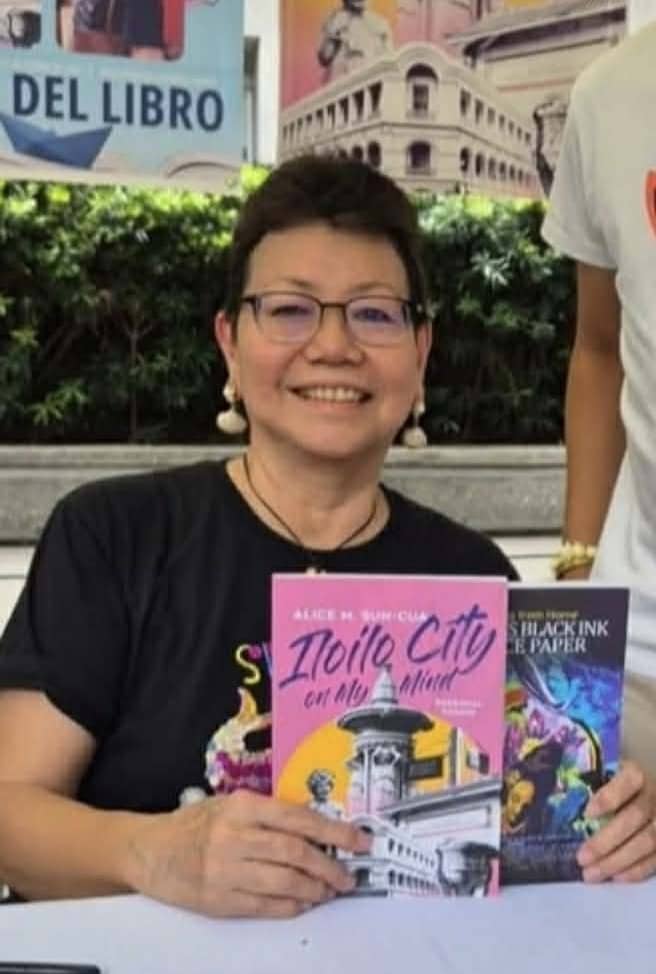
Author Alice Sun-Cua.
As seasons go, winter feels endless. Yet I wait for the warmth of spring, when clearer skies begin to take over and the days slowly lift the spirit. But even in this distance, marked by two vast continents, one cannot help but search for the coordinates of where one belongs. A place where memory may finally settle and the soul may rest in the quiet familiarity of what once shaped it.
This is what Sun-Cua offers through these delicate essays of remembering. It is writing that gently pervades the senses, restoring the textures of a city, the cadence of voices, the warmth of family, and streets long traversed. In reading her pages, the distance between places momentarily dissolves. What remains is the unmistakable recognition that home, once written with such tenderness, can travel with us wherever we go.