
THEATER REVIEW: TGA’s ‘A Chorus Line’: dazzling dancers, dated drama
From a present-day perspective, the premise reads differently and can feel dated. But for fans of the musical, especially those who already love its songs and stories, this staging will certainly have its appeal.
There is no doubt about Theatre Group Asia’s capacity to mount world-class productions on an ambitious scale, as demonstrated in its productions of Request sa Radyo and Into the Woods. What sets the company apart is its genuine commitment to showcasing triple-threat, proudly Pinoy performers, bringing those working in the West End and on Broadway home to the Makati stage.
For its season opener, Theatre Group Asia chose A Chorus Line, the 1975 musical that has endured for decades and even won the Pulitzer Prize for Drama. They hired Emmy-winning Fil-Am director Karla Puno Garcia to helm this licensed Broadway property, meaning the book, music, lyrics and choreography must remain intact. What creative liberties Theatre Group Asia and Garcia have lie in interpretation, particularly pacing, staging, and performance style.
Indeed, Garcia manages the mechanics of the show well. The book by James Kirkwood Jr. and Nicholas Dante, the score by Marvin Hamlisch, and the lyrics by Edward Kleban are essentially fixed. The dancers execute the choreography originally conceived by Michael Bennett with impressive discipline and technical skill.
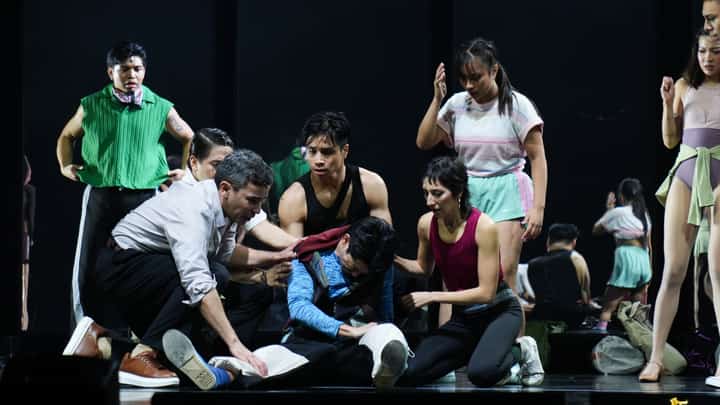
This was my first time encountering the musical, though I was aware of its existence. It is a minimalist show that focuses on Broadway “gypsies” — chorus dancers or ensemble performers who move from show to show in search of work. The story introduces us to 17 dancers auditioning for Zach (Tony Award nominee Conrad Ricamora), who presses them to reveal intimate and deeply personal stories.
Rather than a traditional plot, the structure is essentially a sequence of confessions. One by one, the dancers step forward to recount childhood memories, insecurities, and the moments that led them to the stage. Think of it as “Chorus Line Anonymous,” where audiences listen to these personal revelations.
Traditionally set in a single location (a rehearsal studio) the musical has little narrative momentum, which often exposes the limitations of the script. Much of the show relies on dancers recounting their personal histories through straightforward, conversational monologues, a structure that can feel dramatically thin when not elevated by particularly compelling performances.
From a present-day perspective, the premise reads differently and can feel dated and problematic. Watching dancers reveal deeply personal histories just to secure a job now feels disturbingly close to workplace harassment. The text itself feels thin. It becomes difficult to experience emotional connection with the characters because today their stories no longer carry the same novelty or urgency.
As a result, watching a group of dancers audition for a coveted spot in a Broadway chorus line is intensely tedious for me, largely because the original Broadway show relies so heavily on backstories and prosaic monologues delivered by strangers standing before a black curtain or under a spotlight.
Here, many of the dancers’ monologues struggle to generate the urgency the material requires, as themes that once felt taboo—such as homosexuality—no longer carry the same dramatic impact today. Moments written for humor rely on broad delivery and exaggerated gestures that feel cartoonish rather than character-driven. The pacing also drags at times, weakening whatever dramatic build-up the show attempts to create.
Zach, meanwhile, is staged within the audience itself. Ricamora moves through the aisles and occasionally appears from the balcony. His deep, crystal-clear voice booms with authority and, at times, cruelty as he interrogates the dancers.
As the evening progressed, I realized I am simply not a fan of the text or the music, except for the infectious “One,” with its famous line “One singular sensation,” which left me and my theater companions humming long after the curtain call.
Again, the book and score are beyond the control of Theatre Group Asia or Garcia. But what compensates somewhat for a story that feels dramatically flat is the commendable talent of the dancers and the production’s visual elegance.
The Samsung Performing Arts Theater stage transforms into a striking array of tall rectangular mirrors mounted on movable stands. Their reflections appear slightly distorted, almost carnivalesque, as if dancers see themselves through the warped lens of competition and ambition. Each mirror is framed with neon lights that cast a soft glow as performers move across the stage.
The mirrors shift positions during the choreography and form new spatial patterns. In one number they glide across the stage and reshape the visual landscape, reinforcing the idea of dancers confronting both themselves and their rivals in the audition process.
Indeed, the dance numbers themselves can be breathtaking. The ensemble is fun to watch when they are moving, their energy filling the stage in beautifully coordinated costumes. The dramatic engine of the show lies in these choreography-driven moments rather than in the emotional resonance of the confessions.
For fans of the musical, especially those who already love its songs and stories, this staging will certainly have its appeal. In the hands of Theatre Group Asia, the production value alone is a treat, once again proving the exciting depth of global Filipino talent that the company continues to bring to the local stage.