
Oilmaggedon: Marcos seeks emergency powers
Energy officials warned that continued spikes could push inflation beyond the government’s target.



Energy officials warned that continued spikes could push inflation beyond the government’s target.
PUMP stations are marked ‘out of stock’ at a gas station in Paco, Manila, on Monday after a rush of motorists filled their tanks and stockpiled fuel ahead of looming price hikes triggered by escalating tensions in the Middle East. The surge in demand left several pumps temporarily dry as drivers scrambled to beat the expected spike at the pumps.
PHOTOGRAPHS BY YUMMIE DINGDING AND JOHN CARLO MAGALLON FOR DAILY TRIBUNE
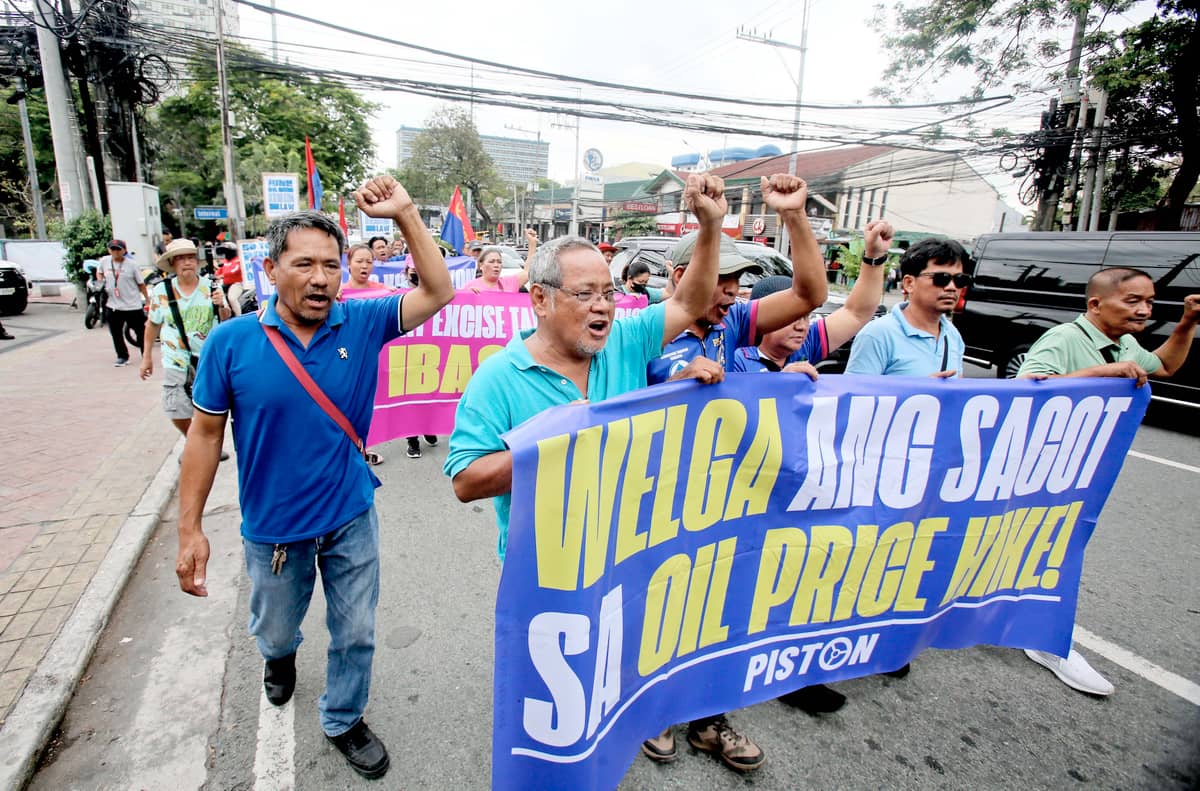
MEMBERS of transport group PISTON stage a protest in front of a gas station along East Avenue in Quezon City on Monday, calling on the government to remove the value-added tax and excise tax on fuel products ahead of an impending big-time oil price hike.
PHOTOGRAPH by Analy Labor for DAILY TRIBUNE
The defense of Vice President Sara Duterte on Wednesday disputed the prosecution’s attribution of more than P191.6…
Batangas 1st District Rep. Leandro Leviste has been ordered arrested by the Makati City Regional Trial Court (RTC) for…
The Commission on Audit (CoA) has “affirmed with finality” its P73.28-million disallowance of confidential funds spent…
Car company Tesla has rolled out its autonomous taxi in Austin, Texas, USA.
Motorists and consumers are bracing for a shock at the pumps, with oil prices set to rise by as much as P24 per liter starting Tuesday — threatening to push inflation higher and further strain household budgets already stretched by global tensions.
As vehicle owners rushed to fill up on Monday, Malacañang formally transmitted a request to Congress seeking emergency powers for President Ferdinand R. Marcos Jr. to temporarily reduce the excise tax on petroleum products.
Presidential Communications Office Undersecretary Claire Castro said the appeal was sent through the Department of Energy (DoE), which will present it to the lawmakers on the President’s behalf.
“The President is ready to exercise emergency powers should global oil prices reach or exceed $80 per barrel,” Castro said, noting the move is aimed at cushioning the impact on consumers and businesses.
She also warned oil industry players against profiteering. The DoE has issued show-cause orders to 54 gas stations suspected of violating price guidelines, with penalties including possible cancellation of their operating permits.
DoE issues staggered price hikes
The DoE on Monday told motorists to brace for higher fuel prices as local oil retailers implement double-digit hikes ranging from P17 to P24 per liter this week.
In a press conference, Energy Secretary Sharon Garin explained that the increases would be staggered to minimize disruption.
Retailers’ announced hikes are as follows: Shell–P24.50 per liter; Petron–P19.20 per liter; Total–P20.20 per liter; Chevron–P17.50; Jetti–P19; and Seaoil–P21 to P23.
The new price increase would surpass the previous single-week record of P13.15 per liter for diesel set in March 2022 during the Russia-Ukraine war.
House mulls excise tax suspension
Meanwhile, the House Committee on Ways and Means, chaired by Marikina Rep. Miro Quimbo, is studying a proposal to temporarily suspend the fuel excise tax. The panel held briefings with key economic, fiscal and energy agencies to assess the impact of the surging petroleum prices and will hold a full hearing on Wednesday.
“We have to fast-track this. We’re waiting for the presidential certification so we can approve it as soon as possible,” Quimbo said. The proposal would allow the President, upon the recommendation of economic managers, to suspend or reduce the excise tax when global oil prices reach extraordinary levels.
Price hikes could push inflation
Energy officials warned that continued spikes could push inflation beyond the government’s target. Simulations show moderate scenarios raising inflation to 4.5–5.1 percent, while more severe hikes could send it as high as 6.3–7.5 percent. Fuel prices could climb P17–P24 per liter.
Garin noted that diesel — widely used in public transport — has a P6-per-liter excise tax which, if suspended, could provide immediate relief to commuters and transport operators.
Finance officials, however, cautioned lawmakers on the fiscal impact: fuel-related taxes generate roughly P276 billion annually, including P160 billion in excise taxes. Suspending fuel excise taxes from May to December alone could result in P136 billion in foregone revenue, although rising VAT collections could offset some losses.
Safeguards to protect consumers
Quimbo emphasized that any tax relief must benefit the public, not the oil companies.
“That is our biggest concern — that we lower taxes but the public does not actually feel the benefit. We fear that the only ones who might benefit are the big oil companies or the businessmen selling fuel,” he said, citing lessons of the Rice Tariffication Law. The committee aims to ensure any response is grounded on solid economic data while protecting both vulnerable sectors and the middle class.
PUV drivers on the frontline
For public utility vehicle (PUV) drivers, the impact is immediate. Jeepney operators — relying on daily fares to support their families — say rising fuel costs are making it harder to make ends meet.
Speaking exclusively to DAILY TRIBUNE, Parañaque jeepney drivers who asked to be identified only as “Kalbo” and “Kuarog” said their daily “boundary” — the amount they must turn over to their operators — ranges from P850 to P1,000. On a typical day on the Baclaran–Sucat route, they could make four round trips, but lately even three trips has been a struggle.
“Most of us are driving for our families. What we want is help on how to cope — it’s too expensive. We’re barely earning. Nothing is left,” Kalbo said.
“That’s what hurts the most. How are we supposed to live? We might not even hit our boundary. Everything goes to gas,” Kuarog added.
With the P17 to P24 hikes coming, the drivers said they may be forced to find alternative sources of income.
“All we want is help, because we really won’t survive if prices hit P100. Most of us won’t even drive jeepneys anymore. We’ll find other jobs,” Kalbo said.
Transport network company drivers are also feeling the strain.
Benjie, a rider for Joyride, said his earnings per liter of fuel have dropped from around P400 to as low as P250.
“Of course we need to keep working — we can’t just settle for nothing. Our families need us,” he said, noting that he may have to park his motorcycle indefinitely if prices continue to rise.
For many drivers, the looming fuel price surge is more than numbers at the pump — it’s the rate of the daily struggle to put food on the table and keep their families afloat.