
BEYOND THE PNR TRACKS: The trillion-peso railway question (Part 3)



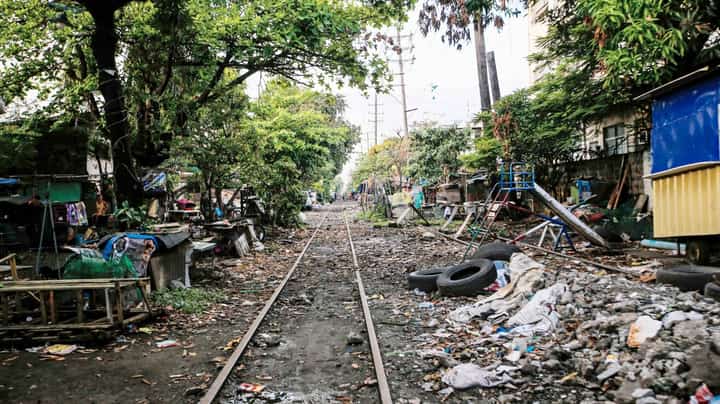
A THRIVING community stands along the abandoned train tracks in Tayuman, Manila, on 8 March. The Philippine National Railways suspended operations nearly two years ago to make way for a more modern railway system, but the project remains under construction, leaving the old tracks reclaimed by residents who have built their homes beside them.
Long before the North–South Commuter Railway (NSCR) became a multibillion-peso megaproject, the Philippines already had a rail backbone.
The system began with the Ferrocarril de Manila–Dagupan railway in 1892, linking Manila to Pangasinan.
By the mid-20th century, the network that would later become the Philippine National Railways (PNR) stretched from La Union in the north down to Legazpi City in Albay in the south, covering more than 900 kilometers of track. Lines branched out to Batangas, Cavinti in Laguna, and parts of Central Luzon.
At its peak, the railway symbolized the country’s growing mobility and national ambition.
But decades of underinvestment, natural disasters, and right-of-way encroachments gradually reduced the system to a shadow of its former scale.
The NSCR is intended to rebuild that rail backbone.
Once completed, the electrified standard-gauge railway will span approximately 147 kilometers from Clark, Pampanga, to Calamba, Laguna, cutting travel time along the corridor to two hours or less.
Government planners estimate the line could carry up to 800,000 passengers per day, dramatically expanding commuter capacity compared with the old system.
Economists say projects of this scale will reshape economic productivity.
“It’s an unfortunate delay because our country needs to invest in a modern and efficient railway system,” said Juan Paolo Colet, managing director at Chinabank.
“This would be a long-term but high-impact investment that would increase economic productivity, reduce pollution, and help insulate commuters from volatile oil prices,” he added.
Yet building the railway is only one part of the challenge.
Budget documents show that several major rail projects, including the NSCR, were shifted to the unprogrammed appropriations starting with the 2024 national budget cycle.
Under this mechanism, funds can be released only after specific conditions are met, such as the availability of loans or higher-than-expected government revenues.
The shift reduced the Department of Transportation’s programmed allocation from P106 billion in 2023 to P73.3 billion in 2024, far below the P214.3 billion originally proposed in the National Expenditure Program.
Among the largest projects affected by the funding structure is the Metro Manila Subway, the country’s first underground railway system, which will run from Valenzuela City to the Ninoy Aquino International Airport in Pasay City.
The project is estimated to cost nearly P488 billion and is financed primarily through loans from the Japan International Cooperation Agency (JICA).
The NSCR is also funded through loans from JICA and the Asian Development Bank.
Taken together, the scale of the country’s rail modernization program will run into the hundreds of billions of pesos. When the P488-billion Metro Manila Subway, the 147-kilometer NSCR corridor, and the P229-billion operations and maintenance concession for the railway are considered alongside other major rail investments, the total value of the government’s rail expansion effort approaches the trillion-peso range.
Beyond construction, the government is preparing to involve the private sector in operating the railway.
The PNR has begun exploring a 15-year concession covering operations and maintenance of the NSCR system. The concession would include trains, depots, stations, guideways, electromechanical systems and other rail infrastructure.
According to Public-Private Partnership Center documents, the P229-billion NSCR operations and maintenance project launched its bidding process on 20 October 2025.
Officials say the arrangement forms part of a hybrid public-private partnership model, combining government financing for construction with private sector expertise in operations.
Undersecretary for Railways Timothy John Batan stressed that experienced operators are essential for the system’s long-term success.
“The turnout of prospective bidders is very encouraging. This procurement of an operations and maintenance provider for the NSCR is critical because it is not enough for us to just build this new line. It is also very important to ensure that its operations will be properly managed,” Batan said.
Transport officials say partial operations are targeted by December 2027, with full operations projected by October 2028.
Other projects affected
Meanwhile, other rail projects have also been affected by the shift in funding structure, including MRT 4, a 12.7-kilometer elevated railway along Ortigas Avenue connecting Metro Manila to Taytay, Rizal, and the remaining phases of the LRT-1 Cavite Extension.
Before its suspension in March 2024, the PNR Metro Commuter Line carried an average of about 20,000 passengers daily, rising to around 25,000 during peak seasons.
Earlier data showed that the commuter line served around 8.2-million passengers in 2022, while daily ridership across PNR commuter services reached 50,000 before the pandemic.
Despite the scale of the railway modernization program, the state railway operator itself receives relatively modest financial support.
Budget records showed that the PNR received approximately P531 million in subsidies in the 2024 national budget, which dropped to P341.38 million in 2025. For the 2026 national budget, the Department of Budget and Management proposed a subsidy of P351.62 million for the state-run railway operator.
The allocation is intended to fund PNR’s operating requirements and maintenance programs while the broader rail network undergoes modernization and expansion.
Economists like it
For economists, the broader value of commuter rail extends far beyond ticket revenues.
RCBC chief economist Michael Ricafort said mass transit investment strengthens economic growth by improving mobility for workers and businesses.
“The development of mass transport/train systems should be a priority, just like in more developed countries in Asia and Asean, to further boost the productivity of the economy in terms of the faster movement of workers, tourists, and other people doing business, as well as the faster movement of goods and products, including for the domestic and export markets,” Ricafort said.
Large-scale investment in rail infrastructure, analysts say, could reduce congestion, strengthen labor mobility, and attract trade investments.
When completed, the NSCR would mark the most significant rail revival in Philippine history.
Yet, after the old PNR system was shut down to make way for its replacement, the question remains whether the country’s trillion-peso rail gamble will finally deliver the modern railway system that generations of commuters have long been promised — beyond the PNR tracks.