
BEYOND THE PNR TRACKS: Long wait for tomorrow’s railway
The delayed NSCR has been billed as the answer to the need for cheap, efficient modern public transport that would put the country on par with its neighbors.




RAIL dream runs late Daily Tribune takes a drone shot of the ongoing construction of the Guiguinto Bulacan station of the North-South Commuter Railway, worth P873 billion. The 147-kilometer railway connecting Clark, Pampanga, in the north and Calamba, Laguna, has faced significant delays. Early targets under the Duterte administration aimed for partial operations by 2025, with full completion initially slated for around 2027, now pushed back to 2032.
PHOTOGRAPH BY ANALY LABOR FOR DAILY TRIBUNE
Steel-reinforced columns now stand where century-old tracks of the old Philippine National Railways once transported generations of Filipino commuters.
The government shut down the country’s main commuter railway in March 2024 to make way for its replacement. Nearly two years later, the trains that were supposed to replace it still have no tracks to run on.
Across Manila, Makati and Taguig, construction crews are slowly raising viaducts that will eventually carry the trains of the North-South Commuter Railway (NSCR).
The delayed NSCR has been billed as the answer to the need for cheap, efficient modern public transport that would put the country on par with its neighbors.
As of March 2026, the 147-kilometer NSCR project, spanning Clark in Pampanga through Metro Manila to Calamba in Laguna, remains mired in delays, with right-of-way acquisitions only at over half the required number for the northern segment.
Officials aim to secure the land for the Malolos-to-Clark stretch by June 2026, while housing for over 16,000 displaced families is slated for completion by year’s end.
The vision is ambitious: a fully elevated, 35-station line integrated with other systems like the Metro Manila Subway, promising fares of P20 to P30 per segment and capacity for up to 800,000 daily passengers once completed by the target, which is perennially moved and is now at 2032.
The massive project is intended to restore the rail backbone the country once had. But for now, the landscape is dominated by unfinished infrastructure, idle tracks, and commuters waiting for a system that has yet to arrive at the station.
The Philippines, once the first in Southeast Asia to build a modern train system, now watches its neighbors race ahead while its own tracks remain unfinished.
The 147-kilometer North–South Commuter Railway is designed to connect Calamba, Laguna, to Clark, Pampanga, cutting travel time across Luzon to under two hours and serving hundreds of thousands of passengers daily.
The line is co-financed by the Japan International Cooperation Agency and the Asian Development Bank and is considered one of the most ambitious transportation projects in the country’s history.
Yet years into construction, the project remains uneven.
Six years after construction began on the northern section of the project, the DAILY TRIBUNE visited station sites in Guiguinto, Bulacan, and the boundary of Meycauayan and Valenzuela, including a station near the National Food Authority office.
Façade’s progress
From a distance, the elevated structures appeared complete. But closer inspection revealed unfinished stations and trackways without rails.
Residents said construction activity slowed during the pandemic when work at some sites stalled.
Some residents of Masagana Homes Phase 3 in Guiguinto were displaced as the project advanced, eventually relocating to Northville in Malis, Guiguinto.
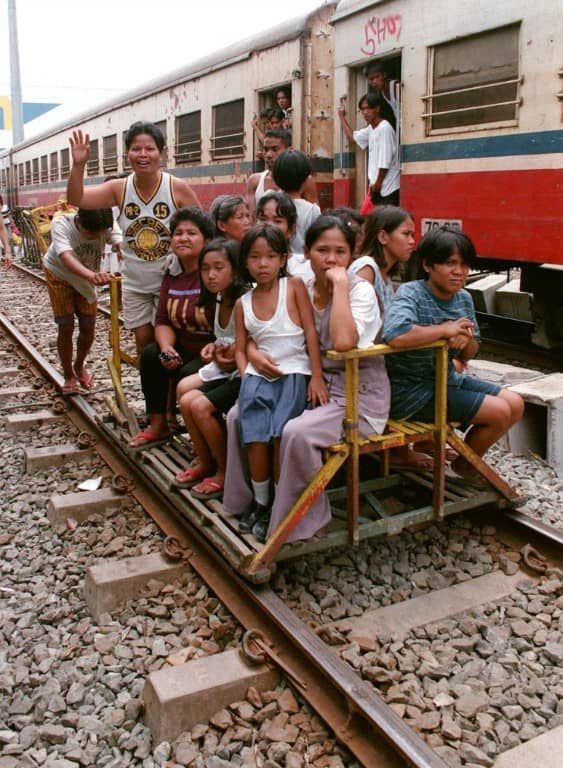
RESIDENTS take short trips aboard improvised wooden trolleys running along the Philippine National Railways tracks. The contraption is easily lifted off the rails to clear the way for a train (in the background) until the tracks are dismantled to make way for the NSCR.
PHOTOGRAPH courtesy of ROMEO GACAD/AGENCE FRANCE-PRESSE
The stations also involve multiple contractors. Guiguinto’s station work is done by Sumitomo, while the Taisei-DMCI Joint Venture handles the Valenzuela site.
Government officials say progress has accelerated in recent months, particularly in the right-of-way acquisition.
Transportation Secretary Giovanni Lopez described 2025 as “a banner year” for land acquisition, noting that 56 percent of the North segment’s required land had been cleared by December — a dramatic increase from just two percent in February.
“2025 was truly a banner year for our right-of-way efforts because we sped up land acquisition so commuters could immediately benefit from the subway and the NSCR,” Lopez said.
As of December 2025, the Department of Transportation had acquired 90.76 percent of the required right-of-way and properties for the Metro Manila Subway Project, while at least 56 percent of the land required for the NSCR North segment had been cleared.
The number of acquired properties in the NSCR North surged to 1,143 parcels by December, up from only 38 parcels in February.
Momentum is also building in the Clark extension. The first major support beam has been installed in Clark, while the first rails were welded at the Mabalacat Depot earlier this year.
The Clark segment spans roughly 6.5 kilometers, featuring an underground station at Clark International Airport, elevated bridges, and depot access.
Still, visible progress varies across the corridor.
In the southern section of the line, right-of-way acquisition continues to delay construction. Only four of the 19 planned station sites have been cleared so far — EDSA, Cabuyao, Sta. Rosa in Laguna and the Banlic depot.
“I need the contractors, the consultants, and DoTr to work closely together,” Lopez said.
Construction is advancing in other areas. Contract Package S-03B, funded by the Asian Development Bank and worth P22.13 billion, covers viaducts and at-grade structures, including the elevated Buendia station and stations at EDSA and Senate-DepEd.
Construction began on 15 March 2024 under the Leighton-First Balfour Joint Venture, with a 54-month completion schedule.
On the ground, workers describe the engineering solution in practical terms.
“The tracks will be raised so they won’t pass through intersections anymore,” one worker said at the Buendia construction site.
Before operations were halted in March 2024, the aging PNR commuter system carried 20,000 to 22,000 passengers daily, or roughly eight million riders annually.
Promise of economic travel
For many working-class commuters from Laguna, Alabang, Paco, and Tutuban, it was the cheapest way into Metro Manila.
For commuters who once relied on the PNR line, the memories remain vivid.
“It was extremely crowded, and it wasn’t convenient because the next train would only arrive every hour,” said a former student from the Polytechnic University of the Philippines in Sta. Mesa.
For a fare of P15 to P60, commuters could travel from Tutuban to Calamba in under three hours.
The trains were slow and often crowded, but they offered something rare in Metro Manila — a way to avoid the traffic.
The NSCR promises something far more ambitious — a modern electrified commuter railway capable of carrying up to 800,000 passengers daily, nearly 40 times the volume once handled by the old commuter system.
Yet, until the trains finally begin to run, commuters remain caught between the railway that once operated and the one that has yet to arrive beyond the PNR tracks.
(To be continued)