
EV, semiconductor investors target Phl – DOF
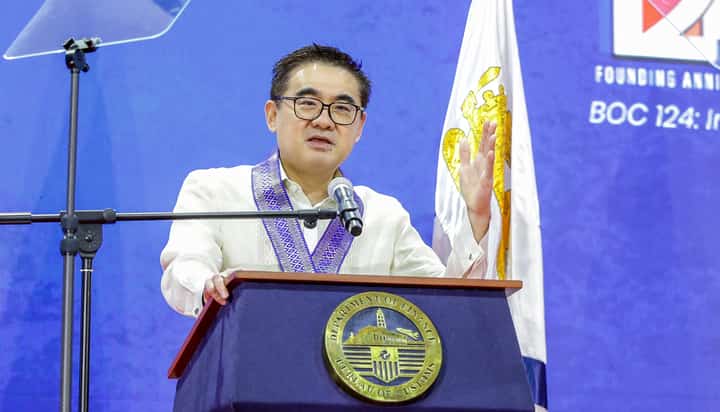
A number of foreign firms are in talks with the Philippine government to expand their respective presences in the country, according to Department of Finance (DOF) Secretary Frederick Go.
Speaking at the ASEAN Editors and Economic Opinion Leaders Forum in Makati on Tuesday, the finance chief said major businesses from the semiconductor, electronics, and electric vehicle (EV) industries are eyeing potential expansions in the Philippines.
“We continue to receive a lot of international semiconductor firms and electronic firms that continue to expand in the Philippines or enter the Philippines for the first time,” Go said, noting the recent P50.7-billion expansion of Samsung Electro-Mechanics Philippines Corporation at its semiconductor components facility in Calamba, Laguna. The South Korea-backed investment is expected to generate more than 3,500 jobs and support the production of multilayer ceramic capacitors used in electric vehicles and smart devices.
Semiconductor exports remain the Philippines’ top export industry, with recent estimates projecting around $45–$47 billion worth of semiconductors to be exported in 2025 alone. Sent mostly to Hong Kong, China, and the United States, the chips are commonly used in smartphones, laptops, tablets, as well as emerging technologies such as electric vehicles and artificial intelligence.
On Sunday, following US President Donald Trump’s circumvention of the US Supreme Court ruling that abolished his blanket tariffs, Go reiterated the country’s commitment to maintaining business ties with the United States, calling it “an important trade and investment partner.” He noted that many key Philippine exports — such as semiconductors and agricultural goods — had already been exempted from tariffs even before the Supreme Court decision.
Go added on Tuesday that the government, through the Department of Trade and Industry (DTI), is also in talks with a company seeking to register an electric vehicle manufacturing business in the Philippines.
“We have to create new markets for the Philippines to trade with and sell to, which is why the activities being engaged in by your economic team, by the DTI signing more economic partnership agreements and free trade agreements, are really important for our industries to grow,” he said.
Meanwhile, DTI Secretary Cristina Roque said the company’s identity remains confidential due to ongoing negotiations, though she confirmed the investment would be significant.
“I cannot say the brand or the nationality as it’s still confidential. But definitely, yes, a foreign EV manufacturer will enter. That’s a big one. We are still in talks, but these are talks that are really progressing,” she said.
“Those investments would surely provide more jobs and revenue for us. Maybe the investments are at $1 billion, but I cannot say exactly how much. We are still in talks,” she added.
Data from the Chamber of Automotive Manufacturers of the Philippines Inc. and the Truck Manufacturers Association showed electrified vehicles (xEVs) accounted for 7.01 percent, equivalent to 32,489 units, of total vehicle sales among their members.
Of the total, hybrid electric vehicles (HEVs) comprised the majority at 25,737 units, followed by battery electric vehicles (BEVs) with 4,613 units, and plug-in hybrid electric vehicles (PHEVs) with 2,139 units.
The government has been supporting the EV sector as part of its shift toward clean energy and environmental protection through the Electric Vehicle Industry Development Act (EVIDA). The law exempts EVs from the Unified Vehicular Volume Reduction Program for eight years from its implementation, allowing them to bypass the weekday number-coding scheme. The measure also grants tax incentives and a temporary zero-tariff policy for manufacturers to attract investors.
Denza country head Adam Hu likewise expressed optimism on Monday about the EV sector’s expansion in the near future.
“Definitely it will grow. So if we talk about EV, the new electric vehicle segment, I do believe it will be growing very fast,” Hu said during a briefing.
“And for the big EV segment, though in 2025 it's just a minor part of the entire EV segment, I do believe in 2026 it will take a larger percentage of the PEV (plug-in EV),” he added.
The Department of Energy aims for EVs to make up about 50 percent of vehicles on the road by 2040, equivalent to around 2.5 million units.
With the Bangko Sentral ng Pilipinas reporting that foreign direct investments (FDIs) are on an upward trend based on the latest data, Go underscored the country’s 2026 ASEAN chairship as an opportunity to build on improving investor confidence, attract more FDIs, and help expand the broader ASEAN economy.
“We invite partners to advance not only with the Philippines but with ASEAN as a region through stronger collaboration and long-term investment partnerships. Together, we can ensure that regional cooperation delivers concrete growth and that opportunity translates into shared prosperity,” Go said.