
Laying the groundwork for climate justice
Resilience must become embedded in supply chains, infrastructure investments, school curricula, and local budgeting processes.
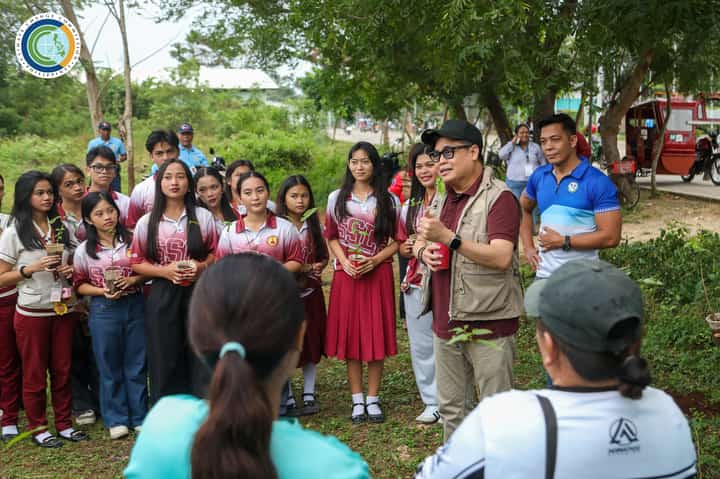
PRACTICING what he preaches, Climate Change Commission vice chairperson and executive director Robert E. A. Borje encouraged youth leaders, students, farmers and fisherfolk in Santa Fe, Cebu to plant tree saplings to advance ecosystem-based adaptation as a practical and community-driven response to climate risks.
Photograph courtesy of Climate Change Commission
Since almost all countries signed on to the United Nations Framework Convention on Climate Change (UNFCCC) in 1992, the treaty's institutional framework established the annual Conference of the Parties (COP) as its supreme decision-making body. These COP meetings have since produced agreements on limiting greenhouse gas (GHG) emissions and temperature.
In the COP19 held in Warsaw, Poland, in 2013, a consensus to address loss and damage from climate change was reached through the creation of the Warsaw International Mechanism for Loss and Damage. But nine years passed before countries agreed to establish the Fund for Responding Loss and Damage (FRLD) at COP27 in Sharm el-Sheikh, Egypt, in 2022, with the fund operationalized at COP28 in Dubai in 2023. At COP29 in Baku, Azerbaijan, in 2024, parties focused on advancing the operationalization of the FRLD.
AT a business and governance forum, Climate Change Commission VCED Robert E. A. Borje reminded private sector leaders that real climate action does not succeed on policy alone but succeeds when institutions, communities and individual Filipinos move together.
Photograph courtesy of Climate Change Commission
The FRLD is intended to assist nations highly vulnerable to the adverse effects of climate change—such as small island states and the Philippines—in responding to economic and non-economic losses caused by extreme weather events like typhoons and droughts.
Funding was expected to begin after the operationalization of the FRLD at COP28 in 2023, but Climate Change Commission (CCC) vice chairperson and executive director (VCED) Robert E. A. Borje says the FRLD board is still discussing the access modalities, disbursement mechanisms and institutional arrangements.
For CCC's VCED, the situation demands foresight and a long-term perspective, something that he possess after a long and fruitful career in diplomatic service.
Collective discipline
Before leading the CCC, Borje spent nearly two decades in diplomacy, representing the Philippines in multilateral arenas and serving in posts abroad. That experience has proven useful in global climate negotiations under the UNFCCC, where he serves as the country’s National Focal Point. He previously served on its Adaptation Committee as the first Filipino appointed to that body.
As CCC’s VCED, he leads a wide-range of climate agenda that extends beyond climate finance. While mobilizing and engaging on climate finance remains an important priority, he also spearheads initiatives to strengthen data systems, improve institutional coordination, enhance the capacity of local governments, empower youth leadership, and realign private-sector incentives to drive sustained climate action.
The son of a retired Navy admiral and a barangay captain, Borje was raised between discipline and grassroots service. The latter is shown by promoting local adaptation plans to municipalities.
His academic training — a communications degree followed by an Executive Master’s in Disaster Risk and Crisis Management — reflects his dual focus: explain clearly, prepare systematically.
At a resilience forum introducing national adaptation strategies, he advised local chief executives gathered there to “build right at first sight,” meaning to make resilience deliberate, not accidental.”
The phrase captures his philosophy. Prevention over reaction. Foresight over improvisation.
At a business and governance forum, he reminded private sector leaders that “real climate action does not succeed on policy alone. It succeeds when institutions, communities, and individual Filipinos move together.”
The setting mattered. He was asking corporations to view climate risk not as corporate social responsibility but as an operational reality.
Resilience, he argues, must become embedded in supply chains, infrastructure investments, school curricula, and local budgeting processes.
In other words, climate-safe living will not emerge from one agency. It must grow from collective discipline.
Pushing for responsibility
Colleagues describe Borje as measured and methodical — more inclined to listen than to dominate discussion. In international negotiations, that temperament helps him balance diplomacy with national interest. At home, it allows him to convene agencies that historically worked in silos.
He has received national honors for public service. Yet in interviews and public remarks, he rarely frames his work in terms of achievement. More often, he speaks of timelines — 2030 targets, mid-century pathways, adaptation benchmarks.
He talks about “mainstreaming” climate in development plans — a technical phrase that, in practice, means changing how roads are built, how cities expand, how farms irrigate.
There is honesty in the way Borje discusses climate governance. He does not promise a climate-proof Philippines within a decade. He acknowledges the scale of the challenge — global emissions, economic pressures, political cycles.
Likewise, climate justice will not be achieved in one administration, or even one generation. But it can begin now — in zoning ordinances, corporate disclosures, school programs, adaptation budgets.
The keyword to making this possible is responsibility. Responsibility from local governments to integrate risk into planning. Responsibility from businesses to invest in sustainability. Responsibility from citizens to understand that climate action is not optional.
On most days, Borje’s work does not make headlines. No ribbon-cuttings. No photo-ops. No applause. Instead, he quietly helps construct architecture and systems that anticipate storms before they strike, policies that reduce vulnerability before tragedy unfolds. With his stewardship of the CCC, he is laying the groundwork for giving Filipinos the climate justice they deserve.