
Six planets shine in rare February celestial parade
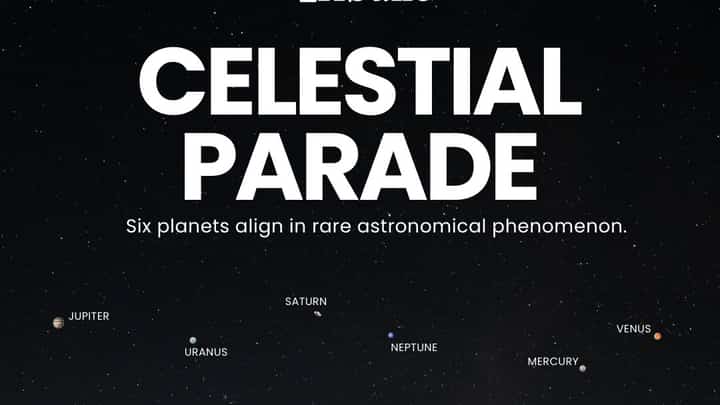
SKYWATCHERS may see six planets after sunset on 28 February 2026, with the best viewing window beginning about 30 minutes after sunset.
Graphic by Sheila Figueroa / Daily Tribune images.
MANILA, Philippines — Skywatchers will have a chance to witness a rare celestial display as six planets become visible in the evening sky on 28 February 2026, an event often described by astronomers as a planetary parade.
The alignment involves Mercury, Venus, Jupiter, Saturn, Uranus, and Neptune, all appearing along the ecliptic, the path traced by the Sun and planets across the sky. Unlike a perfect straight line in space, the planets will appear grouped from Earth’s perspective.
Astronomy sources note that the best time to observe the phenomenon is about 30 minutes after local sunset. In the Philippines, where sunset is calculated at 06:05 p.m., the optimal viewing window begins shortly afterward, provided skies are clear.
Four planets — Venus, Jupiter, Saturn, and Mercury — may be visible to the naked eye. Venus is expected to be the brightest, followed by Jupiter, while Saturn will appear moderately bright. Mercury, although technically visible, may be more difficult to locate due to its low position near the horizon.
Two planets — Uranus and Neptune — will require binoculars or a telescope. Uranus will appear higher in the sky compared with the other western planets, while Neptune will sit low near Saturn, making it the most challenging object to detect.
Observers are advised to look low in the western sky shortly after sunset to locate Mercury, Venus, Saturn, and Neptune. Uranus will appear higher toward the southwest, while Jupiter will stand out brightly high in the southeastern sky, remaining visible much longer than the other planets.
Planetary visibility will change quickly during the evening. Mercury and Venus will set first, followed by Saturn and Neptune. Uranus will remain visible longer, while Jupiter will dominate the sky for most of the night.
Astronomy guides emphasize safety precautions during early evening observations. Binoculars or telescopes should never be pointed near the Sun. Viewing should only begin once the Sun has fully set below the horizon.
Experts note that while multiple planets appearing in the sky is not extremely rare, alignments involving several easily visible planets at convenient evening hours occur only every few years. The next comparable event is projected for late October 2028, followed by another notable alignment in February 2034.
For beginners, astronomy apps and sky maps may help identify planetary positions in real time, especially for fainter targets such as Uranus and Neptune.
With favorable weather and a clear horizon, the late February skies could offer an engaging and accessible introduction to planetary observation for both casual viewers and experienced enthusiasts.