
Bigger storm
Bongbong has been faltering in his response to the political volatility he faces, which is not even half as intense as the insurrection that marred the term of his father.

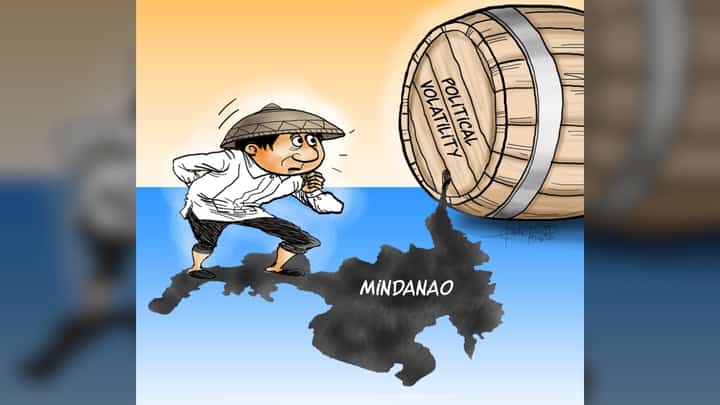
A challenge even greater than the current political strife may soon confront President Ferdinand Marcos Jr. if he does not act swiftly, which is the brewing discontent in the Bangsamoro Autonomous Region in Muslim Mindanao (BARMM), worsened by the postponement of the elections originally set for 30 March this year.
Burdened by a sharp drop in survey ratings, Marcos appears to have lost his grip on the corruption scandal, as public perceptions of stonewalling and cover-ups have come to dominate the investigations.
A prominent Australian scholar and counterterrorism and cognitive warfare expert who has studied and lived in volatile areas of Mindanao said another outbreak of hostility is possible in the Bangsamoro region.
A peace agreement between the national government and the Moro Islamic Liberation Front, the dominant Muslim separatist group in Mindanao, was signed in 2014.
The Bangsamoro autonomous region for the majority Muslim population was formalized in 2019 under President Rodrigo Duterte. A period of stability and development followed.
The BARMM government was inaugurated thereafter, and the first session of the Bangsamoro Parliament was held.
Despite the autonomous region, around 40 percent of Armed Forces of the Philippines battalions are deployed in Mindanao, tasked with internal security operations and quelling a hodgepodge of local groups under the banner of the Islamic State East Asia (ISEA).
Australia-based counterterror expert Haroro J. Ingram said in a report that endemic conflicts and poverty made the Bangsamoro population desperate for peace dividends to be fully delivered; thus, uncertainty was heightened by the postponed elections.
At stake is ISEA’s ambition of regaining a foothold in Southeast Asia after its 2017 defeat in Marawi City.
Haroro said the peace process is more fragile now than at any point since the autonomous region was established, which is evident in the surge in violence in local communities, partly brought about by the uneven delivery of government services.
“The decisive constituency in the Bangsamoro region’s fortunes are current and former combatants from violent rebel groups. These are the actors with the capacity to either anchor peace or reignite conflict,” Haroro said.
Haroro worked in Mindanao’s conflict-impacted areas in the aftermath of the 2017 Marawi siege.
He said the Bangsamoro peace process had the memory of the Marawi conflict as a reminder to stay the course, but “that momentum has now largely dissipated.”
Haroro interviewed hundreds of former combatants and communities across the Bangsamoro, and the outcome suggested “the balance is tipping in a dangerous direction: persistent security threats, missed reintegration opportunities, dashed expectations, and communities quietly hedging against the peace endgame’s collapse.”
Perceptions of wavering commitment to Bangsamoro autonomy have been fueling discontent.
On 21 January, President Marcos celebrated with his Bangsamoro government counterparts the BARMM’s seventh anniversary, but a bill was filed to reset the autonomous region’s first elections to 28 September 2026.
“Two days later, four Philippine Army personnel were killed in an ambush. Then, late last week, the Philippine Army clashed with a different ISEA faction, the DI-Hassan Group. Islamic State has reportedly claimed responsibility for both incidents,” Haroro said.
Duterte, whose commitment to the Bangsamoro region was widely regarded as firm, still faced the IS threat, indicating the presence of several violent groups seeking dominance in the southern region.
Bongbong has been faltering in his response to the political volatility he faces, which is not even half as intense as the insurrection that marred the term of his father, Ferdinand Marcos Sr.
Such a crisis cannot be managed through reimagining and optics.