
If it quacks like a duck
Its inequitable nature is reflected in some facilities receiving P5,000, others P10,000, and still others P50,000 without any rational basis or accountability.

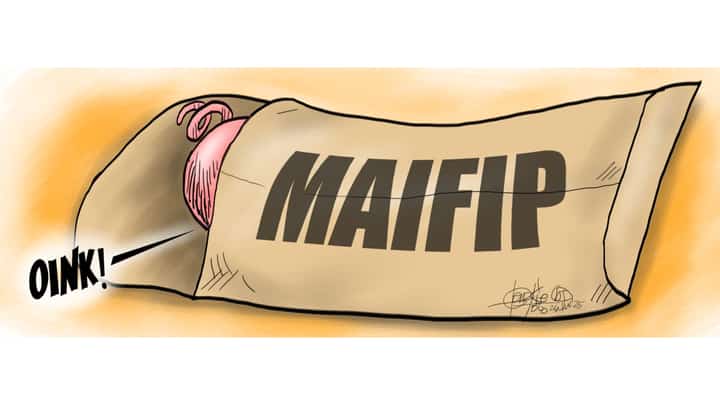
Blowing the lid off the flood control racket led the government to turn the screw tighter on so-called hard projects, or infrastructure development, prompting pork-hungry members of Congress to shift to soft programs or ayuda schemes.
Still smarting from the vicious battle for the reserve funds of the Philippine Health Insurance Corp., the healthcare sector is now zeroing in on the Medical Assistance for Indigent and Financially Incapacitated Patients (MAIFIP) of the Department of Health as a new outlet for the theft of public funds through the 2026 General Appropriations Act (GAA).
According to sector stakeholders, MAIFIP is a revival of the pork barrel system, once operating through conventional channels within the Department of Public Works and Highways and other agencies.
Aside from its use as a conduit for discretionary funds, MAIFIP undermines the Universal Health Care (UHC) Act, which was painstakingly developed to provide free hospitalization services.
Dr. Anthony Leachon, a healthcare advocate and former adviser to the Department of Health, said the program is nothing short of a new pork barrel cloaked in health rhetoric.
He added that it is potentially unconstitutional because it undermines PhilHealth’s role as the single source of healthcare benefits mandated under the UHC law.
MAIFIP fragments financing and creates a parallel structure to PhilHealth, thereby weakening the very foundation of UHC.
The dilution of PhilHealth’s authority risks violating both the spirit and the letter of the landmark law, he added.
Despite having a P53-billion budget, the Department of Health (DoH) admits that MAIFIP lacks clear guidelines while promising that rules will be issued soon.
“This is not governance; it is improvisation,” according to Leachon.
“In reality, patronage politics fills the vacuum. Without guarantee letters or transparent processes, we know how the system works: a phone call or text from a local government head or lawmaker can tilt the balance,” the health sector figure pointed out.
Its inequitable nature is reflected in some facilities receiving P5,000, others P10,000, and still others P50,000 without any rational basis or accountability.
Such is the height of health patronage, as it promotes a mendicant mentality, fosters dependency and entrenches political favoritism rather than building a sustainable, process-based system.
By draining resources away from PhilHealth, the institution mandated to protect the Filipino people under UHC, both the poor and the middle class are affected.
Already burdened by taxes, the middle class will see its contributions diverted into a discretionary fund rather than a unified insurance system.
In 2025, the Bicameral Conference Committee denied a subsidy to PhilHealth while allowing MAIFIP to dominate health financing.
The tragedy is compounded when viewed alongside the unresolved flood control program, another glaring example of misplaced priorities and systemic neglect.
Leachon said that while communities drown in actual floods, the health system is drowning in political patronage.
The skewed priorities under the Marcos administration reveal a government more committed to discretionary spending and political expediency than to long-term, sustainable solutions.
MAIFIP is being used to dismantle UHC and replace it with patronage politics disguised as health assistance.
The Department of Health has argued that MAIFIP is not a form of pork barrel because funds are released directly to hospitals, but health advocates emphasize that the core issue lies not in where the funds go but in how this assistance is accessed through political favor.
Since MAIFIP operates at the discretion of politicians, it is effectively a pork barrel.