
The Swing Guru
Sto. Domingo makes a living molding future champs
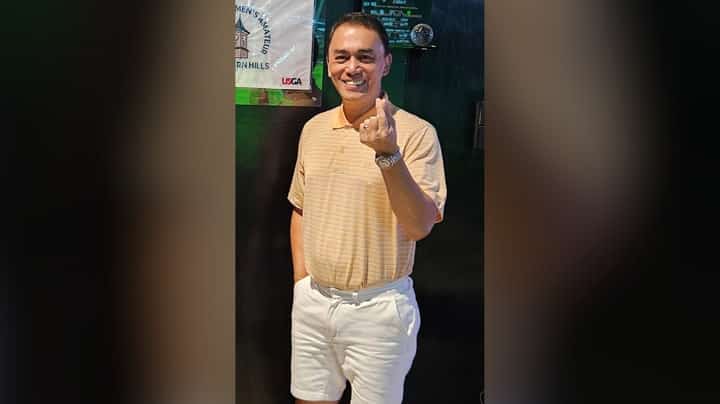
Before the ball ever flies, before the applause breaks the quiet of a fairway, golf begins in stillness — hands on a grip, feet on the ground, patience in the mind.
For Norman Sto. Domingo, one of the country’s most respected golf teachers, that stillness has defined a lifetime spent shaping players, guiding potential, and quietly influencing the direction of Philippine golf from the range into the world’s biggest stage.
“I’m okay. Actually, I don’t go to tournaments anymore. I teach golf,” Sto. Domingo said in the latest episode of Off the Court, the weekly sports show of DAILY TRIBUNE last Thursday.
While many coaches use teaching to chase glory, Sto. Domingo’s path bent early toward instruction, discipline, and understanding the game beyond scorecards.
He has taught for more than three decades, and in that time, he has seen Philippine golf evolve from sun-baked driving ranges to data-driven virtual bays, from backyard talent to global contenders, including Rianne Malixi — the future of Philippine golf.
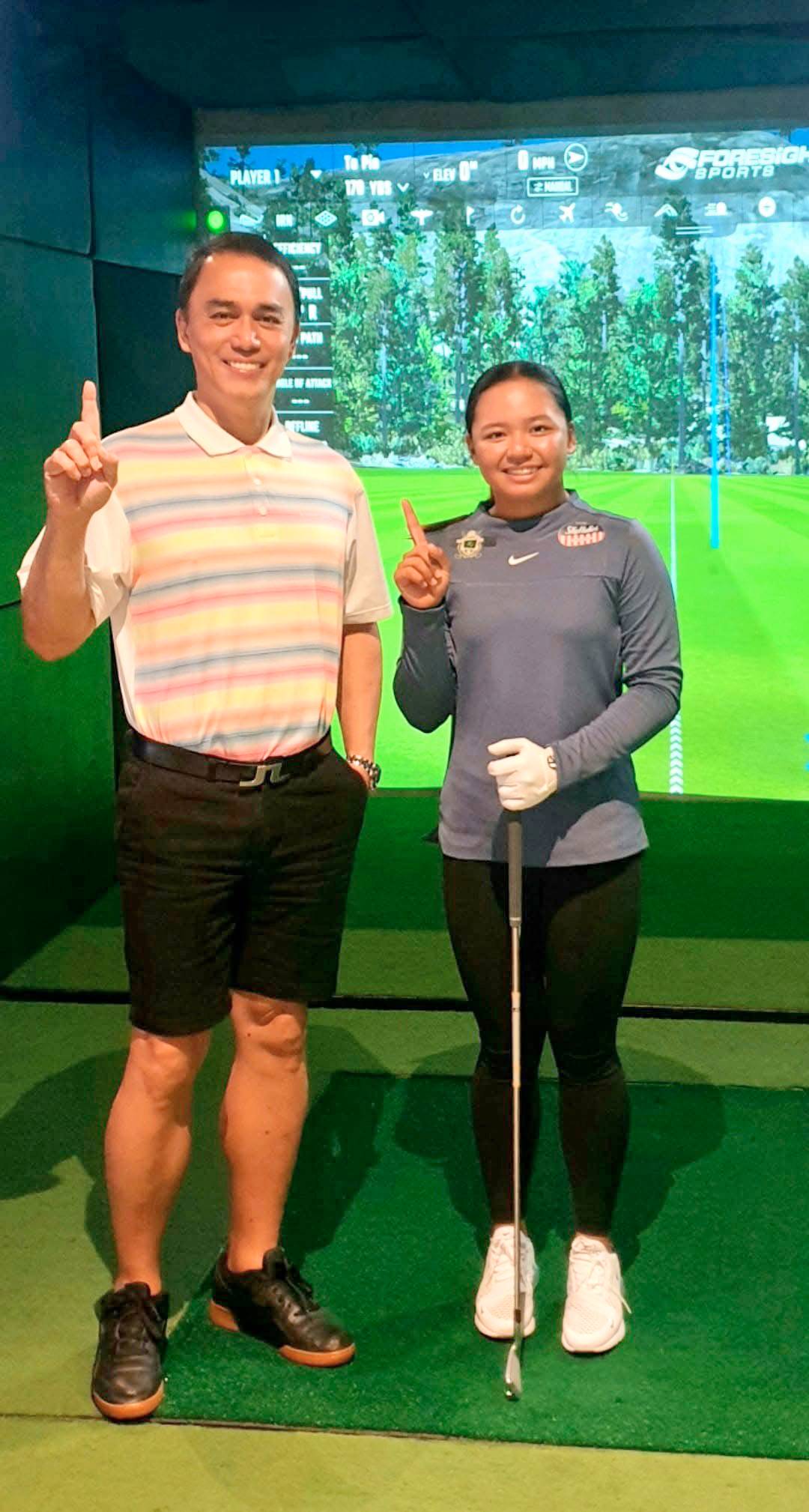
RIANNE Malixi credits her golf brilliance to the patience of her coach — Norman Sto. Domingo.
“We teach a lot of good players. One of our best in the Philippines is Rianne Malixi,” said the 61-year-old Sto. Domingo, who was branded as the “Swing Guru” by countless of young golfers and their parents for his ability to turn a complicated swing method into a crystal-clear instruction.
True enough, Malixi is a living proof of Sto. Domingo’s teaching brilliance.
The 18-year-old shotmaker is a back-to-back US Women’s Amateur Open and Junior Girls Open champion who is now studying and competing for Duke University in North Carolina. Her rise, in many ways, mirrors the philosophy of the coach behind her — measured, patient, rooted in fundamentals.
“I’m teaching her. She’s the US Women’s Amateur Open Champion and Junior Girls Open Champion in the US — back-to-back in 2024.“
Family man
Actually, Sto. Domingo did not always imagine himself becoming a full-time mentor. His own playing career followed a familiar arc — strong junior golf career, competitive promise, and then the reality of adulthood.
“In junior golf, it’s only until 17 years old — sometimes 18. After that, junior tournaments stop, and normally you either mature into higher competition or turn professional,“ Sto. Domingo recalled.
In his case, life intervened.
“I was still studying. I also got married early at 21, so golf was no longer a priority. I stopped playing competitively,” he said, putting emphasis on the reality that he would rather spend his time raising his young family than enjoy the company of his friends in the golf course.
But golf never left as that balance between passion and practicality would later define his coaching style — golf as a serious pursuit, but never detached from life itself.
“After many years, I was already working for about four years. I still played once a week, more for enjoyment and learning,“ Sto. Domingo said.
“Later on, my friend Thirdy Escaño invited me to be part of the Southwoods team. That’s how everything started again — this time, leaning more toward teaching.”
Teaching
Teaching, Sto. Domingo admitted, was not something he mastered overnight.
“Coaching is something you only truly learn by doing,” he said, stressing that he discovered that knowing golf and teaching golf are completely different disciplines.
“I honestly thought I already knew how to teach. I started playing in 1976 and trained from 1984 to 1997. I thought that experience was enough.”
“But after three years of training, I realized I still didn’t know how to teach properly.”
The turning point came through the Nicklaus-Flick Golf Schools in the United States, a prestigious golf academy that was co-founded by golf legend Jack Nicklaus and Jim Flick, where Sto. Domingo absorbed a philosophy that would anchor his entire coaching career.
From there, learning became continuous.
“I learned the basics from the Jack Nicklaus Academy. Jack Nicklaus personally taught me how to teach, even if it was only for a short period,“ Sto. Domingo said.
“I continued learning on my own — reading books, applying techniques and teaching continuously.”
Sto. Domingo said he didn’t know that the cycle — learn, apply, teach, repeat — is already running for more than three decades because he is actually enjoying his teaching journey.
“I’ve been coaching for 32 years now, and I think I already understand what I’m supposed to do with my golf career,” Sto. Domingo said.
But at the heart of Sto. Domingo’s instruction is simplicity. He said he is wary of overloading beginners with jargon or unrealistic expectations, especially in a sport that already intimidates many newcomers.
“The most important thing in golf is how you hold the club,” he added, stressing that grip, posture, balance are the basics everybody must master for them to learn proper swing and enjoy the game.
“If you hold it correctly, everything else becomes easier. It’s simple, but it has to be correct.”
That philosophy carries into his advice for beginners, especially those taking a swing at his Quantum Golf branches in Pasig and Alabang.
“My suggestion is to have at least one or two formal lessons before you start,” he said. “Friends usually teach, but if they don’t really know golf, they just teach based on guesswork.”
Digital greens
As technology reshapes the sport, Sto. Domingo has embraced innovation without abandoning tradition.
Quantum Golf, the virtual golf facility he helped build, is a product of that balance. It was born in the aftermath of the pandemic and has an answer in every golfer’s changing needs.
“Quantum Golf was formed around 2022. It’s been about three to four years now,” Sto. Domingo said.
“It was really hard. We had to move around a lot. The driving range was closed for months.”
Online lessons became a necessity, even if they initially felt unatural but time and demand changed his mind.
“Many people wanted online or Zoom lessons, but I didn’t believe in it at first,” Sto. Domingo said.
“Now, I have five to six families enrolled. Some kids even fly in just to have lessons. Others can’t travel, so they do Zoom sessions instead.”
Quantum Golf’s virtual setup allows players to see what the naked eye often misses. And for Sto. Domingo, data does not replace feel, but it enhances understanding, making the players know the metrics they need to accomplish and the progress they are having.
“You can see all the data — distance, impact position, and more,” he said. “In a regular driving range, you only see the ball fly. In virtual golf, you get data that helps you learn properly.”
Low-profile relationship
But beyond facilities, Sto. Domingo remains deeply involved in talent development, particularly with Malixi, whom he first encountered before the spotlight found her.
“I kept hearing the name Rianne — she was only 11 years old then. People told me she was really good,“ said Sto. Domingo, who saw something special on Malixi that other coaches didn’t.
“She wasn’t that famous yet — she was good, but still under the radar.”
“When I brought her to the Pradera Verde team, she got exposed to players like Yuka Saso,” he said. “If we were to list our top prospects, she’s number one. No question.”
Sto. Domingo said his coach-player relationship has not faded — even now. In fact, Malixi would still send her videos to seek his advice despite competing competitively in the United States and various parts of the world.
“She still sends me videos so I can check her form. But we agreed to keep our relationship low profile to avoid conflicts with her coach there,” Sto. Domingo added. “The fundamentals we worked on — especially her rotation and consistency — are still there in her game today.”
For Sto. Domingo said success stories like Malixi’s are affirmations, not endpoints. His larger concern lies with accessibility, patience and culture — how golf is taught, funded, and experienced, especially by children.
“Golf is not an easy sport because you need time and resources,” Sto. Domingo noted, adding that golf may be demanding but can still be accessible based on how badly a player wants to improve.
“You need to have a budget and you also need skills. If you think you can handle those three; remember, time, resources and skills, then go for it.”
True enough, like his relationship with Malixi, Sto. Domingo has chosen a more quiet role, the steady hand behind every swing, the voice that reminds young golfers to start with the grip, be patient with their drives and to enjoy the process before even hoping to score an ace.