
Big bold rhetoric won’t work
The latest labor statistics show employment contracting by 277,000 year-on-year to 49.27 million, while unemployment grew by 590,000 to 2.25 million in November 2025.

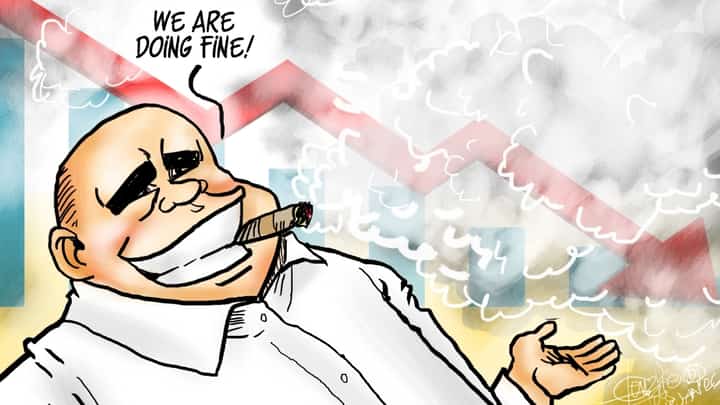
Economic managers on Friday unveiled before top business executives what they billed as “Big Bold Reforms,” amid the efforts to contain the backlash from the government corruption scandal.
The global perception of our country, built over years of government leaders’ budget manipulations, is that irregularities are deeply ingrained and pervasive, so that a level playing field will never be achieved.
Finance Secretary Frederick Go, nonetheless, presented to the executives key reforms in trade facilitation, transportation and other sectors to sustain economic growth.
It will be like rolling the rock uphill to hurdle the effects of the pork-infested budget and the image it has created for the country.
Grand-scale corruption, which captured the public attention so overwhelmingly in the last half of 2025, has pushed aside the efforts to fix the weakening economy.
The struggle to overcome the detrimental effects of the anomalies has led to worsening indicators, signaling a deterioration of the once robust growth momentum.
The latest labor statistics show employment contracting by 277,000 year-on-year to 49.27 million, while unemployment grew by 590,000 to 2.25 million in November 2025. The unemployment rate rose to 4.4 percent from 3.2 percent the year before.
Economic think tank Ibon believes the employment data is overstated, as it counts a huge 3.52-million unpaid family workers as employed.
Moreover, the unemployment data is understated because it does not count an estimated two to three million who have stopped looking for jobs or have “dropped out of the labor force.”
Nearly 31 million, or 62 percent, of the total employment is concentrated in sectors most prone to severe employment swings and are also the lowest-paying, such as agriculture and fishing, wholesale and retail, accommodation and food services, construction and other services, according to Ibon.
“These sectors are revolving doors of insecure livelihoods,” the report indicated.
Labor market distortions explain why inflation easing to 1.8 percent lately has brought little relief to the poorest and most vulnerable Filipinos, as not enough decent-paying jobs are being generated.
This was evident in the recent Social Weather Stations (SWS) survey, which showed that 51 percent of respondents rated themselves poor. Considering that another 12 percent rate themselves on the borderline, the poll results translate to 63 percent of Filipino families considering themselves poor and vulnerable.
The Big Bold Reforms rhetoric is necessary to arrest the political decline of the Marcos administration. Yet, figures from the government itself indicate a more substantial impact from the massive theft of public funds.
A coherent development strategy that generates stable and productive employment across sectors is long overdue, according to Ibon.
Difficult to overcome is the loss of confidence in the administration’s handling of the corruption debacle.
If Big Bold Reforms is an indication, the responses to the rot spreading in governance would likely be through empty soundbites and optics.
Decisive actions that would break the stranglehold of rent-seeking economic players and the inability to break free from patronage politics would render the supposed reform initiatives mere cosmetic measures.
Consider that the 2026 national budget retained the means to make massive pork barrel allocations to satisfy Congress allies, despite the outrage over the overpriced and nonexistent flood control projects.
The show of ending all anti-flood measures, for instance, worsens the ordeal of Filipinos when the heavy rains start.
It is then that the Marcos administration dons its oft-invoked reformist posture — in reality nothing more than a smokescreen.