
Deakin accompanies son to LTO over Skyway traffic violation

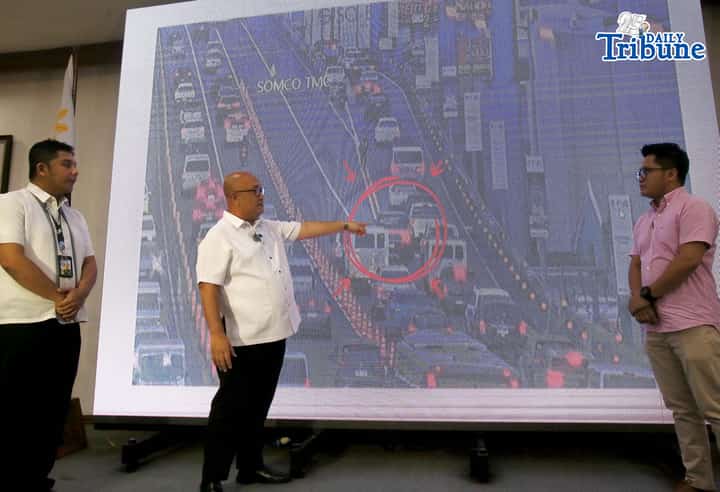
LAND Transportation Office (LTO) Chief Markus Lacanilao showed a photo from CCTV of a traffic incident involving Deakin’s son, who crossed a double solid line and was driving an unregistered vehicle. Lacanilao made it clear that reckless violation is not a criminal case but merely an administrative case. Lacanilao’s statement came after motoring vlogger James Deakin’s son received a ticket for reckless driving for entering a double yellow line at the exit of the NLEX–Skyway Quezon Avenue and had problems retrieving his son’s driver’s license. The statement was made during a press conference held at the LTO office in Quezon City on Wednesday, 07 January 2026.
Photo by Analy Labor
Transport blogger James Deakin appeared at the Land Transportation Office (LTO) to accompany his son, who was issued a subpoena following an alleged traffic violation on Skyway dated 18 December.
Deakin had earlier taken to social media to air his concerns over the incident, saying his 19-year-old son is a new driver who has held a license for only a few months and is unfamiliar with Skyway exits.
He questioned the decision to penalize his son for “reckless driving” over what he described as a lane violation and sought clarification on why calendar days, rather than working days, were applied in settling the apprehension.
In a press briefing, the LTO said the violation was issued after the driver crossed a double solid line, which it described as a “clear, universal and strict traffic rule” that prohibits motorists from crossing or changing lanes at any time.
LTO Chief Assistant Secretary Markus Lacalinao clarified the difference between reckless driving and reckless imprudence, stressing that Deakin’s son is not facing any criminal charge.
He said the case is “purely administrative in nature” and will not form part of the driver’s permanent record.
The LTO also reiterated that traffic violations must be settled within 15 calendar days under traffic adjudication rules, which include weekends and holidays, contrary to the belief that drivers are given 15 working days.
“Because the apprehension happened around Christmas time it was expected that there would be closed days in government offices. Because of this, it should be the driver's responsibility to consider the schedule of the holidays and schedules of the office in accordance with his obligation, within the given time,” the LTO chief said.
On Monday, after Deakin’s camp was directed to respond to a show cause order, the content creator said in a social media post that the “original lesson he tried to teach his son” — that society improves when rules are followed — was ultimately reinforced.
According to Deakin, the LTO handled the matter professionally, observed due process, and even gave them the option not to livestream the hearing for the press.
“There were bumbs along the way. But today is what mattered. Because it proved that when individuals within institutions respect due process,the system does actually work,” Deakin said.
“Whatever the resolution, I’m grateful my son got to see due process work and the value it has in society. That was the whole point from day one,” he added.