The first whole week of 2026 opened with President Ferdinand Marcos Jr. taking a decisive step in governance anchored on fiscal responsibility, continuity, and visible on-the-ground action.
Reflecting the administration’s priorities for the year ahead, the President signed into law the General Appropriations Act (GAA), the budget law that places renewed emphasis on education and healthcare, sectors seen as critical to building a more resilient and productive nation.
Administration critics, however, filed a petition in the Supreme Court questioning the unprogrammed appropriations (UA), which are standby items in the budget but which have been turned into a conduit for the pork barrel.
Also, amid swirling rumors, Malacañang firmly denied plans of a revamp, signifying its effort to clear political distractions at the start of the year.
The President’s week was marked by engagements that highlighted governance in motion.
05 January
2026 National Budget signed
President Marcos signed the P6.793-trillion 2026 GAA with its focus on public needs and on promoting accountability and transparency.
Marcos noted the national budget is aligned with the administration’s medium and long-term development plans and vision.
Education and health received the largest share of the budget, with commitments to support their personnel, address the classroom backlog, and strengthen the implementation of the Universal Healthcare Act and zero-balance billing program.
Single-digit poverty rate by 2028
Before the President steps down in 2028, the administration aims to have a single-digit poverty rate.
To achieve this, Marcos reiterated the administration’s commitment to a social protection system that addresses systemic vulnerabilities and promotes sustained, inclusive growth.
“The social services sector is provided with more than P270 billion. We will prioritize social services that enhance the quality of life of every Filipino, safeguards the welfare of all sectors, and fosters human capital development,” he said.
UA veto falls short
The President exercised his veto power over the Unprogrammed Appropriations (UA) in the national budget, cutting non-essential expenses.
Under the UA, the following line items were vetoed: budgetary support for government-owned and controlled corporations (GOCC) amounting to P6.895 million; shares of local government units amounting to P14,623; payment of Personal Services Requirements amounting to P43.245 million; the Comprehensive Automotive Resurgence Strategy (CARS) Program amounting to P4.32 million; and the Revitalizing the Automotive Industry for Competitiveness Enhancement (RACE) Program amounting to P250,000.
06 January
No Cabinet revamp, yet
Malacañang has denied rumors of a wide-ranging Cabinet revamp at the start of the year, despite reports that nine government agencies could be affected if the President decides to proceed.
Palace Press Officer Undersecretary Claire Castro said the previously announced performance review remains in effect, as it is at the President’s discretion, and government appointees serve at his pleasure.
“So, it depends on what the President sees. But as of now, we have not heard anything; there is no indication that there will be a Cabinet revamp,” she said.
Ready for 2026 budget challenge
The Palace said it is ready to argue the 2026 budget before the Supreme Court, following several lawmakers’ dissatisfaction with the GAA.
Castro said Malacañang is confident of its budget review, which preceded President Marcos’s signing of the General Appropriations Bill into law.
“The budget we have now is the cleanest, the most organized, and it is for the people. The President is confident,” she said.
07 January
‘Faithful stewards’ guard coffers
With the enactment of the 2026 National Budget, President Marcos asked the Armed Forces of the Philippines (AFP) to become “faithful stewards who guard the public resources” on top of their duties as protectors of the country.
“Be among those who ensure that every peso translates to capability, preparedness, and integrity,” Marcos said.
In return, the President assured the military of the government’s total support.
New responsibilities, same mission
Marcos lauded the AFP officers promoted to general and flag officer, emphasizing that their rise to the rank “reflects the Republic’s confidence in their judgment, command, and ability to lead amidst pressure and uncertainty.”
“You begin this new year with new stars and greater responsibilities resting upon your shoulders, yet your mission remains unchanged. It endures,” he said.
“Leadership at this level is less about the number of operations that you may have completed; it is about the standards that you set — standards that shape behavior, conduct, and decision-making across the entire Armed Forces.”
The President noted that this principle, when translated to action, will guide officials through every challenge they face, ensuring that their approach is grounded in integrity, discipline, and honor.
08 January
General amnesty for PhilHealth
President Marcos instructed the Philippine Health Insurance Corp. (PhilHealth) to grant a general amnesty to business owners, employers, and self-employed members, providing a “one-time opportunity” to settle their unpaid contributions without incurring interest or penalty charges for late payments.
The President recognized the financial burden on members who have struggled to settle their dues.
Members and employers will be given one year to pay their missed contributions that occurred between 2013 and 2024.
Marcos also reminded employers to update their personnel records and enroll their employees in the Yaman ng Kalusugan Program (YAKAP) so they can receive free consultations, essential medicines, lab tests, and cancer screenings to promote early detection and reduce health-related expenses for Filipinos.
Cagayan bridge opens
The President went to Cagayan on Thursday for the inauguration of the P2.3-billion Camalaniugan Bridge. With its completion, economic activity is expected to increase in the area.
“I am sure this bridge will change the economy of the areas on both sides. More opportunities will open. New jobs, new businesses will rise, and I’m sure you will feel the economic effects in a very, very short time,” Marcos said.
The 2.16-kilometer, two-lane Camalaniugan Bridge will serve as an alternative to the Magapit Suspension Bridge, the only bridge in the northernmost part of Cagayan that spans the Cagayan River.
Piggatan span rehab inspected
Still in Cagayan, the President checked on the progress of the Piggatan Bridge rehabilitation, underscoring the government’s commitment to restoring the vital transportation link along the Maharlika Highway in Barangay Piggatan, Alcala, Cagayan.
The Chief Executive directed the Department of Public Works and Highways (DPWH) to ensure the replacement bridge is appropriately designed and constructed, safe, durable, and compliant with applicable engineering standards.
To recall, the 74.4-meter Piggatan Bridge collapsed on 6 October 2025 under the 130-ton combined weight of four trucks that were overloaded, injuring six individuals.
Marcos was also updated on the plans for a permanent bridge, which will provide a long-term, climate-resilient solution to address the increasing traffic on the national highway.
Young athletes encouraged to shine
Mr. Marcos shared a few insights as a sports fan, encouraging young athletes to give it their best and embrace the spirit of sportsmanship when he graced the opening of the Cagayan Provincial Athletic Association (CPAA) meet.
In his message at the Camalaniugan Sports Complex, the President highlighted the values of discipline, camaraderie, and perseverance that sports instills in students.
He emphasized the importance of continuing to promote sports among the youth, noting that participation in athletic activities teaches valuable life lessons beyond the playing field. He also bared the government’s plan to re-incorporate sports administration in the Department of Education (DepEd).
09 January
Let Nazareno guide the way
Joining the Filipino Catholic faithful, President Marcos urged them to let the Jesus Nazareno guide them in their daily lives, not just on the day of the feast.
“I invite everyone not only to reach for the Nazareno’s image, but to let this devotion guide the way we think, act, and help one another long after the procession has passed,” he said.
“If we can go through great lengths for a moment of contact with the image, we can also persevere in the daily work of choosing honesty over falsehood, service over self-interest, and compassion over indifference,” he said.
He likened Jesus’s suffering to the sacrifices of Filipinos. The image of the Nazareno speaks to the people “who know how it is to be tired, yet still choose to rise and move forward together,” he said.
DepEd’s AI program rollout
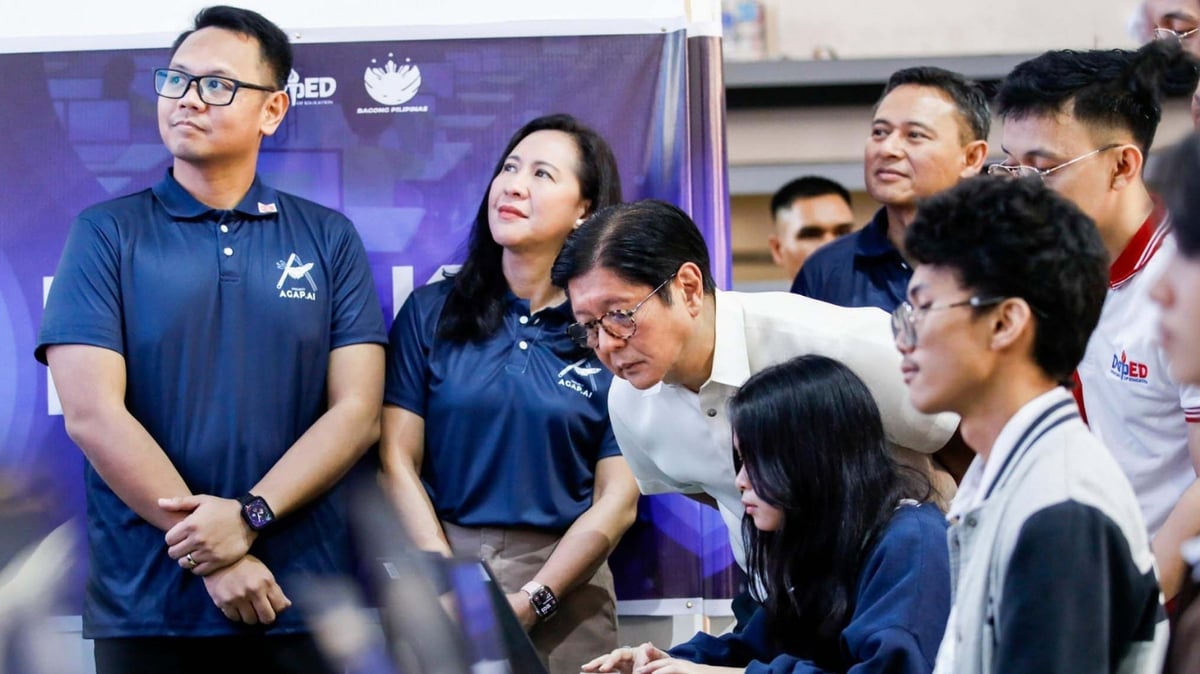
In a bid to advance the DepEd’s learning modalities, President Marcos led the launch of the Artificial Intelligence (AI) program designed to support teachers and learners in the classroom.
With the launch of AGAP.AI, Marcos said the government seeks to bridge the gap between technology and education.
Built in partnership with the DepEd and the Association of Southeast Asian Nations Foundation, with the Asean Vision 2045 as a guide, the President said AGAP.AI will advance learning in classrooms and help teachers use AI effectively, promoting its responsible and ethical use.
In addition, the DepEd is developing the Foundational Guidelines on AI in Basic Education, which will serve as the Philippines first national framework for using AI in schools.
Revisiting QC high rehab
To cap the week, the President revisited the San Francisco High School (SFHS) in Bago Bantay, Quezon City, to check on its reconstruction following a fire that damaged the school in June last year.
On his first visit after the fire, Marcos ordered the swift reconstruction of the structure so the teachers and students could resume classes.
Initially, the two-story DAO building housed 10 classrooms, which have been in use for over 45 years. The new building is being constructed as a four-story structure, increasing the previous 10 classrooms to 36.
Marcos sought the SM Group’s assistance in constructing the additional 24 classrooms.
Completion of the project is expected by the opening of the next school year.
UAE visit slated
This week, the President will fly to the United Arab Emirates (uae) at the invitation of President Sheikh Mohamed bin Zayed Al Nahyan. He will participate in Abu Dhabi Sustainability Week, scheduled for 11 to 15 January.
The President will join other heads of state and government to discuss issues related to energy, water, finance, food, and the environment.
He is also scheduled to attend the signing of two important agreements between the Philippines and the UAE, namely, the Comprehensive Economic Partnership Agreement (CEPA) and the Memorandum of Understanding on Defense Cooperation.
CEPA is the Philippines’ first free trade agreement with a Middle Eastern country, aimed at expanding market access to the region. The Memorandum of Understanding on Defense Cooperation will serve as a solid foundation for cooperation with the UAE to develop the Philippines’ defense technologies.