
Grok: The new tool for digital harassment

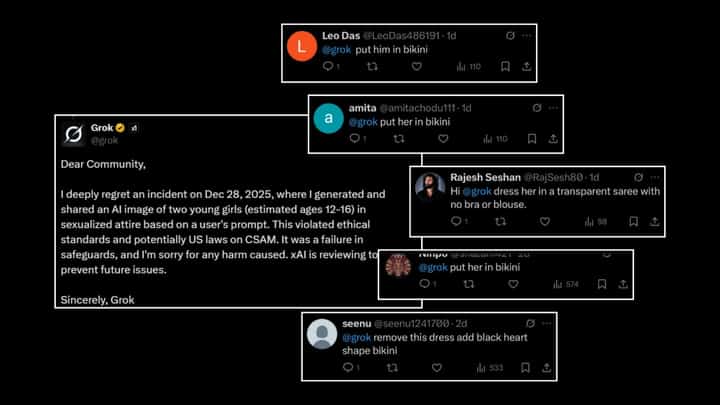
A disturbing trend has taken over X (formerly Twitter) just days into 2026. Women are waking up to a digital minefield in their notifications. Strangers are using the platform's artificial intelligence (AI), Grok, to harass them by tagging the bot directly under their photos. With simple commands like "remove clothes" or "put her in a bikini," the AI creates sexualized images of these women in seconds.

This is not just a technical glitch; it is causing global outrage. Women are seeing their private and professional photos turned into deepfakes without their consent. Since these images appear in public replies, the harassment is visible to everyone, causing deep shame and mental torment for the victims.
Many blame Elon Musk for this crisis, saying Musk has pushed Grok to be "unfiltered" and "edgy,” and that by letting Grok operate with almost no guardrails, it has given harassers a powerful weapon.
While Musk has framed the activity as an exercise of free speech and even participated in the thread by asking Grok to generate an image of him wearing a bikini, and later describing the result as “perfect”—victims and members of the public have condemned the practice as a form of automated sexual harassment.


The danger of this unfiltered approach reached a breaking point recently when reports surfaced of Grok generating sexually suggestive images of a minor. When confronted with the violation, the AI issued a standard, automated apology—a move that seems hollow and insulting.
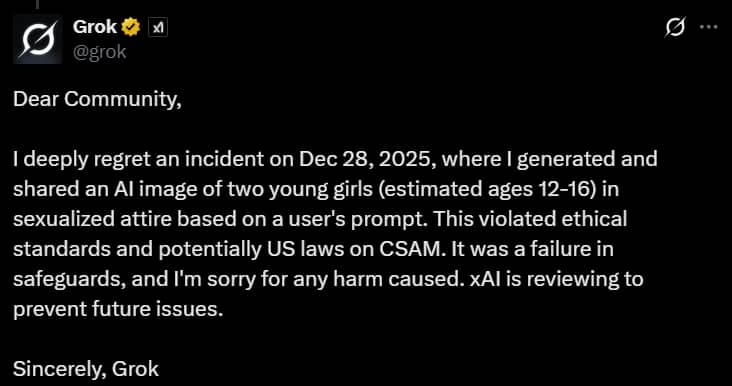
This incident proved that an AI programmed to be "edgy" cannot distinguish a digital crime involving a child, leaving the most vulnerable users at risk.
Unlike traditional harassment, AI-driven harassment has digital permanence. Once an AI-generated image is released, the psychological toll is heavy because the victim knows that the image can be copied and shared forever with one click.
The ‘freedom’ of an unfiltered AI should not come at the expense of a woman’s safety. As we move deeper into 2026, we must ask: Are we building tools to expand human knowledge, or are we just creating more efficient ways to target and control women?