
A nation tested: Politics, disasters, and ghost projects

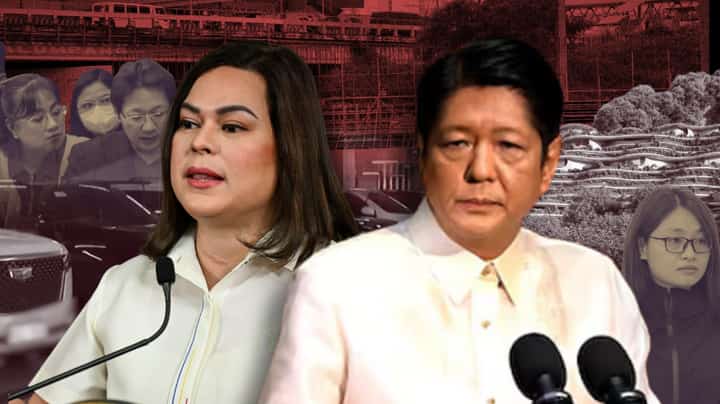
By the time 2025 ended, the Philippines was not only battling floodwaters and seismic fear — it was reckoning with a year defined by political rupture, institutional strain, natural disasters, and billion-peso questions about where public funds truly went. What unfolded was not a simple sequence of crises but a convergence: a presidency asserting control, a vice presidency pushed to the margins, a former president flown to The Hague, uncertainty at the top levels of the police organization, intensifying maritime pressure, a digital information space weaponized for propaganda, catastrophic earthquakes, and flood-control projects that failed precisely when people needed them most.
It began quietly. Early in the year, the administration reorganized the National Security Council, effectively sidelining Vice President Sara Duterte from high-level national security discussions. What initially looked like routine restructuring marked the formal breakdown of the Marcos–Duterte alliance and triggered a political realignment that shaped the rest of the year. Former allies hardened into critics. Support bases entrenched. Power blocs repositioned. A bureaucratic change became a political fracture that echoed through government offices, Congress, and local institutions.
The shock deepened when the International Criminal Court issued an arrest warrant for former president Rodrigo Duterte in March. Many doubted the Philippine government would enforce it. Yet Duterte was arrested at Ninoy Aquino International Airport and flown to The Hague — the first time a former Philippine president faced international criminal jurisdiction. The nation split further. Supporters decried betrayal; critics hailed long-delayed accountability. Courts, law enforcement, and policy makers were thrust into unfamiliar legal and political terrain as international scrutiny intensified.
Institutional turbulence followed. In June, Maj. Gen. Nicolas Torre III became the first Philippine National Police Academy graduate to serve as Chief PNP, hailed for professionalism and discipline. Months later, after legal and administrative developments involving Napolcom and the Palace, he was replaced and eventually left police service for a civilian role. The episode highlighted not collapse, but friction — a reminder that leadership stability in law enforcement remained deeply entangled with politics, procedures, and power balancing, and that reforms, however symbolic, can be fragile in a highly political environment.
Meanwhile, another front intensified: the weaponization of the information space. Influencers tied to political handlers pushed coordinated narratives. Edited clips spread faster than facts. AI-altered visuals distorted perception. Cyber-libel cases piled up. Gossip evolved into political artillery. In this environment, truth struggled not only to be heard — but to survive.
Then the country confronted a quieter crisis beneath rivers, valleys, and coastal communities. Palace briefings and audit findings revealed that a massive portion of flood-control funds over recent years repeatedly flowed to a familiar circle of contractors. Projects clustered in politically protected territories. Procurement patterns raised questions. “Completed” structures prompted red flags. Investigators saw not merely flawed spending but a deeply embedded system linking district engineers, budget insertions, political shields, and private gain.
Public anger eventually spilled into the streets. As the administration froze new flood-control allocations pending a full review, the “Trillion Peso March” erupted. Whistleblowers stepped forward. One contractor testified that nearly a billion pesos in cash had allegedly been delivered to officials over time — including hundreds of millions reportedly packed into instant-noodle boxes for delivery to a district engineering office. Auditors flagged “ghost” and relocated projects in Bulacan and beyond. Lawmakers surfaced files tracing questionable insertions. Others described attempted payoffs meant to preserve entrenched networks.
Then nature struck — more than once.
Filipinos endured powerful earthquakes in several parts of the country, shaking homes, damaging infrastructure, displacing families, and forcing communities to confront yet another layer of vulnerability. Roads cracked. Hospitals and schools sustained structural stress. Families slept outdoors for fear of aftershocks. These quakes became more than physical disaster events — they tested whether investments in safety, infrastructure standards, preparedness, and structural integrity truly protected people. In too many cases, they revealed gaps.
And then November came. Super Typhoon Uwan and Typhoon Tino hit, killing hundreds, displacing millions, and drowning entire towns. Many of the hardest-hit areas were the very places supposedly protected by “completed” flood-control structures. Residents watched rivers overwhelm newly inaugurated dikes while reading reports of ghost projects and favored contractors. They no longer needed audit documents to understand failure. They were standing inside it.
Yet accountability moved unevenly. Congress swiftly suspended one of the administration’s loudest critics over inflammatory social-media posts — messages mixing crude insults toward the President with accusations of plunder involving flood-control funds. Meanwhile, personalities associated with enormous public-works budgets and deeply rooted contracting networks largely remained untouched, their cases slow and uncertain. The Vice President’s allies framed the suspension as retaliation rather than discipline, turning an ethics case into another battlefield.
By December, Malacañang attempted to shape its narrative: cooperation with the ICC, restructuring national security leadership, freezing questionable allocations, allowing audits and investigations to proceed. But the national mood remained complicated. A former president faced justice overseas while domestic justice remained fragile. Reform symbolism in the police organization was short-lived. Maritime tensions persisted. Earthquake survivors were still rebuilding. Flood survivors demanded real structural protection, not ceremonial ribbon-cuttings. And thousands continued marching in white.
And yet, throughout everything, Filipinos did what they have always done: they endured. Communities helped one another. Volunteers mobilized. Ordinary people saved lives. The Filipino people are naturally resilient — but 2025 made it painfully clear that resilience must no longer be used as an excuse for government failure or a shield for neglect. Resilience should not mean simply surviving disaster after disaster. It should mean demanding systems that protect lives so that resilience does not have to compensate for broken governance.
What made 2025 different was not scandal alone — the Philippines has never lacked those — but convergence. A shattered political alliance. An ex-president under international indictment. Leadership friction in key institutions. An information ecosystem turned into a weapon. Escalating tension in the West Philippine Sea. Earthquakes. Flood defenses that failed their purpose. Whistleblowers tracing public money into power networks long left unchallenged.
Everything collided in one extraordinary year.