
2025: A church between farewell and welcome

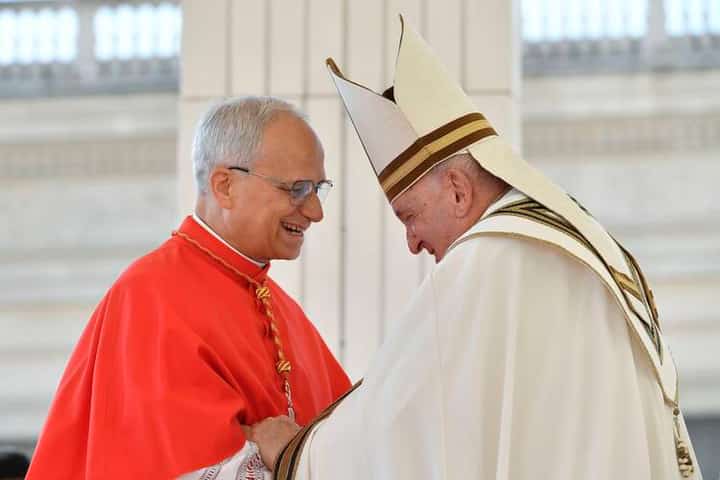
THE Catholic Church mourned Pope Francis and welcomed Pope Leo XIV, marking a historic transition in leadership and vision.
Photo from Association of Catholic Priests.
The year 2025 marked one of the most emotionally charged transitions in modern Catholic history—a season of mourning followed swiftly by renewal. Within weeks, the global Church said goodbye to a pope who reshaped its tone and priorities, and welcomed a new shepherd tasked with guiding faith through a rapidly changing world.
The final days of a pastoral pope
On 21 April 2025, Pope Francis quietly passed away at the Vatican, closing a papacy defined by humility, compassion, and an unwavering focus on the margins of society. He was 88.
In his final weeks, the Argentine-born pontiff had been battling serious health complications, yet his death still felt abrupt for millions who had grown accustomed to his reassuring presence and unorthodox warmth. True to the simplicity he championed throughout his life, his farewell rites reflected restraint rather than grandeur. The funeral Mass, held days later in St. Peter’s Square, drew world leaders, clergy, and ordinary faithful alike—united not by spectacle, but by gratitude.
Honoring his personal wishes, Pope Francis was laid to rest not beneath the Vatican, but at the Basilica of Santa Maria Maggiore in Rome, a place deeply tied to his Marian devotion. It was a final gesture consistent with a pope who preferred closeness over ceremony, service over status.
A conclave and a turning page
Grief soon gave way to anticipation. On 7 May, cardinals from across the world entered the Sistine Chapel, sealing themselves into the solemn rhythm of discernment that has guided papal elections for centuries. By the afternoon of 8 May, white smoke rose above Vatican City—an ancient signal announcing that the Church had chosen its next leader.
The name revealed from the balcony surprised many and inspired others: Cardinal Robert Francis Prevost, an American with deep pastoral and administrative experience, had been elected pope. He chose the name Leo XIV, becoming the first pope born in the United States and the second from the Americas.
Why Leo XIV?
The choice of name was deliberate and symbolic. By invoking Pope Leo XIII, remembered as the architect of modern Catholic social teaching, the new pontiff signaled both continuity and challenge. His papacy begins at a time shaped by technological disruption, economic inequality, and the ethical questions surrounding artificial intelligence—issues not unlike the upheavals of industrialization faced by his namesake more than a century ago.
Pope Leo XIV’s inauguration Mass on 18 May drew attention not only for its historic significance, but for its tone: sober, thoughtful, and forward-looking. Where Pope Francis spoke the language of encounter and mercy, Leo XIV appears poised to emphasize discernment, governance, and the moral responsibilities of a digitized age.
One faith, two legacies
The swift passage from Francis to Leo XIV underscored the Church’s enduring paradox—unchanging in belief, yet constantly adapting in leadership. One pope leaves behind a legacy of radical tenderness and pastoral closeness; another steps forward carrying the weight of history, expectation, and a future still being written.
In 2025, the Catholic Church did not simply lose a pope and gain another. It crossed a threshold—between remembrance and responsibility, between the lessons of compassion and the demands of a new era.